
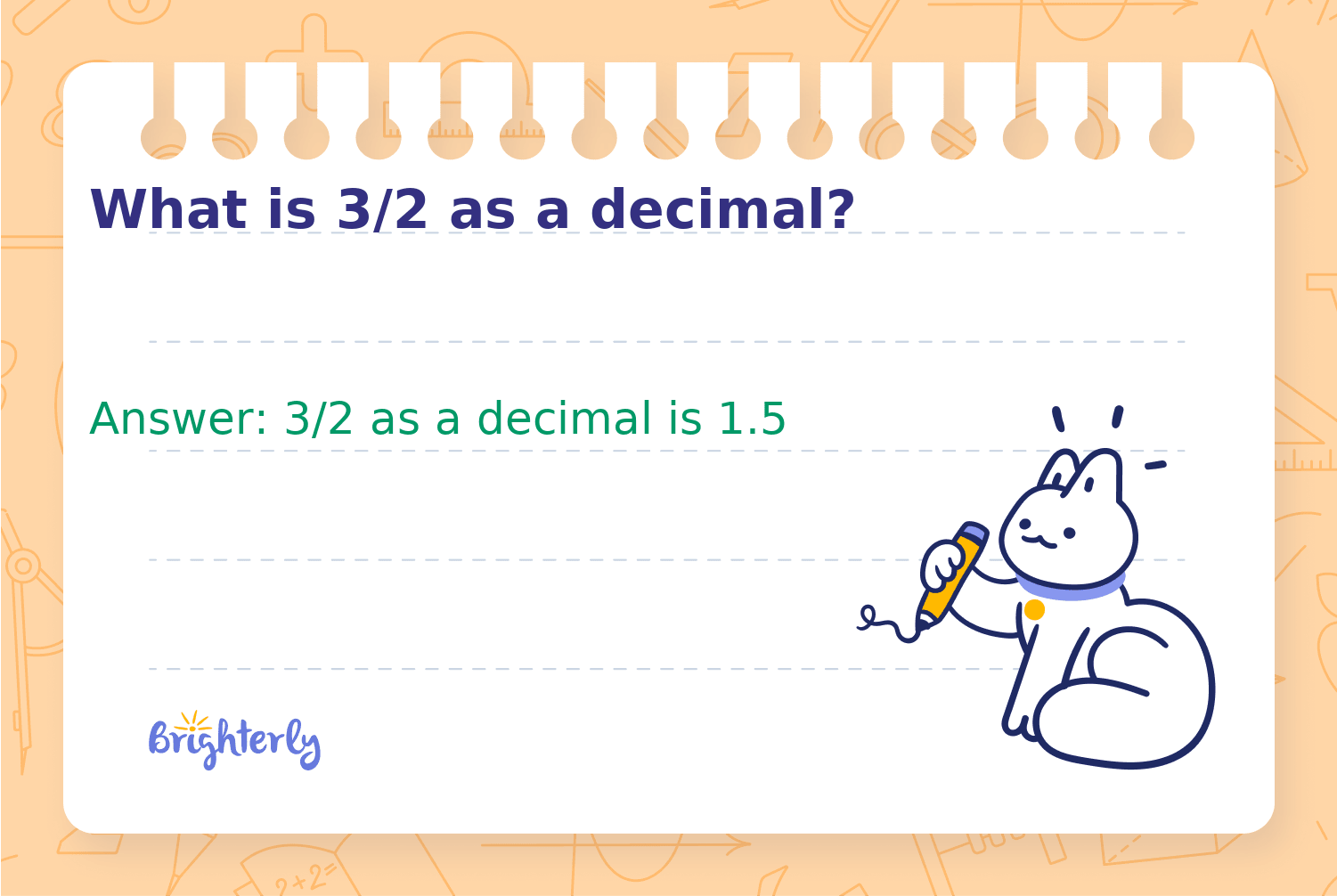
In an increasingly data-driven world, understanding the fundamental building blocks of numbers is paramount, especially when it comes to managing finances. While “what’s 3 2 as a decimal?” might appear to be a simplistic math problem, its underlying principles are deeply embedded in nearly every financial transaction, calculation, and decision we make. The seemingly straightforward answer, 1.5, serves as a gateway to exploring the critical role of decimal precision in personal finance, investing, and business operations. Without a firm grasp of how fractions translate into decimals, or how decimals represent precise values, individuals and businesses risk misinterpreting financial data, making inaccurate projections, and ultimately, making suboptimal financial choices. This article delves into the indispensable nature of decimal understanding, demonstrating its pervasive influence across the monetary landscape and providing actionable insights for enhancing financial literacy.
The Fundamental Role of Decimals in Personal Finance
Decimals are the bedrock of modern financial systems, providing the necessary granularity to represent values beyond whole numbers. From the price of a gallon of gas to the interest rate on a savings account, nearly every financial metric we encounter is expressed using decimals. Their importance in personal finance cannot be overstated, acting as the silent enabler of accuracy in budgeting, saving, and managing daily expenditures.
Everyday Applications: From Budgets to Bills
Consider a typical household budget. It’s rare that expenses or incomes align perfectly with whole dollar amounts. Rent might be $1,500.00, but a utility bill could easily come to $78.43, and groceries might total $123.79. Each of these figures, with its decimal components, contributes to the overall financial picture. When tracking spending, calculating averages, or forecasting future expenses, decimals ensure that every cent is accounted for. Rounding errors, though seemingly minor individually, can compound rapidly over time, leading to significant discrepancies between a projected budget and actual spending. This precision is vital for creating a realistic financial plan, avoiding overspending, and ensuring that funds are allocated effectively. Similarly, when splitting bills with housemates or friends, decimals provide the exact amount each person owes, preventing disputes and ensuring fairness.
Why Precision Matters: Avoiding Costly Errors
The seemingly small difference between 1 and 1.5, or even 1.50 and 1.51, can have profound financial implications. Imagine calculating a mortgage payment or an investment return. An interest rate quoted as 5% (0.05) versus 5.25% (0.0525) will result in materially different outcomes over the life of a loan or investment. Even a tiny error in a decimal place when dealing with large sums can translate into hundreds or thousands of dollars lost or gained. For instance, miscalculating a sales tax or a discount percentage due to a decimal oversight can lead to incorrect payments, overcharges, or underpayments. These errors not only create administrative headaches but can also erode trust, incur penalties, or lead to significant financial leakage for individuals and businesses alike. Financial models, often built on intricate formulas involving numerous variables, rely entirely on the accuracy of decimal inputs. A single misplaced decimal point in a spreadsheet can invalidate an entire financial projection, leading to flawed strategic decisions.
Bridging Fractions and Whole Numbers in Financial Contexts
The conversion of fractions to decimals, exemplified by “3/2 to 1.5,” is a foundational skill in financial literacy. While many financial instruments are already presented in decimal form, understanding their fractional origins can deepen comprehension. Interest rates, for example, are often expressed as percentages, which are essentially fractions of 100 (e.g., 5% = 5/100 = 0.05). Stock prices used to be quoted in fractions of a dollar (e.g., 1/8, 1/16), and while now standardized to decimals, knowing the conversion helps grasp historical context and the inherent divisibility of assets. Understanding that 3/2 represents “one and a half” or 150% in a financial context allows for a more intuitive understanding of growth rates, ratios, or proportions. This mental agility to move between fractional and decimal representations empowers individuals to interpret a wider array of financial data with confidence.
Demystifying the Conversion: 3/2 to 1.5 and Beyond
At its core, “what’s 3 2 as a decimal?” is a question about division. Understanding this simple operation is crucial for a multitude of financial calculations, allowing for clear and unambiguous representation of values.
The Simple Math Behind Fractional Conversions
The process of converting a fraction like 3/2 to a decimal is straightforward: divide the numerator (3) by the denominator (2). The result is 1.5. This fundamental principle extends to any fraction encountered in finance. If an investment grows by “one and a quarter times,” understanding that 1 1/4 equals 1.25 is essential for calculating its new value. If a company’s revenue increased by “three-fifths,” converting 3/5 to 0.60 allows for easy multiplication to determine the exact growth in monetary terms. This simple division operation transforms abstract fractions into concrete, easily quantifiable decimal numbers that are compatible with financial calculators, spreadsheets, and banking systems. The elegance of decimals lies in their ability to represent any real number on a continuous scale, making comparisons and calculations far more efficient than with fractions.
Practical Examples: Loan Rates, Investment Returns, and Discounts
Consider a loan with an annual percentage rate (APR) of 6%. This is typically expressed as 0.06 in calculations. If you’re comparing it to another loan with a rate of 5 3/4%, you must convert 3/4 to 0.75, making the rate 5.75% or 0.0575. Without this conversion, direct comparison and accurate interest calculations are impossible. Similarly, investment returns are frequently expressed as percentages, which are then converted to decimals for compound interest calculations. A 7% annual return means multiplying your principal by 1.07 each year.
Discounts also rely heavily on decimal conversions. A “20% off” sale means multiplying the original price by (1 – 0.20), or 0.80, to find the discounted price. If a complex discount structure offers “a third off the second item,” converting 1/3 to approximately 0.3333 is crucial for accurate savings realization. These everyday financial scenarios underscore the practical necessity of being able to fluently move between percentages, fractions, and decimals.

Mental Math Shortcuts for Quick Financial Assessments
While calculators are ubiquitous, developing mental math skills for decimal conversions can significantly improve financial agility. Recognizing common fraction-to-decimal equivalents (e.g., 1/2 = 0.5, 1/4 = 0.25, 3/4 = 0.75, 1/3 ≈ 0.33, 2/3 ≈ 0.67) allows for rapid estimation and quick assessments of financial propositions. For instance, if an item costs $40 and is “25% off,” knowing that 25% is 1/4 means you can quickly deduce a $10 discount, bringing the price to $30. Similarly, if an investment promised “one and a half times your money back,” you immediately understand that a $1,000 investment would yield $1,500. These mental shortcuts are invaluable for on-the-spot decisions, budgeting tweaks, and quickly verifying calculations presented by others, fostering a proactive approach to financial management.
Impact on Investing and Business Finance
Beyond personal budgets, decimal precision forms the backbone of complex financial analysis in investment and business finance, where even minute differences can equate to millions.
Understanding Stock Prices and Market Fluctuations
Stock prices, once quoted in fractions, are now universally displayed in decimal format. A stock trading at $150.75 or $150.80 represents a clear, measurable difference in value. When millions of shares are traded daily, these decimal fractions multiply rapidly. Investors rely on these precise decimal values to calculate gains, losses, and portfolio valuations. Options contracts, bond yields, and exchange rates also depend entirely on decimal accuracy. A slight movement in an exchange rate, say from 1.1025 to 1.1030, might seem negligible, but for international corporations dealing in billions, this represents a substantial difference in revenue or cost. Understanding these granular decimal movements is crucial for informed trading decisions and risk management.
Calculating Interest, Dividends, and Returns on Investment
The calculation of interest – whether simple or compound – fundamentally relies on decimals. A 5.5% interest rate is used as 0.055 in formulas. Dividends paid per share are typically specified to two or more decimal places, directly impacting an investor’s total income. Calculating the annual percentage yield (APY) for savings accounts or the total return on investment (ROI) for a portfolio requires meticulous decimal handling. For example, if an investment yields a return of 8.25%, converting this to 0.0825 is the first step in determining actual monetary growth over time. Furthermore, comparing investment opportunities often involves dissecting returns quoted to several decimal places, as even a quarter of a percentage point difference can be significant over long investment horizons.
Business Ratios and Performance Metrics: The Decimal Edge
In business finance, decimals are indispensable for computing key performance indicators (KPIs) and financial ratios that provide insights into a company’s health and efficiency. Ratios such as profit margins (Net Income / Revenue), debt-to-equity (Total Debt / Shareholder Equity), or current ratio (Current Assets / Current Liabilities) are almost always expressed as decimals. A profit margin of 0.15 (15%) versus 0.145 (14.5%) indicates a subtle but important difference in profitability. These ratios are vital for internal management to track performance, for analysts to compare companies, and for investors to assess viability. Miscalculating these ratios due to decimal errors can lead to erroneous conclusions about a company’s financial standing, potentially guiding flawed strategic decisions or investment choices. Accurate decimal representation ensures that financial reporting is transparent, consistent, and reliable, forming the basis for critical business analysis and forecasting.
Empowering Financial Decision-Making Through Numerical Literacy
Mastering the nuances of decimals is not merely an academic exercise; it is a vital component of financial literacy that empowers individuals and businesses to make superior, data-driven decisions. The ability to correctly interpret and apply decimal values unlocks a deeper understanding of financial mechanisms and potential outcomes.
Beyond Simple Conversions: Applying Decimals to Complex Scenarios
While understanding that 3/2 equals 1.5 is a starting point, true financial literacy involves applying this decimal thinking to more complex scenarios. This includes understanding how inflation rates (e.g., 3.2% annually) erode purchasing power over time, how different compounding frequencies (daily, monthly, annually) impact investment growth, or how fluctuating foreign exchange rates affect international transactions. For instance, calculating the future value of an investment with continuous compounding involves exponential functions where decimal accuracy is paramount. Similarly, understanding the concept of an effective annual rate (EAR) versus a nominal rate requires converting and comparing decimal values that account for compounding effects. These advanced applications underscore the necessity of a robust decimal foundation.
Leveraging Financial Tools and Software with Decimal Precision
Modern financial management relies heavily on digital tools, from budgeting apps and spreadsheet software to sophisticated investment platforms. These tools are designed to handle decimal precision automatically, but users must input and interpret data correctly. Understanding how to format cells for currency with two decimal places, interpret percentages in formulas, or input exact interest rates prevents software from generating inaccurate results. Spreadsheets, in particular, are powerful decimal calculators. Knowing how to use functions like ROUND, TRUNC, or FIXED to manage decimal places appropriately ensures that calculations remain precise without being overly cumbersome. The user’s ability to verify the output of these tools, by understanding the underlying decimal mathematics, is a crucial check against potential errors.
The Long-Term Value of Mastering Financial Math
The consistent application of decimal accuracy in financial matters cultivates a habit of meticulousness that pays dividends over a lifetime. It fosters confidence in managing personal finances, reduces susceptibility to misleading financial claims, and enhances the ability to critically evaluate investment opportunities. For businesses, it translates into better financial reporting, more accurate forecasting, and ultimately, sounder strategic planning. In a world where financial well-being is increasingly tied to numerical fluency, the seemingly simple question of “what’s 3 2 as a decimal?” expands into a comprehensive imperative for financial education. Mastering this fundamental concept is not just about getting the right answer; it’s about building a robust framework for navigating the complex and ever-evolving landscape of money with clarity, precision, and confidence.
aViewFromTheCave is a participant in the Amazon Services LLC Associates Program, an affiliate advertising program designed to provide a means for sites to earn advertising fees by advertising and linking to Amazon.com. Amazon, the Amazon logo, AmazonSupply, and the AmazonSupply logo are trademarks of Amazon.com, Inc. or its affiliates. As an Amazon Associate we earn affiliate commissions from qualifying purchases.