
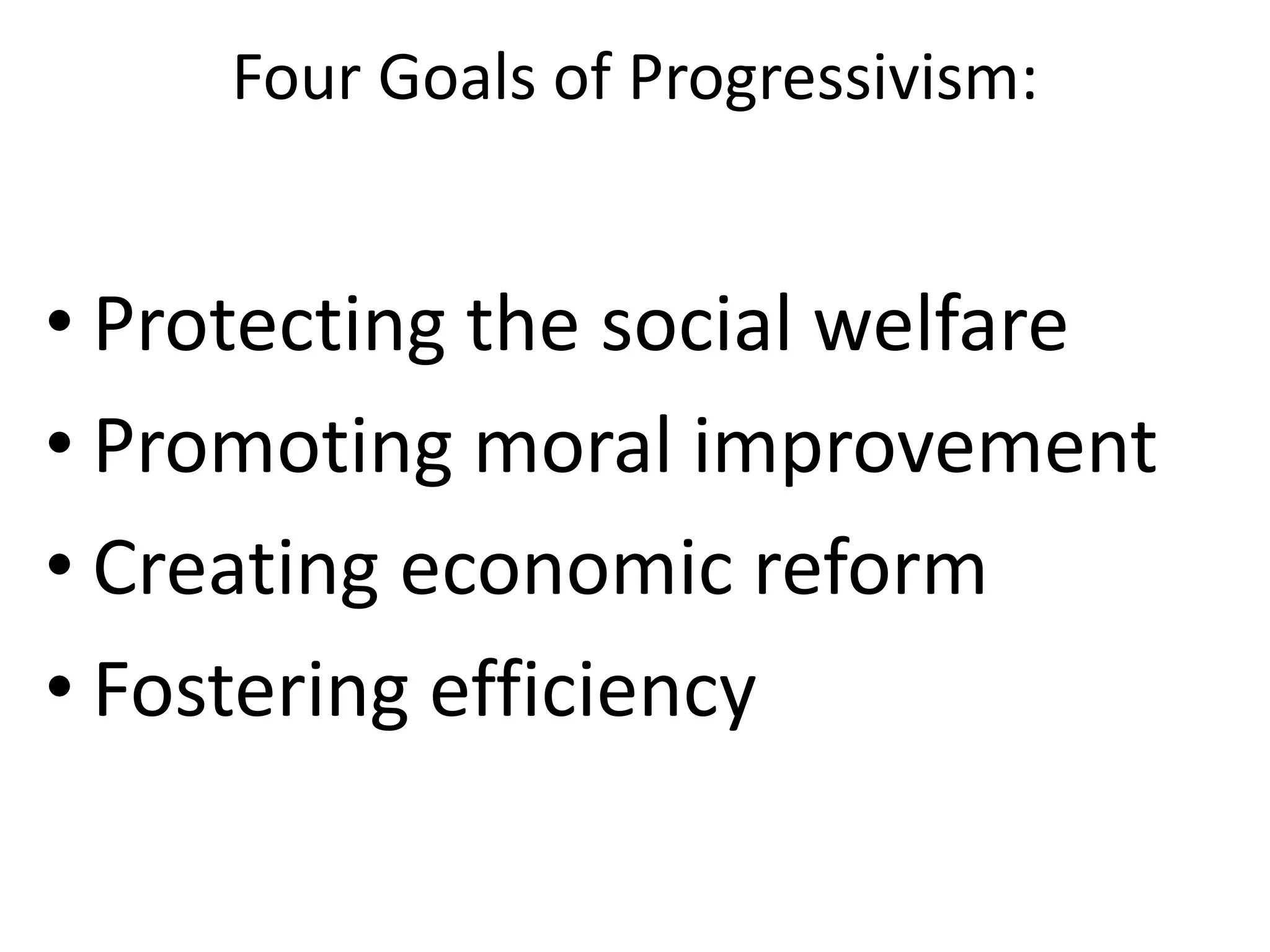
The Progressive Movement, emerging in the late 19th and early 20th centuries, was a broad and complex series of reforms aimed at addressing the profound economic and social issues brought about by rapid industrialization, urbanization, and unchecked capitalism. While often remembered for its social and political dimensions, a substantial and foundational core of its agenda was dedicated to rectifying financial inequities, reforming business practices, and establishing a more stable and just economic system. From curtailing corporate monopolies to advocating for worker rights and overhauling the nation’s financial infrastructure, the Progressives sought to reshape the very mechanisms of American commerce and wealth distribution.

Reining in Corporate Power and Monopolies
One of the most significant economic goals of the Progressive Movement was to curb the unprecedented power of large corporations and trusts that had come to dominate key industries. The era of industrial consolidation had led to the rise of monopolies and oligopolies that stifled competition, exploited consumers, and wielded undue influence over economic policy.
Curbing Trusts and Cartels
Progressives viewed massive industrial trusts—like Standard Oil, American Tobacco, and the Northern Securities Company—as threats to economic fairness and market liberty. These behemoths often achieved their dominance through predatory pricing, horizontal and vertical integration that squeezed out smaller competitors, and secret agreements that fixed prices and allocated markets. The goal was to dismantle these anti-competitive structures and prevent their future formation. Legislation such as the Sherman Antitrust Act (though initially weak) and later the Clayton Antitrust Act were direct responses to this objective, aiming to prohibit price discrimination, tying contracts, and interlocking directorates that allowed a few individuals to control multiple competing companies. The prosecution and breakup of major trusts under Presidents Theodore Roosevelt and William Howard Taft underscored this commitment to reining in financial power.
Promoting Fair Competition
Beyond merely breaking up trusts, Progressives sought to foster an environment where fair competition could thrive. They believed that a truly free market required a level playing field, not one skewed by the immense financial resources and tactics of monopolies. This involved advocating for regulations that ensured all businesses, regardless of size, could compete on merit. The Federal Trade Commission (FTC), established in 1914, was a direct outcome of this goal, designed to monitor business practices, investigate complaints of unfair competition, and issue cease-and-desist orders to companies engaging in deceptive or monopolistic behaviors. Its mission was fundamentally economic: to protect consumers and legitimate businesses from exploitative or manipulative market forces.
Protecting Small Businesses
The independent entrepreneur and the small business owner were seen as vital to the American economic fabric. Progressives recognized that unchecked corporate power not only harmed consumers but also crushed smaller enterprises, leading to a concentration of wealth and opportunity in the hands of a few. By enforcing antitrust laws and promoting fair competition, they aimed to protect the financial viability of small businesses, allowing them to innovate, grow, and contribute to local economies without being swallowed or undermined by larger, more powerful entities. This objective was rooted in a desire for a more decentralized and equitable distribution of economic activity and prosperity.
Economic Justice and Worker Protection
The rapid industrial expansion also exposed severe injustices in the labor market. Progressives were deeply concerned with the financial exploitation of workers, advocating for reforms that would ensure more equitable distribution of wealth and safer working conditions.
Fair Wages and Working Conditions
The era saw widespread low wages, long hours, and hazardous environments, particularly for factory workers, miners, and agricultural laborers. Progressives championed legislation to establish minimum wages, limit working hours (e.g., the eight-hour day), and mandate safer workplaces. They argued that decent compensation and reasonable hours were not just humanitarian concerns but essential for economic stability, allowing workers to participate more fully in the consumer economy and reduce reliance on charity or public assistance. Laws like the Adamson Act, which established an eight-hour day for railroad workers, exemplified this pursuit of economic justice through federal regulation.
Child Labor Reform
Perhaps one of the most egregious financial exploitations was child labor. Children, some as young as five or six, worked in dangerous factories, mines, and fields for meager wages, depriving them of education and a healthy childhood. Progressives sought to abolish child labor, not only on moral grounds but also to protect the adult labor market from wage depression caused by cheap child labor and to ensure the future economic productivity of an educated citizenry. While federal attempts like the Keating-Owen Act faced legal challenges, the movement successfully pushed for state-level bans and regulations, viewing it as an essential step towards a more humane and economically sound society.
Worker Safety and Compensation
Industrial accidents were rampant, often leading to severe injuries or death, with little to no financial recourse for affected workers or their families. Progressives pushed for worker’s compensation laws, which shifted the burden of workplace injuries from the individual to the employer, ensuring injured workers or their dependents received financial support. They also advocated for government inspection of workplaces and safety standards, understanding that a healthy and secure workforce was vital for sustained economic productivity and individual financial well-being. This represented a significant shift in corporate responsibility for the financial costs associated with its operations.
Financial System Reform and Stability
The Progressive Movement also recognized the inherent instability and lack of oversight in the nation’s financial system, particularly evident after a series of devastating panics and depressions. A key goal was to modernize and stabilize banking and currency.
Establishing the Federal Reserve

The Panic of 1907 underscored the fragility of the fragmented banking system, where individual banks operated without a central authority to manage liquidity or provide a safety net. Progressives, often led by figures like Senator Nelson Aldrich, worked towards creating a more resilient financial structure. The Federal Reserve Act of 1913 was a monumental achievement, establishing the Federal Reserve System. Its primary financial goals were to provide the nation with a safer, more flexible, and more stable monetary and financial system. This included controlling the money supply, regulating banks, and acting as a lender of last resort to prevent financial crises from spiraling out of control, thereby protecting deposits and the broader economy.
Income Tax and Wealth Redistribution
Before the Progressive Era, the federal government relied heavily on tariffs and excise taxes, which disproportionately affected lower and middle-income individuals. Progressives argued for a more equitable tax system where those with greater financial capacity contributed a larger share. This led to the ratification of the 16th Amendment in 1913, establishing the federal income tax. The goal was twofold: to provide a stable and elastic source of government revenue for public services and to implement a progressive tax structure to mitigate extreme wealth inequality. It represented a fundamental shift in how the government financed itself and how it could influence the distribution of wealth.
Consumer Protection in Financial Transactions
Beyond direct economic exploitation by monopolies, Progressives also addressed financial deception and lack of transparency facing consumers. This included advocating for truth in labeling, fair weights and measures, and safeguards against adulterated products. While often framed as health or safety issues, these concerns had direct financial implications, as consumers were often paying for inferior, misrepresented, or dangerous goods. The Pure Food and Drug Act and the Meat Inspection Act, for example, aimed to protect the financial interests of consumers by ensuring they received what they paid for and that their health (and thus their ability to earn income) was not jeopardized by unscrupulous producers.
Public Utility Regulation and Equitable Access
Many essential services, such as water, electricity, and transportation, were provided by private corporations that often held local monopolies. Progressives targeted these “public utilities” for regulation, recognizing their critical role in economic life.
Controlling Rates and Services
Without competition, private utility companies had the power to charge exorbitant rates and provide substandard service, essentially holding communities hostage. Progressives pushed for the establishment of state and local regulatory commissions to oversee these utilities. The financial goal was to ensure that rates were fair and reasonable, preventing companies from extracting excessive profits from essential services. They argued that utilities, by their very nature, operated under a public trust and therefore their financial operations needed to be transparent and accountable to the public they served.
Preventing Exploitation
The unregulated power of utilities led to situations where basic necessities became unaffordable for many, stifling economic opportunity and exacerbating poverty. By regulating these monopolies, Progressives aimed to prevent financial exploitation, ensuring that access to vital services was broad and equitable, not limited by a company’s profit motives. This was an economic imperative, as reliable and affordable infrastructure was seen as a foundation for broader economic development and individual prosperity.
Expanding Public Ownership
In some instances, where regulation proved insufficient or private companies resisted reforms, Progressives advocated for public ownership of utilities. Municipal ownership of waterworks, gas companies, and even streetcar lines was proposed and sometimes implemented. The rationale was largely financial: to remove the profit motive entirely from essential services, allowing them to be run more efficiently and affordably for the benefit of all citizens, rather than enriching private shareholders. This was a radical but often considered solution to ensuring economic fairness in vital sectors.
Advancing Economic Transparency and Accountability
Underlying many of the Progressive economic goals was a deep-seated belief in the need for greater transparency and accountability from both corporations and government. Secret deals, opaque accounting practices, and corruption were seen as corrosive to a fair and functioning economic system.
Anti-Corruption Measures
Corruption, particularly the intertwining of financial interests and political power, was a significant target. Progressives sought to sever the ties between wealthy corporations and political machines through campaign finance reform, direct elections of senators (17th Amendment), and greater oversight of lobbying. The financial goal here was to ensure that economic policies were made in the public interest, not swayed by the financial contributions or influence of powerful special interests, which often led to unfair advantages and wealth accumulation for a select few.
Government Oversight and Data
To effectively regulate complex economic systems, Progressives understood the need for reliable data and professional expertise. They advocated for the creation of government agencies staffed by experts—economists, statisticians, and financial analysts—who could gather information, conduct investigations, and provide impartial recommendations. This was crucial for implementing evidence-based economic policies and holding corporations accountable with objective financial data, rather than relying on company-provided figures or anecdotal evidence.
Informed Public Participation
Ultimately, Progressives believed that an informed citizenry was essential for a healthy economic democracy. They pushed for greater public access to information about corporate practices and government finances, believing that transparency would empower voters and consumers to make better decisions. This included public reports on corporate earnings, government expenditures, and the impact of economic policies, enabling a more engaged and financially literate populace to advocate for their own economic interests.
aViewFromTheCave is a participant in the Amazon Services LLC Associates Program, an affiliate advertising program designed to provide a means for sites to earn advertising fees by advertising and linking to Amazon.com. Amazon, the Amazon logo, AmazonSupply, and the AmazonSupply logo are trademarks of Amazon.com, Inc. or its affiliates. As an Amazon Associate we earn affiliate commissions from qualifying purchases.