
Compound interest is often hailed as the “eighth wonder of the world” by financial experts, and for good reason. It represents the process of earning interest not only on your initial principal but also on the accumulated interest from previous periods. This exponential growth mechanism is a cornerstone of wealth creation, making it indispensable for personal finance, investment planning, and even understanding debt. Grasping how to compute compound interest is fundamental to making informed financial decisions and harnessing its incredible power.
Understanding the Power of Compound Interest
At its core, compound interest is interest on interest. Unlike simple interest, which is calculated only on the principal amount, compound interest continually adds the earned interest back to the principal. This new, larger principal then earns interest in the subsequent period, leading to an accelerating growth trajectory. The implications are profound: small, consistent contributions can grow into substantial sums over time, and even modest investments can yield significant returns when given enough time to compound.
To illustrate, consider a simple scenario: if you invest $1,000 at a 5% simple interest rate annually, you’d earn $50 each year, and after ten years, you’d have $1,500. With compound interest, that $50 earned in the first year is added to your principal, so in the second year, you’re earning interest on $1,050. This seemingly minor difference accumulates dramatically over decades, showcasing why understanding its computation is crucial for anyone looking to build financial security.
The Core Formula Explained
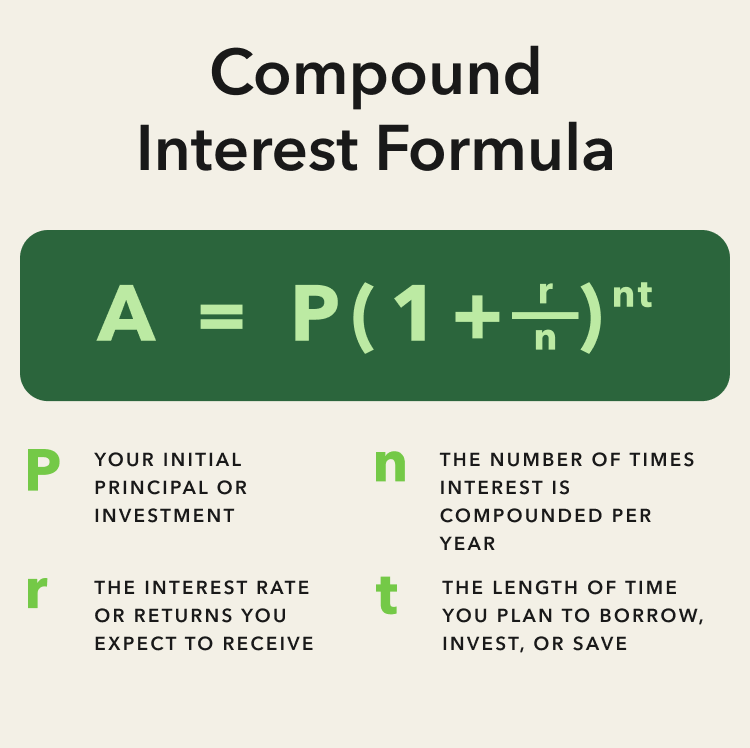
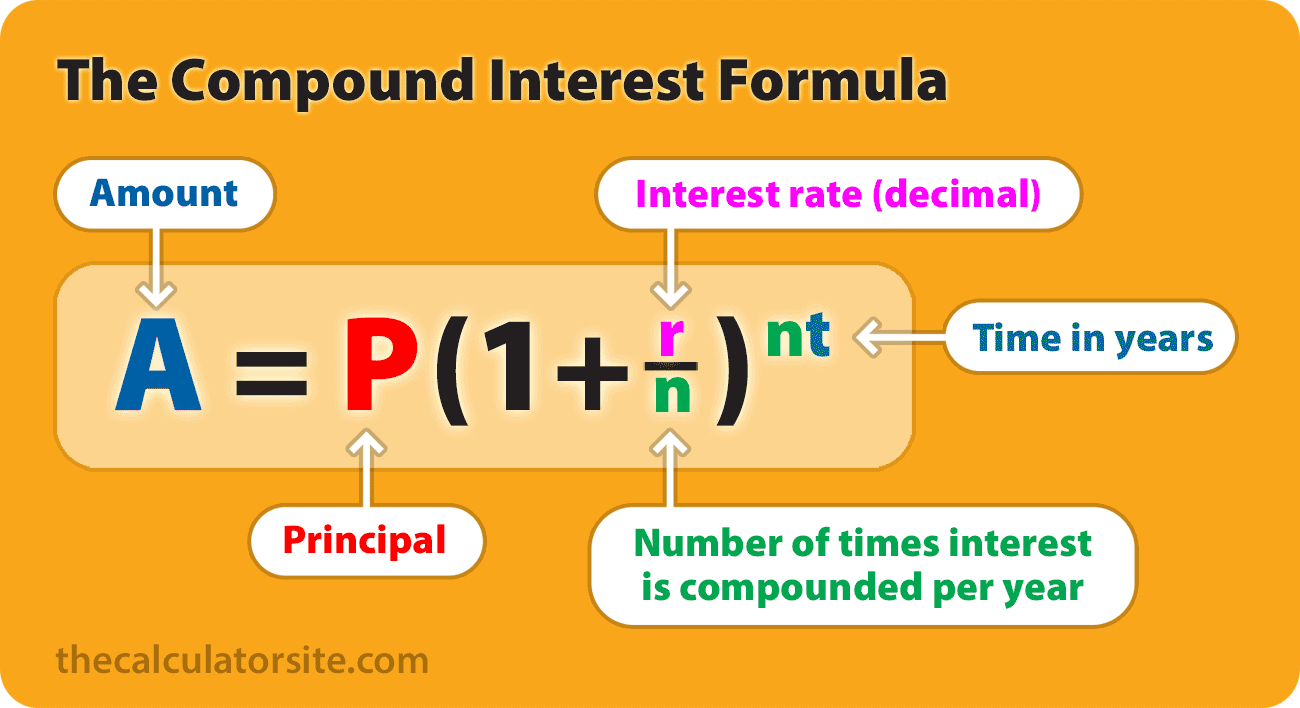
Computing compound interest relies on a specific mathematical formula that captures the interplay of the initial investment, interest rate, compounding frequency, and the investment horizon. The standard formula for compound interest is:
A = P(1 + r/n)^(nt)
Let’s break down each variable to understand its role in the calculation:
Principal Amount (P)
This is the initial sum of money deposited or borrowed. It’s the starting point for your investment or debt. For instance, if you invest $5,000 in a savings account, $5,000 is your principal.
Annual Interest Rate (r)
This is the stated annual rate of interest, expressed as a decimal. If an investment offers a 5% annual interest rate, you would use 0.05 in the formula. It’s critical to convert percentages to decimals before computation.
Number of Times Interest is Compounded Per Year (n)
This variable specifies how frequently the interest is calculated and added back to the principal within a single year. Common compounding frequencies include:
- Annually (n = 1)
- Semi-annually (n = 2)
- Quarterly (n = 4)
- Monthly (n = 12)
- Daily (n = 365)
The more frequently interest is compounded, the faster your money grows, as interest is being earned on a larger base more often.
Number of Years the Money is Invested or Borrowed For (t)
This is the duration for which the principal is invested or the loan is held, measured in years. The longer the time frame, the more opportunities your money has to compound, leading to significant growth.
Future Value (A)
This is the total amount of money you will have after ‘t’ years, including both the principal and all the accumulated compound interest. It’s the ultimate outcome of your investment or the total amount owed on a loan.
Step-by-Step Calculation Examples
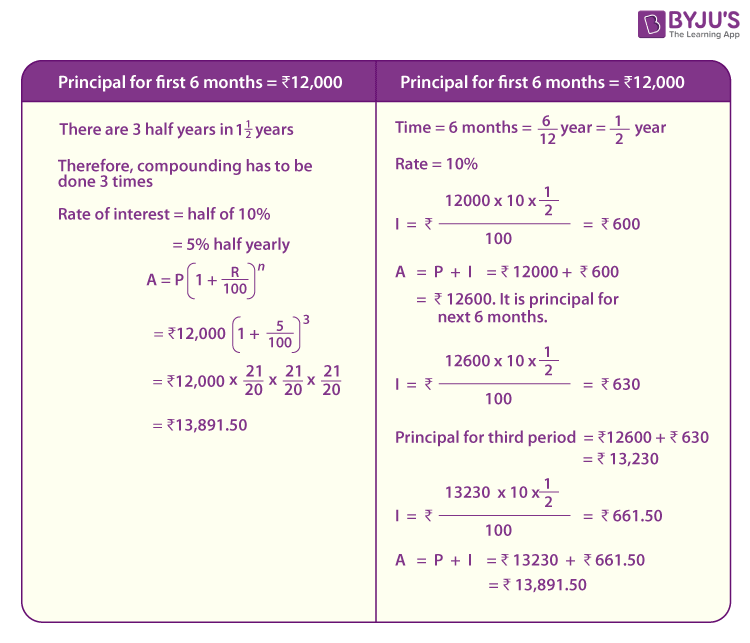
To solidify your understanding, let’s walk through a few practical examples with varying compounding frequencies.
Scenario: You invest $10,000 in an account with an annual interest rate of 6% for 10 years.
Annual Compounding (n = 1)
Here, interest is calculated and added to the principal once a year.
- P = $10,000
- r = 0.06
- n = 1
- t = 10
A = 10,000 * (1 + 0.06/1)^(1*10)
A = 10,000 * (1.06)^10
A = 10,000 * 1.790847
A = $17,908.47
After 10 years, your investment will be worth $17,908.47. The interest earned is $7,908.47.
Quarterly Compounding (n = 4)
With quarterly compounding, interest is calculated and added four times a year.
- P = $10,000
- r = 0.06
- n = 4
- t = 10
A = 10,000 * (1 + 0.06/4)^(4*10)
A = 10,000 * (1 + 0.015)^40
A = 10,000 * (1.015)^40
A = 10,000 * 1.814018
A = $18,140.18
Compounding quarterly results in slightly more growth, with the investment reaching $18,140.18. The additional interest earned is $231.71 compared to annual compounding.
Monthly Compounding (n = 12)
Monthly compounding means interest is added twelve times a year.
- P = $10,000
- r = 0.06
- n = 12
- t = 10
A = 10,000 * (1 + 0.06/12)^(12*10)
A = 10,000 * (1 + 0.005)^120
A = 10,000 * (1.005)^120
A = 10,000 * 1.819396
A = $18,193.97
Monthly compounding yields even greater returns, bringing the total to $18,193.97. This illustrates the principle that higher compounding frequency, even with the same annual rate, leads to higher overall returns.
Factors Influencing Compound Growth
While the formula provides the exact calculation, understanding the sensitivity of the output to its input variables is key to optimizing financial strategies.
The Impact of the Interest Rate
The interest rate (r) is a significant driver of compound growth. A higher interest rate means a larger percentage of the principal and accumulated interest is added in each compounding period. Even a percentage point or two difference can lead to substantially different future values over long periods. This highlights the importance of seeking out investments with competitive interest rates for your savings and investments. Conversely, for debt, minimizing the interest rate is crucial to avoid the negative effects of compounding.
The Significance of Compounding Frequency
As demonstrated in the examples, the number of times interest is compounded per year (n) directly impacts the final sum. More frequent compounding means that interest starts earning interest sooner, leading to a marginally higher return. While the difference between daily and monthly compounding might seem small, it adds up over decades, especially with larger principal amounts. When comparing financial products, always consider the stated annual percentage yield (APY) rather than just the annual interest rate (APR), as APY accounts for compounding frequency, offering a more accurate picture of effective returns.
The Exponential Power of Time
Perhaps the most powerful variable in the compound interest formula is time (t). Due to the exponential nature of compounding, the growth accelerates significantly in later years. An investment that doubles in the first 7 years might double again in the next 5 years, and then again in 3-4 years. This phenomenon, often referred to as the “hockey stick effect,” underscores the immense advantage of starting to save and invest early. The longer your money has to compound, the more substantial the returns will be, making time an irreplaceable asset in financial planning.
Leveraging Compound Interest for Financial Success
Understanding how to compute compound interest is just the first step; applying this knowledge to your financial life is where its true value lies.
Early Investment
The single most impactful strategy is to start investing as early as possible. Even small amounts invested at a young age have decades to grow, far outperforming larger sums invested later in life due to the power of time and compounding.
Reinvesting Earnings
To fully harness compounding, ensure that any interest or dividends earned on your investments are reinvested. This increases your principal, providing a larger base for future interest calculations and accelerating your wealth accumulation. Many investment accounts offer automatic reinvestment options for convenience.
Avoiding High-Interest Debt
Just as compound interest works wonders for savings, it can be detrimental when applied to debt. High-interest debts like credit card balances can compound rapidly, making them incredibly difficult to pay off. Prioritizing the elimination of high-interest debt is crucial to prevent compound interest from working against you.
Utilizing Financial Tools and Calculators
While manual computation is valuable for understanding, leveraging online compound interest calculators or spreadsheet functions (like FV in Excel or Google Sheets) can quickly project future values for various scenarios. These tools allow you to experiment with different principal amounts, interest rates, compounding frequencies, and time horizons, helping you visualize potential outcomes and plan effectively.
By mastering the computation of compound interest and implementing strategies that align with its principles, individuals can strategically grow their wealth, achieve their financial goals, and secure a more prosperous future. It’s not just a mathematical concept; it’s a foundational principle of financial wisdom.
aViewFromTheCave is a participant in the Amazon Services LLC Associates Program, an affiliate advertising program designed to provide a means for sites to earn advertising fees by advertising and linking to Amazon.com. Amazon, the Amazon logo, AmazonSupply, and the AmazonSupply logo are trademarks of Amazon.com, Inc. or its affiliates. As an Amazon Associate we earn affiliate commissions from qualifying purchases.