
The year 2021 stands as a landmark era in the history of American real estate and personal finance. For many homeowners and investors, it represented a “once-in-a-lifetime” window of opportunity, characterized by borrowing costs that dropped to levels previously thought impossible. As the world navigated the complexities of the post-pandemic recovery, a unique confluence of monetary policy, economic uncertainty, and housing demand created a market environment where mortgage rates touched their absolute floor.
Understanding what mortgage rates were in 2021 is not just an exercise in nostalgia; it is a critical component of understanding the current financial landscape. The rates secured during this period continue to influence consumer spending, housing inventory, and the broader economy years later.

The Historical Context of 2021 Mortgage Rates
To understand why mortgage rates were so low in 2021, one must look at the aggressive intervention of the Federal Reserve. Following the global economic shock of 2020, the central bank took unprecedented steps to ensure liquidity and stimulate borrowing.
The Role of the Federal Reserve and Quantitative Easing
In 2021, the Federal Reserve maintained the federal funds rate at a near-zero range of 0% to 0.25%. While the federal funds rate does not directly dictate mortgage rates, it influences the broader interest rate environment. More significantly, the Fed engaged in a massive bond-buying program known as quantitative easing (QE). During much of 2021, the Fed was purchasing approximately $120 billion in assets each month, including $40 billion in mortgage-backed securities (MBS).
This consistent demand for MBS kept yields low. Because mortgage rates are closely tied to the yields on these securities, as well as the 10-year Treasury note, the Fed’s intervention effectively placed a ceiling on how high rates could climb, even as the economy began to show signs of heating up.
The Pandemic-Induced Economic Environment
The economic volatility of 2021 also played a role. Despite a rebounding stock market, there was significant uncertainty regarding inflation and new variants of COVID-19. Historically, in times of uncertainty, investors flock to the safety of government bonds. This “flight to safety” keeps bond prices high and yields low, which in turn keeps mortgage rates suppressed. For the majority of 2021, this dynamic remained in play, providing a stable foundation for record-low borrowing costs.
Average Rates for Popular Mortgage Products in 2021
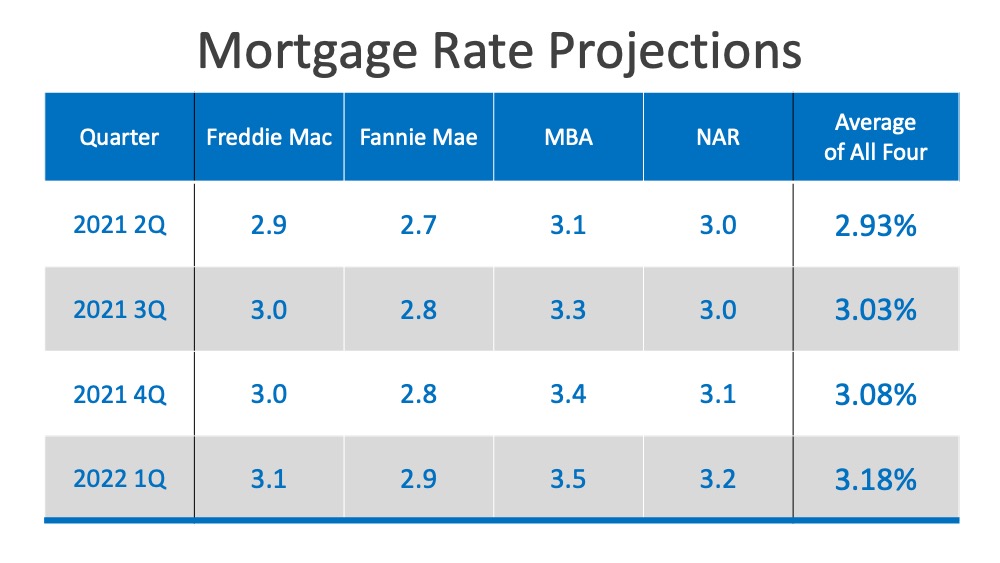
In 2021, the average mortgage rates across all major products hit historic lows, with the first week of the year setting a record that remains unbroken. According to data from Freddie Mac’s Primary Mortgage Market Survey, the market saw fluctuations but remained remarkably affordable throughout the twelve-month period.
30-Year Fixed-Rate Mortgages
The 30-year fixed-rate mortgage is the benchmark for the U.S. housing market. In the first week of January 2021, the average rate for a 30-year fixed mortgage hit an all-time low of 2.65%. To put this into perspective, for much of the previous decade, a “good” rate was considered anything below 4.5%.
Throughout 2021, the 30-year fixed rate largely hovered between 2.7% and 3.1%. There was a brief spike in the spring where rates climbed toward 3.18%, driven by early optimism about the economic reopening, but they retreated back toward 2.8% by mid-summer. The year ended with rates beginning a slow ascent, closing December at approximately 3.11%.
15-Year Fixed-Rate Mortgages
For homeowners looking to pay off their debt faster or investors seeking to maximize equity growth, the 15-year fixed-rate mortgage was incredibly attractive in 2021. This product typically carries a lower interest rate than its 30-year counterpart. In 2021, the average 15-year fixed rate fell as low as 2.10% in late July. For most of the year, borrowers with strong credit profiles were able to secure rates between 2.1% and 2.4%, making the cost of debt almost negligible when adjusted for inflation.
Adjustable-Rate Mortgages (ARMs)
Interestingly, adjustable-rate mortgages were less popular in 2021 than in previous years. Typically, borrowers choose an ARM to get a lower initial rate than a fixed-rate loan. However, with 30-year fixed rates already below 3%, the “spread”—or the difference in interest—between a fixed-rate and an adjustable-rate mortgage was minimal. In 2021, the 5/1 ARM average rate often sat around 2.5% to 2.8%. Most borrowers opted for the security of a 30-year fixed rate, as there was little incentive to take on the future risk of a floating rate when permanent lows were available.

The Economic Drivers and Market Consequences
The availability of cheap capital in 2021 fundamentally altered the behavior of both consumers and institutional investors. The low-rate environment served as a catalyst for several major shifts in the financial sector.
The Refinancing Boom
One of the most significant financial stories of 2021 was the massive wave of mortgage refinancings. Homeowners who had purchased properties in the mid-2010s at rates of 4% or 5% found that by refinancing into a 2.75% loan, they could shave hundreds of dollars off their monthly payments. This “found money” increased household disposable income and allowed many families to pay down high-interest consumer debt or invest in the equities market. For many, 2021 was the year they locked in their housing costs for the next three decades, essentially hedging against the inflation that would follow in 2022 and 2023.
Impact on Housing Prices and Inventory
While low rates were a boon for monthly affordability, they had the unintended consequence of driving home prices to record highs. Because buyers could afford larger loan amounts with the same monthly payment, bidding wars became common. The “purchasing power” of the average buyer increased significantly, which, when met with a chronic undersupply of housing, led to double-digit annual price appreciation in many markets.
Furthermore, 2021 saw the rise of the “lock-in effect.” Homeowners who secured a sub-3% rate in 2021 became increasingly reluctant to sell their homes in later years, knowing they would have to trade their low rate for a much higher one. This has contributed to the inventory shortages seen in the current market.
Institutional Investment in Real Estate
The low interest rates of 2021 also attracted institutional investors and Wall Street firms to the residential real estate market. With the cost of debt so low, the yield on rental properties became highly attractive compared to other fixed-income investments. This influx of corporate capital further intensified competition for entry-level homes, moving the needle on personal finance from “homeownership as a lifestyle choice” to “real estate as a primary asset class” for a wider range of investors.
Comparing 2021 to Historical and Future Norms
To truly appreciate the significance of 2021 mortgage rates, one must view them through a historical lens. For the 50 years prior to 2021, the average 30-year fixed mortgage rate was approximately 7.75%.
Looking Back: The Long-Term Perspective
In the early 1980s, mortgage rates peaked at over 18% as the Federal Reserve fought rampant inflation. Throughout the 1990s, rates in the 7% to 9% range were considered standard. Even the “low” rates following the 2008 financial crisis generally stayed in the 3.5% to 4.5% range. Therefore, the sub-3% rates of 2021 were a statistical anomaly—a “black swan” event in the credit markets caused by a global health crisis and an unprecedented monetary response.
Looking Forward: The Post-2021 Spike
The transition out of 2021 was abrupt. As inflation began to rise in late 2021 and early 2022, the Federal Reserve shifted its stance from stimulus to tightening. By the end of 2022, mortgage rates had more than doubled, and by 2023, they had reached levels not seen in two decades. This rapid ascent highlighted just how subsidized the 2021 market had been. Those who moved or refinanced in 2021 essentially captured a period of “negative real interest rates,” where the rate of inflation was often higher than the interest rate on their mortgage, effectively allowing them to borrow money for free in real terms.
Strategic Lessons from the 2021 Mortgage Market
The 2021 mortgage market offers several enduring lessons for personal finance and investment strategy. It underscores the importance of being “market-ready” to capitalize on volatility and the value of fixed-rate debt in a portfolio.
The Value of the Fixed-Rate Hedge
The primary lesson of 2021 is the power of the 30-year fixed-rate mortgage as a tool for wealth preservation. In an inflationary environment, debt with a fixed low interest rate becomes an asset. As the value of the dollar decreases, the “real” value of the debt decreases, while the value of the underlying real estate typically rises. Those who secured loans in 2021 successfully insulated their largest monthly expense from the inflationary pressures that hit the rest of the economy in the following years.
Timing vs. Time in the Market
While 2021 provided a masterclass in market timing, it also served as a reminder that the window for “perfect” conditions is often short. Many prospective buyers waited for prices to drop, only to find that as rates rose in 2022, their overall cost of ownership increased significantly despite price plateaus. The 2021 era proved that interest rates are often a more powerful driver of long-term wealth in real estate than the purchase price itself.
As we look back, the mortgage rates of 2021 represent a unique chapter in financial history. They were the result of a specific set of global circumstances that are unlikely to be repeated anytime soon. For those who participated in the market that year, the benefits of 2% and 3% interest rates will likely continue to yield financial dividends for decades to come. For everyone else, 2021 serves as the ultimate benchmark for what is possible when monetary policy and economic necessity align to create the lowest borrowing costs in history.
aViewFromTheCave is a participant in the Amazon Services LLC Associates Program, an affiliate advertising program designed to provide a means for sites to earn advertising fees by advertising and linking to Amazon.com. Amazon, the Amazon logo, AmazonSupply, and the AmazonSupply logo are trademarks of Amazon.com, Inc. or its affiliates. As an Amazon Associate we earn affiliate commissions from qualifying purchases.