
The year 1800 stands as a singular monument in human history. It was the moment the world’s population finally touched the one-billion mark, a feat that had taken nearly 300,000 years of human existence to achieve. From a financial and economic perspective, this milestone was not just a demographic curiosity; it was the catalyst for the greatest transformation of wealth, capital, and market structures the world had ever seen.
To understand the world population in 1800 is to understand the birth of modern capitalism. It was an era where the “Malthusian Trap”—the theory that population growth would always outpace food production, leading to inevitable famine—was being challenged for the first time by the gears of the Industrial Revolution. For the savvy investor or the student of business history, the demographics of 1800 provide a blueprint for how labor, resources, and innovation intersect to create global markets.

The Billion-Person Milestone: A Financial Turning Point
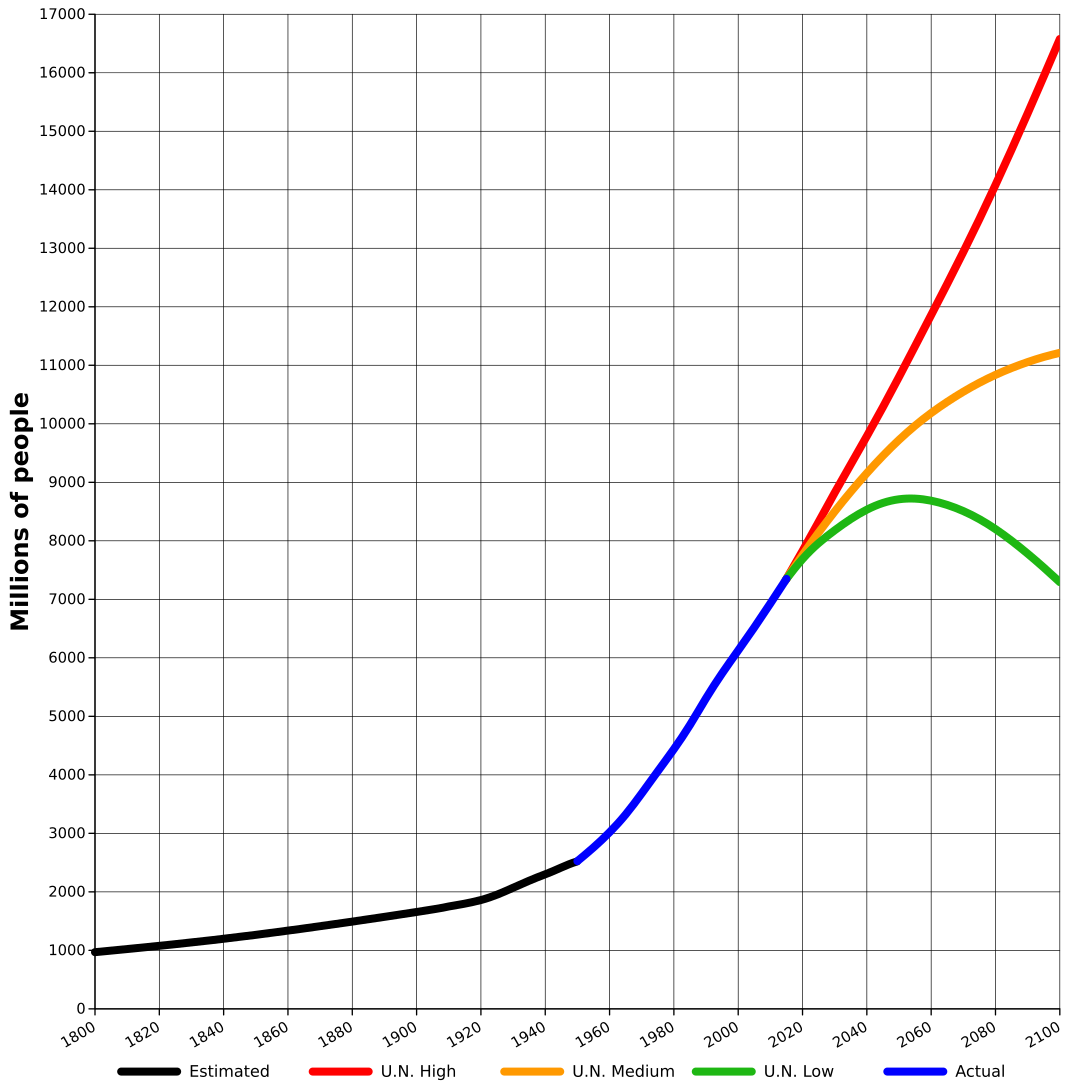
In 1800, the global population was roughly 1 billion. To put this in perspective, that is less than the current population of India alone. However, the distribution of this population and the economic output per person were radically different from the modern era. At this time, the vast majority of the world’s wealth was tied directly to land and agricultural output.
The Malthusian Trap and Pre-Industrial Constraints
Before the 19th century, economic growth was essentially a zero-sum game. If the population grew too quickly, resources became scarce, prices skyrocketed, and the population would inevitably contract due to “positive checks” like war or disease. In 1800, Thomas Robert Malthus published his famous essays, arguing that humanity was destined for poverty because population grows geometrically while food production only grows arithmetically.
From a money management perspective, this meant that capital was static. Wealth was concentrated in the hands of the landed gentry, and there was little room for “disposable income” among the masses. The 1800 population milestone represents the final moment in history where human life was governed by the sheer availability of soil and rain.
Capital Allocation in an Agrarian Society
In 1800, approximately 80% to 90% of the world’s population was involved in subsistence farming. This meant that the “market” for goods and services was incredibly narrow. Investing in this era was almost exclusively the domain of merchant companies and state-backed ventures. The concept of a “retail consumer” did not exist in the way we understand it today. Business finance was focused on the movement of commodities—sugar, tea, cotton, and spice—from the peripheries of empires to the growing urban centers of the West.
The Industrial Revolution: How Demographics Fueled the Rise of Modern Capital
While the population hit one billion, a shift was occurring in England and parts of Western Europe that would change the valuation of human labor forever. The Industrial Revolution turned the growing population from a “burden” into a “resource.”
Labor as the Primary Asset
In the centuries leading up to 1800, labor was expensive because productivity was low. One farmer could only produce enough food for a few people. As the 19th century dawned, mechanical innovations like the steam engine and the power loom allowed a single worker to produce ten times the output of their predecessors.
This demographic surge in 1800 provided the necessary “reserve army of labor” for the burgeoning factories of the north of England and the American Northeast. For business owners, this was a period of unprecedented margin expansion. The cost of labor remained low due to the sheer volume of people moving from rural areas to cities, while the value of finished goods increased as global trade networks expanded.
The Birth of Global Trade Networks
The one billion people alive in 1800 were increasingly connected by maritime trade. The population growth in the Americas, fueled by both migration and forced labor, created new markets for European manufactured goods. This was the era of the “Atlantic Economy.”
Financial tools that we take for granted today—insurance, letters of credit, and joint-stock companies—were refined during this period to manage the risks associated with global trade. The sheer scale of the population required a more sophisticated way to move money across borders. If you were a financier in 1800, your focus was not on the local bakery, but on the massive fluctuations in the price of cotton in Liverpool or tea in London, driven by the needs of a billion people.
Wealth Distribution and Economic Power Centers in 1800
In 1800, the global economic map looked very different than it does today. While Europe was on the brink of an industrial explosion, the “Old World” of the East still held a significant share of the global population and, by extension, a significant share of global GDP.
The Decline of the East and the Rise of the West
Asia accounted for approximately 65% of the world’s population in 1800. China alone had a population of roughly 300 million, while the Indian subcontinent held about 200 million. Because economic output was largely proportional to population size in a pre-industrial world, China and India were the world’s largest economies.
However, the “Great Divergence” was beginning. Even though the East had the numbers, the West was beginning to have the capital efficiency. European nations were leveraging their smaller but more technologically advanced populations to extract wealth from global colonies. This period teaches a vital lesson in business finance: scale (population) is important, but efficiency (technology and capital) is what ultimately dictates market dominance.
Colonialism and the Extraction of Value
The demographics of 1800 cannot be discussed without acknowledging the role of colonial extraction. Much of the capital that built the financial centers of London, Amsterdam, and Paris was derived from the exploitation of populations in the Global South. The population in 1800 was divided between those who participated in the emerging global market as consumers and those who were forced to participate as laborers. This disparity created the massive capital reserves that would later fund the expansion of railroads, telegraphs, and modern infrastructure.
Investing in the Future: How 1800 Shaped Modern Portfolio Theory
The way we think about wealth today—growth, compound interest, and market expansion—found its roots in the demographic pressures of the early 1800s. As the population grew, the old ways of storing wealth (gold and land) became insufficient to meet the needs of a modernizing world.
The Evolution of Banking and Credit
With a billion people to feed, clothe, and house, the demand for credit exploded. Traditional banking, which had been reserved for monarchs and merchant princes, began to democratize. The early 19th century saw the rise of provincial banks and the expansion of the bond market. Governments needed to borrow money to fund the wars of the era (like the Napoleonic Wars), and they turned to the growing middle class to do it.
This period marked the transition from “hoarded wealth” to “circulating capital.” Money was no longer just a store of value; it became a tool for growth. For the first time, people were investing in “futures”—the idea that tomorrow’s world would be more populous and more productive than today’s.
Lessons from 1800 for Today’s Emerging Markets
Looking back at the world of 1800 provides a lens through which we can view today’s emerging markets. Countries that are currently experiencing rapid population growth and the early stages of industrialization are following a path blazed two centuries ago. The key for modern investors is to identify where the “demographic dividend”—the point where the working-age population is at its peak—will occur. In 1800, that dividend belonged to Europe; today, it is shifting toward Africa and Southeast Asia.

From 1800 to Today: Scaling Economic Systems for 8 Billion
The jump from 1 billion to 8 billion people has required a total redesign of our financial systems. In 1800, the primary concern was whether we could grow enough wheat to prevent starvation. Today, our concerns are around data, digital currency, and the sustainability of global supply chains.
The population of 1800 proved that humanity could break the Malthusian Trap through innovation and capital allocation. It proved that a growing population is not a liability, but an asset, provided there is a financial system capable of supporting it. As we navigate the complexities of the 21st-century economy, the lessons of 1800 remain clear: demographics drive markets, but technology and capital decide who wins.
The billion people who inhabited the earth in 1800 set the stage for the most rapid accumulation of wealth in human history. They were the first generation to witness the transition from a world of scarcity to a world of potential. By studying their economic landscape, we gain a better understanding of our own—one where the sheer scale of humanity continues to be the ultimate driver of value and opportunity.
aViewFromTheCave is a participant in the Amazon Services LLC Associates Program, an affiliate advertising program designed to provide a means for sites to earn advertising fees by advertising and linking to Amazon.com. Amazon, the Amazon logo, AmazonSupply, and the AmazonSupply logo are trademarks of Amazon.com, Inc. or its affiliates. As an Amazon Associate we earn affiliate commissions from qualifying purchases.