
When Usain Bolt crossed the finish line at the 2009 World Championships in Berlin, the clock stopped at 9.58 seconds. While the world gasped at the sheer audacity of the record, a complex network of sports scientists, engineers, and data analysts were looking deeper into the hardware and software that captured that moment. Bolt’s top speed was recorded at a staggering 27.78 miles per hour (44.72 km/h). However, understanding that number requires moving beyond the stopwatch and into the realm of high-speed cinematography, biometric sensors, and computational fluid dynamics.
In the world of elite athletics, technology is no longer just a tool for measurement; it is the lens through which we understand the limits of human biology. The story of Usain Bolt’s top speed is a case study in how technology identifies, analyzes, and validates the outer edges of human potential.
Measuring the Unmeasurable: The Evolution of Timing Technology
To determine that Bolt reached his peak velocity between the 60-meter and 80-meter marks, the IAAF (now World Athletics) relied on technology far more sophisticated than a standard digital timer. The precision required to validate a world record involves a multi-layered technological stack designed to eliminate human error and environmental interference.
From Manual Chronographs to Dual-Beam Infrared Sensors
In the early 20th century, sprints were timed by hand, leading to variances of up to 0.2 seconds—an eternity in a 100-meter dash. By the time Bolt stepped onto the track in Berlin, the industry had moved to Fully Automatic Timing (FAT). This system uses a starter’s pistol linked electronically to the timing computer.
The “top speed” measurement itself is derived from laser-based distance sensors. These devices emit infrared pulses that bounce off the athlete’s torso hundreds of times per second. By calculating the “Time of Flight” (ToF) for these pulses, the software creates a continuous velocity curve. This is how we know Bolt didn’t just run 9.58; we know exactly where he accelerated, where he plateaued, and how his velocity decayed in the final ten meters.
High-Frequency Photo-Finish Cameras and Transponders
While the laser measures velocity, the photo-finish camera validates the result. Modern cameras used in elite sprinting, such as those developed by Omega or Seiko, capture up to 10,000 frames per second. Unlike a standard video camera that captures a full frame, a photo-finish camera captures a vertical slice of the finish line.
This digital “slit-scan” technology ensures that the thickness of a jersey or the lean of a torso is captured with millimeter precision. For Bolt, this technology confirmed that his center of mass was moving at a speed that defied existing biomechanical models, providing the data necessary for researchers to begin “reverse-engineering” his stride.
The Biomechanics of Speed: Data Analytics and Human Kinematics
Once the raw speed was captured, the focus shifted to why Bolt was faster than his peers. This is where data analytics and kinematic software transform a video recording into a mathematical model of efficiency.
Motion Capture Analysis of the 9.58-Second Sprint
Using high-speed footage, biomechanists used “digitization” software to track 15 to 20 points on Bolt’s body. This allows for a frame-by-frame analysis of joint angles, limb velocity, and trunk lean. The data revealed a technological anomaly: despite being 6’5″, Bolt possessed the “fast-twitch” explosive capabilities of a much smaller man.
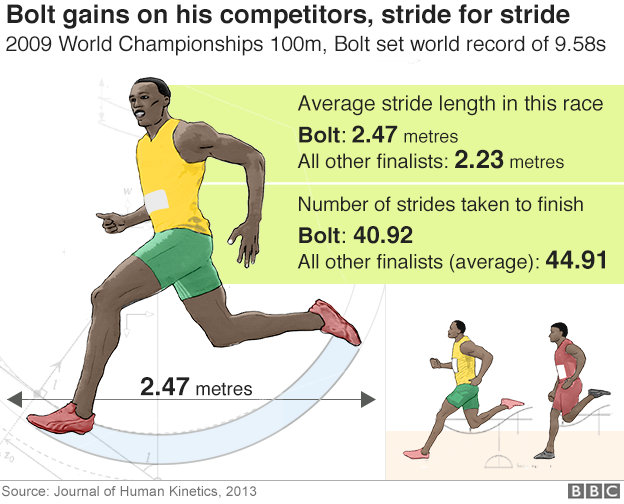
Traditionally, tall sprinters were thought to be at a disadvantage because of the “inertia” of long limbs. However, data analytics showed that Bolt’s stride length averaged 2.44 meters. He completed the 100-meter race in just 41 strides, whereas his competitors required 44 to 45. The technology allowed coaches to see that Bolt wasn’t necessarily moving his legs faster than others; he was applying more force to the ground more efficiently.
Ground Reaction Force (GRF) and Kinetic Efficiency
One of the most critical metrics in top-speed analysis is Ground Reaction Force. While Bolt did not wear “smart shoes” during his record run (as the technology was in its infancy), modern force-plate technology has since been used to simulate his run.

Sophisticated algorithms calculate that Bolt exerted a peak force of roughly 1,000 pounds against the track. High-speed sensors show that his foot was in contact with the ground for only 0.08 seconds per stride. This “short contact time” is the holy grail of sprinting technology. By analyzing the “stiffness” of the ankle joint through computer modeling, engineers have been able to design footwear that mimics the energy-return properties of Bolt’s own physiology.
Environmental Variables and Computational Fluid Dynamics (CFD)
A human running at 27.78 mph is essentially a vehicle moving through a fluid medium: air. To understand Bolt’s top speed, researchers utilized Computational Fluid Dynamics (CFD)—the same technology used to design Formula 1 cars and aerospace components.
The Impact of Wind Assistance and Aerodynamics
On the day of the 9.58-second sprint, the wind gauge measured a tailwind of +0.9 m/s. While this is well within the legal limit of +2.0 m/s, tech-driven simulations have allowed scientists to “scrub” the wind data to see what Bolt would have run in a vacuum.
Using CFD, researchers at the National Autonomous University of Mexico determined that Bolt’s massive frame was actually an aerodynamic disadvantage. He had a higher “drag coefficient” than smaller sprinters. The software calculated that less than 8% of the energy Bolt produced was used for motion, while the rest was used to overcome air resistance. This insight changed the way sprinters train, emphasizing “low-profile” body positions during the transition from the drive phase to the top-speed phase.
Synthetic Track Engineering: The Surface-Human Interface
The track in Berlin was not just “dirt and rubber.” It was a highly engineered “Mondo” surface, a product of intense material science. These tracks are designed using hexagonal backing cells that act like small springs.
When a runner’s foot hits the surface, the track deforms and then returns that energy to the runner’s foot. Sensors embedded in experimental tracks have shown that the “tuning” of the track’s hardness to the athlete’s weight can result in a 1-2% increase in speed. Technology facilitated the perfect “interface” between Bolt’s spikes and the Berlin surface, allowing for the maximum transfer of kinetic energy.
The Future of Speed: AI and Real-Time Biometric Feedback
While Usain Bolt’s record remains stands, the technology used to monitor and potentially break it has moved into the realm of Artificial Intelligence and the Internet of Things (IoT).
Machine Learning in Talent Identification
Today, software platforms use machine learning to scan thousands of hours of youth sprinting footage. By identifying “mechanical signatures”—the specific way a hip rotates or a foot strikes—AI can predict which athletes have the skeletal structure to reach “Bolt-level” speeds before they ever reach a professional track. This predictive modeling is the new frontier in sports tech, moving from measuring what has happened to predicting what could happen.
Wearable Tech: Predicting the Next Human Limit
In the modern era, an athlete’s kit is embedded with MEMS (Micro-Electro-Mechanical Systems) sensors. These include 3D accelerometers and gyroscopes that provide real-time data on “braking forces” and “vertical oscillation.”
If Bolt were running today, he would likely be wearing a sensor-laden vest that transmits data via Bluetooth to a coach’s tablet. This allows for “Live Biometric Correcting.” If the software detects a 2-degree deviation in knee lift that causes a drop in top-end velocity, the correction can be made in the next training set.

Conclusion: The Synthesis of Man and Machine
Usain Bolt’s top speed of 27.78 mph was a triumph of human spirit, but it was validated and understood through the triumph of technology. From the infrared lasers that caught his peak velocity to the CFD models that analyzed his drag, technology has turned the 100-meter sprint into a data-rich laboratory.
As we look toward the future, the integration of AI-driven analytics and advanced material science suggests that the “human ceiling” may not have been reached yet. However, any athlete who hopes to surpass Bolt will not only need his extraordinary genetics but also the cutting-edge technological infrastructure that continues to redefine our understanding of the fastest man alive.
aViewFromTheCave is a participant in the Amazon Services LLC Associates Program, an affiliate advertising program designed to provide a means for sites to earn advertising fees by advertising and linking to Amazon.com. Amazon, the Amazon logo, AmazonSupply, and the AmazonSupply logo are trademarks of Amazon.com, Inc. or its affiliates. As an Amazon Associate we earn affiliate commissions from qualifying purchases.