
The story of the first Nike shoe is not merely a chronicle of footwear manufacturing; it is the foundational case study for modern brand building. In the early 1970s, the athletic landscape was dominated by established European giants. The emergence of Nike—and the specific shoe that started it all—represents a masterclass in how a clear corporate identity, innovative product differentiation, and aggressive marketing can disrupt an entire industry. To understand what the first Nike shoe was, one must look past the rubber and suede to the brand strategy that transformed a fledgling startup into a global cultural phenomenon.

From Blue Ribbon Sports to Nike: The Strategic Identity Pivot
Before there was a “Nike” shoe, there was Blue Ribbon Sports (BRS). Founded by Phil Knight and Bill Bowerman, BRS began as a distributor for Japanese Onitsuka Tiger shoes. The transition from a distributor to a proprietary brand is one of the most significant strategic pivots in business history. This shift was born out of a desire for control over brand destiny and the realization that to achieve true scale, a company must own its intellectual property.
The Phil Knight and Bill Bowerman Partnership
The brand identity of Nike was forged through a unique binary leadership. Phil Knight provided the business acumen—the “hustle” and the vision for market expansion—while Bill Bowerman provided the “product soul.” Bowerman was a track coach at the University of Oregon with an obsessive focus on performance. This partnership ensured that from day one, the brand was rooted in authentic performance. In brand strategy, this is known as “Foundational Authority.” Because the creators were deeply embedded in the running community, the brand possessed an organic credibility that money could not buy.
Defining the Brand DNA through Innovation
As the relationship with Onitsuka Tiger frayed, Knight and Bowerman knew they needed a visual and conceptual departure. They weren’t just making a shoe; they were defining a new philosophy of movement. This led to the birth of the “Swoosh.” Commissioned for a mere $35 from design student Carolyn Davidson, the logo was intended to convey motion and speed. While Knight famously said he didn’t “love it” initially, the strategic decision to commit to a singular, bold graphic identity allowed the brand to become instantly recognizable across borders and languages.
The Waffle Trainer and the Moon Shoe: Engineering Brand Perception
When discussing the “first” Nike shoe, history points to two pivotal models: the “Moon Shoe” (the hand-made prototype) and the “Waffle Trainer” (the commercial breakthrough). These shoes were the physical manifestations of the brand’s promise: innovation that serves the athlete.
The Kitchen Lab: Turning Hardware into Heritage
The legendary story of Bill Bowerman ruining his wife’s waffle iron to create a new type of traction sole is more than just a quirky anecdote; it is a core pillar of Nike’s brand storytelling. By using a household item to solve a professional athletic problem, Bowerman established Nike as an “innovator’s brand.” This narrative of the “mad scientist” in the kitchen created an emotional connection with consumers. It suggested that Nike was a company that would stop at nothing—including destroying kitchen appliances—to help an athlete run faster. In terms of brand positioning, this moved Nike away from being a mere commodity and toward being a high-tech performance tool.

The 1972 Olympic Trials: Debut as Marketing Strategy
The official debut of the Nike brand occurred at the 1972 Olympic Trials in Eugene, Oregon. This was a deliberate strategic choice. By placing the “Moon Shoe” (so named because the tread pattern resembled the footprints left by astronauts on the moon) on the feet of elite marathoners, Nike utilized “top-down” marketing. They didn’t target the casual jogger first; they targeted the elite. This created a “halo effect.” If the world’s best athletes were wearing the Swoosh to compete for Olympic glory, the brand was instantly validated as the gold standard for everyone else.
The Nike Cortez: Storytelling and Cultural Integration
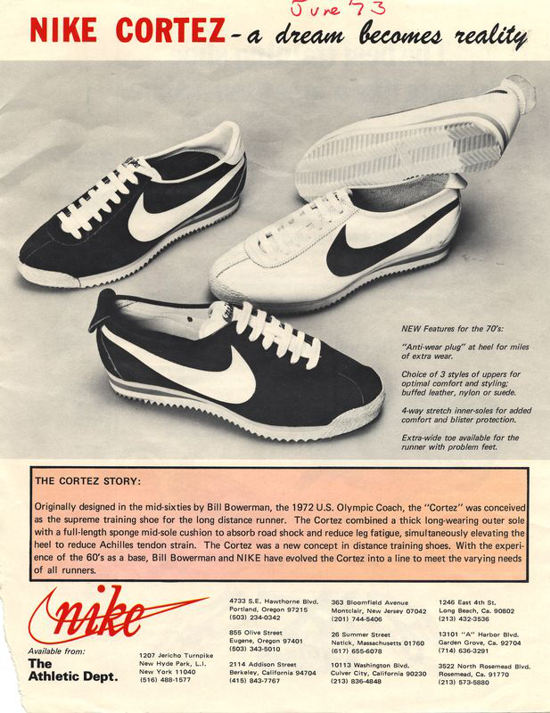
While the Waffle Trainer provided the technical foundation, the Nike Cortez—released in 1972—was the shoe that defined the brand’s visual language and its ability to cross over into the lifestyle market. The Cortez was the first official track shoe released under the Nike name after the split from Onitsuka, and its success was a result of meticulous market positioning.
Aesthetic Minimalism and the Power of Recognition
The Cortez featured a thick, cushioned sole and a bold, oversized Swoosh on the side. This was a strategic design choice. In the 1970s, athletic shoes were often cluttered with various stripes and logos. Nike’s decision to use a clean, high-contrast colorway (white leather with a red swoosh and blue accents) made the shoe pop on the track and, more importantly, on television. This emphasized “Visual Equity”—the idea that a consumer should be able to identify the brand from a distance. The Cortez became a moving billboard for the company.
From Athletics to Lifestyle: Expanding the Brand’s Reach
The Cortez was also the first Nike shoe to demonstrate the brand’s potential for “Cultural Salience.” While designed for long-distance running, its clean silhouette made it attractive for everyday wear. This began the brand’s journey from the track to the streets of Los Angeles and eventually into the broader pop-culture consciousness. By successfully transitioning a performance product into a fashion staple, Nike pioneered the “athleisure” category decades before the term existed. This expansion of the “Brand Universe” allowed Nike to tap into a much larger consumer base without losing its core identity as a performance company.
Legacy and Longevity: How the First Shoe Built a Corporate Empire
The first Nike shoes—the Moon Shoe, the Waffle Trainer, and the Cortez—were not just products; they were the blueprints for a corporate identity that has remained remarkably consistent for over fifty years. The brand strategy established in those early years continues to drive the company’s multi-billion dollar valuation today.
Consistency in Brand Messaging
One of the most impressive aspects of Nike’s brand strategy is its consistency. The core message of “Just Do It” (introduced later) was built on the foundation laid by the first shoes: that everyone is an athlete and that Nike provides the tools to unlock that potential. The “Waffle” technology is still referenced in modern designs, and the Cortez remains a top-seller in the lifestyle category. This longevity is achieved through “Heritage Marketing”—the practice of using a brand’s history to reinforce its current authority. By constantly reminding consumers of their “scrappy” beginnings in Oregon, Nike maintains a sense of authenticity even as a massive multinational corporation.
The Valuation of Heritage in Modern Marketing
Today, the “first” Nike shoes are treated as historical artifacts. In 2019, an original pair of 1972 Nike Waffle Racing Flat “Moon Shoes” sold at auction for $437,500. From a brand perspective, this astronomical price point validates the “Mythology” of the company. Nike has successfully transitioned from a manufacturer of goods to a curator of culture. The story of the first shoe is a key component of the brand’s “Intangible Assets.” When consumers buy a pair of Nikes today, they aren’t just buying foam and mesh; they are buying a piece of a narrative that began with a waffle iron and a dream of revolutionizing the way the world moves.
In conclusion, “what was the first Nike shoe” is a question with a layered answer. Technically, it was the Moon Shoe and the Waffle Trainer; commercially, it was the Cortez. However, strategically, the first Nike shoe was a vessel for a new kind of brand identity—one built on authentic performance, bold visual storytelling, and a relentless pursuit of innovation. By focusing on these pillars from the very beginning, Phil Knight and Bill Bowerman did more than just create a shoe; they created a blueprint for how a brand can capture the imagination of the world.
aViewFromTheCave is a participant in the Amazon Services LLC Associates Program, an affiliate advertising program designed to provide a means for sites to earn advertising fees by advertising and linking to Amazon.com. Amazon, the Amazon logo, AmazonSupply, and the AmazonSupply logo are trademarks of Amazon.com, Inc. or its affiliates. As an Amazon Associate we earn affiliate commissions from qualifying purchases.