
To understand the age of marriage in Edo Japan (1603–1868), one must look beyond simple biological maturity and examine the complex financial frameworks that governed the era. During this period, marriage was rarely a matter of personal sentiment; it was a calculated economic merger designed to ensure the survival and prosperity of the ie, or the family household. In the Edo period, the “age” of marriage was not a fixed chronological milestone but rather a variable threshold determined by capital accumulation, labor requirements, and inheritance laws.
The financial health of a household dictated when its members could enter the marriage market. Whether among the elite samurai, the industrious merchant class, or the agrarian peasantry, marriage served as the primary mechanism for the transfer of assets and the stabilization of long-term economic units. Consequently, the average age of marriage varied significantly across the social hierarchy, reflecting the diverse financial pressures faced by each class.
The Economic Foundation of the Ie System
The cornerstone of Edo society was the ie system, a patriarchal household structure that functioned more like a corporate entity than a modern nuclear family. The ie possessed its own assets, reputation, and lineage, and the primary goal of any head of household was to preserve this capital for the next generation. Marriage was the most critical financial transaction in this pursuit.
Marriage as a Strategic Financial Merger
In the eyes of Edo-era administrators and family patriarchs, a wedding was an agreement between two economic units. For the wealthy merchant classes (chōnin), a marriage could secure a trade alliance or consolidate market share. For the samurai, it could solidify political standing and ensure the continuation of a government-granted stipend.
Because the stakes were so high, the “age” at which an individual married was often deferred until the household could afford the associated costs. For men, this meant waiting until they were positioned to inherit the family business or until they had secured a stable income. For women, it meant waiting until their family could provide a dowry that reflected their social standing and financial ambition. The timing was a balance between the biological need for an heir and the financial necessity of maintaining the household’s solvency.
The Role of the Dowry and Marriage Gifts
The financial mechanics of an Edo marriage centered on the yuinō, a series of ceremonial gifts and cash exchanges that functioned as a modern-day security deposit and capital infusion. The groom’s family would typically provide a sum of money to the bride’s family to cover the costs of her wedding preparations. In return, the bride brought with her a dowry consisting of clothes, furniture, and sometimes significant liquid assets.
This exchange created a high barrier to entry for marriage. If a family suffered a poor harvest or a business downturn, marriages within the household were often postponed for years. The age of marriage, therefore, served as a real-time indicator of the regional and class-specific economic climate. When capital was liquid and the economy was stable, marriage ages tended to drop; during periods of famine or inflation, the age of marriage spiked as families prioritized immediate survival over long-term expansion.
Determinants of Marriageable Age Across Social Classes
While the national average age for marriage evolved over the 250 years of the Tokugawa Shogunate, it was never uniform. The financial requirements of different occupations created distinct demographic patterns.
The Merchant Class: Balancing Capital and Lineage
In the urban centers of Edo, Osaka, and Kyoto, the merchant class operated under a strict system of apprenticeship. A young man entering a merchant house as an apprentice (detchi) had no personal capital and was forbidden from marrying. He had to work his way up to the rank of clerk (bantō) before marriage became a financial possibility.
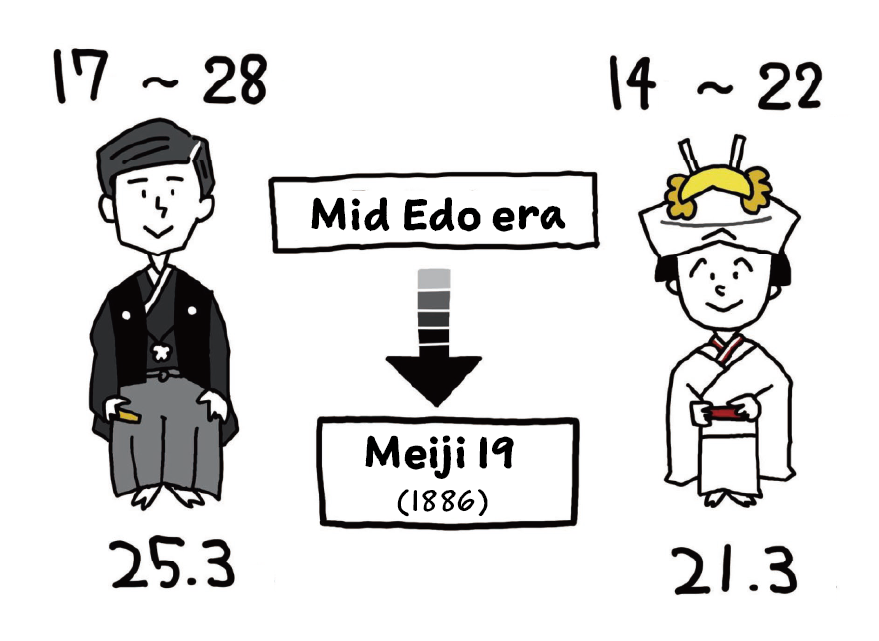
As a result, merchant men often married quite late, frequently in their late twenties or early thirties. By this time, they had demonstrated their business acumen and were either ready to start a branch family (bunke) or were positioned to inherit the main house (honke). Merchant daughters, conversely, were often married in their late teens or early twenties, with their families using the dowry as a strategic investment to attract a high-performing “adopted son-in-law” (muko-yōshi) who could take over the business if a biological male heir was lacking.
The Peasantry: Labor Needs and Household Viability
In rural Japan, where 80% of the population lived, the age of marriage was more closely tied to the labor market and the productivity of the land. A farm required a certain amount of manual labor to remain viable, and marriage was the most efficient way to recruit that labor.
Historical records, such as the shūmon-aratame-chō (religious census records), suggest that peasant women in the 18th and 19th centuries typically married between the ages of 18 and 22. Men in these communities usually married in their early to mid-twenties. However, these ages fluctuated based on land ownership. Households with large landholdings encouraged earlier marriage to increase the labor force, while “landless” peasants or those with marginal holdings often delayed marriage or remained single, as they lacked the financial “floor” required to support a new household.
The Samurai: Stipends and Socio-Economic Status
The samurai class faced a unique set of financial constraints. Their income was fixed in the form of rice stipends (koku) granted by their lord (daimyō). Because these stipends were often modest and did not increase with the size of the family, samurai had to be extremely cautious about the timing of marriage.
For a samurai, marriage was often delayed until a formal position within the bureaucracy was secured. Younger sons who would not inherit the family headship were in a particularly difficult financial position; they often remained unmarried for their entire lives unless they were adopted into another family as an heir. This created a “surplus” of unmarried samurai men in urban centers, shifting the average age of first marriage for this class significantly higher than that of the general population.
Financial Stability as a Prerequisite for Union
Across all classes, the concept of “readiness” for marriage was defined by the ability to sustain a household without depleting the ancestral capital of the ie. This required a level of financial literacy and planning that is often overlooked in historical analyses.
The Cost of Setting Up a New Household
Entering a marriage required a massive one-time capital expenditure. Beyond the yuinō, families had to invest in new housing, tools, and the social ceremonies that validated the union. In the Edo period, social status was maintained through visible consumption and the adherence to strict sumptuary laws. A marriage that appeared “cheap” could result in a loss of creditworthiness in the community, which was devastating for merchant families who relied on reputation for trade.
Because of these costs, the age of marriage was often a reflection of a family’s “savings rate.” Families would spend a decade or more accumulating the necessary funds to marry off a daughter or establish a son. This economic reality acted as a natural form of population control; in times of economic contraction, the high cost of marriage prevented the formation of new households, thereby limiting the birth rate and preserving the per-capita wealth of the existing population.
Divorce and the Financial Liquidation of Marriage
The financial nature of Edo marriage is perhaps most evident in how it ended. Divorce was surprisingly common, particularly among the commoner classes, and it was handled as a contractual dissolution. The famous “three-and-a-half lines” (mikudari-han) of a divorce decree were not just a social severance but a financial one.
Upon divorce, the bride’s family was generally entitled to the return of her dowry and personal effects. This made divorce a significant financial risk for the husband’s family. If the marriage was dissolved because of the husband’s failings, the loss of the dowry could jeopardize the household’s liquidity. Consequently, the “age of marriage” was also influenced by risk assessment; families would wait until they were confident in the long-term stability of the union before committing their capital. This led to a culture where “trial marriages” or long periods of engagement were common among the lower classes to ensure the economic fit before the formal exchange of assets.

The Legacy of Edo’s Economic Marriage Model
The age of marriage in Edo Japan provides a fascinating look at how a society manages its human and financial capital in a closed, resource-constrained environment. Marriage was the primary vehicle for wealth distribution, labor management, and social mobility. By setting the age of marriage at the intersection of biological capability and financial viability, Edo society ensured that new households were created only when they could be economically supported.
This focus on financial prerequisite remains a lingering cultural trait in modern Japan, where the cost of marriage and the requirement for a stable “breadwinner” income continue to influence marriage ages and birth rates. In the Edo period, the age of marriage was not just a number—it was a balance sheet. It represented the moment when a family’s accumulated savings met the demands of social reproduction, ensuring that the ie survived another generation in an increasingly complex and monetized economy. Understanding this era requires recognizing that for the people of Edo Japan, the heart of the home was always closely guarded by the requirements of the purse.
aViewFromTheCave is a participant in the Amazon Services LLC Associates Program, an affiliate advertising program designed to provide a means for sites to earn advertising fees by advertising and linking to Amazon.com. Amazon, the Amazon logo, AmazonSupply, and the AmazonSupply logo are trademarks of Amazon.com, Inc. or its affiliates. As an Amazon Associate we earn affiliate commissions from qualifying purchases.