
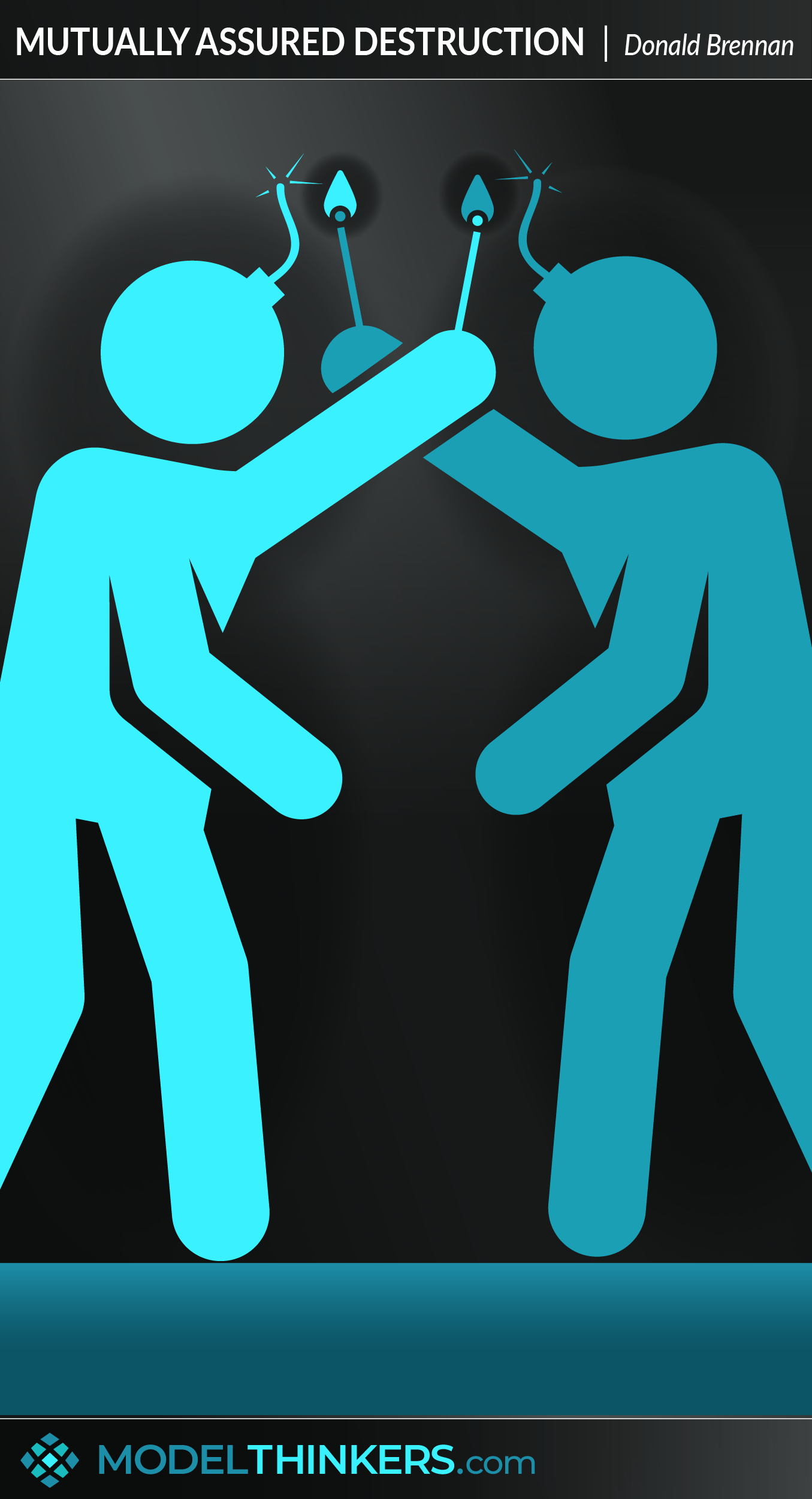
In the annals of twentieth-century history, few concepts carry the weight or the chilling logical precision of Mutually Assured Destruction (MAD). While often discussed in political or sociological terms, MAD was, at its core, a triumph—and a terror—of engineering and technological systems design. It was a doctrine of military strategy and national security policy in which a full-scale use of nuclear weapons by two or more opposing sides would cause the complete annihilation of both the attacker and the defender.
From a technological perspective, MAD represents the ultimate “fail-safe” gone wrong, or perhaps gone exactly right. It relied on the development of complex delivery systems, sophisticated early warning networks, and redundant communication architectures. Today, as we move deeper into the era of cyber warfare and Artificial Intelligence, the principles of MAD have migrated from physical silos to the digital domain. Understanding the technology behind MAD is essential to understanding the current state of global digital security.
The Technological Foundations of MAD: The Nuclear Triad
The efficacy of Mutually Assured Destruction was never based on the mere existence of nuclear warheads. Instead, it was based on the technological “Triad”—a three-pronged system of delivery vehicles designed to ensure that even if one branch were neutralized, the remaining two could still deliver a catastrophic second strike.
Intercontinental Ballistic Missiles (ICBMs)
ICBMs represented the pinnacle of mid-century aerospace engineering. These were not merely rockets; they were highly sophisticated autonomous vehicles. To achieve MAD, engineers had to solve the problem of inertial guidance systems. Without GPS, these missiles relied on gyroscopes and accelerometers to calculate their position in space relative to their launch point. The technology required to hit a target halfway across the globe with a margin of error of only a few hundred meters necessitated breakthroughs in materials science, solid-fuel chemistry, and miniaturized computing.
Submarine-Launched Ballistic Missiles (SLBMs)
The most technologically significant component of the Triad was the nuclear-powered ballistic missile submarine (SSBN). These vessels were masters of stealth tech, utilizing acoustic silencing, hydrodynamic hull designs, and advanced sonar to remain undetected. The technological challenge here was “Second Strike Capability.” By placing missiles on mobile, underwater platforms, the technology ensured that no first strike could ever truly disarm an opponent. The communication tech involved—Very Low Frequency (VLF) radio waves capable of penetrating seawater—became the backbone of the “Dead Hand” philosophy.
Strategic Bombers and Electronic Countermeasures
The third leg of the triad involved long-range bombers. Unlike missiles, bombers could be recalled, but they faced the technological hurdle of penetrating sophisticated integrated air defense systems (IADS). This led to a massive tech race in Electronic Warfare (EW). Engineers developed radar-jamming equipment, chaff dispensers, and eventually stealth (low-observable) technology. This era of tech development proved that MAD was as much about the “invisibility” of the weapon as it was about its explosive power.
The Automation of Armageddon: Early Warning Systems and “Dead Hand” Tech
A critical component of MAD was the ability to detect a launch almost instantaneously. This necessitated the creation of the most complex sensor networks the world had ever seen. The technology evolved from simple radar to sophisticated satellite-based infrared sensors capable of detecting the heat signatures of rocket plumes.
The SAGE System and Early Computing
The Semi-Automatic Ground Environment (SAGE) was a massive system of computers and networking equipment used by the U.S. in the 1950s. It was one of the first instances of real-time human-machine interaction. SAGE utilized the AN/FSQ-7 computer, the largest computer ever built, which used over 50,000 vacuum tubes. This technological marvel laid the groundwork for modern wide-area networking (WAN) and digital data links, all in service of ensuring the response time required for MAD.
The “Dead Hand” (Perimeter) System
Perhaps the most terrifying technological implementation of MAD was the Soviet “Perimeter” system, often referred to as the “Dead Hand.” This was an early form of an automated command-and-control system. If the system detected nuclear radiation, seismic shocks, and a loss of communication with high-level leadership, it was programmed to bypass human command and launch the entire arsenal automatically. It was a literal “if-then” logic gate applied to the end of the world. This represents the first major historical instance where humans delegated the ultimate existential decision to an automated technological system.
Digital MAD: Cyber Warfare and the New Frontier of Security

As the physical threat of nuclear silos has been supplemented by the invisible threat of server farms, the concept of MAD has entered the digital realm. In modern digital security, we see a parallel phenomenon: Mutually Assured Cyber Destruction.
Zero-Day Exploits as Modern Warheads
In the tech world, a “Zero-Day” exploit is a vulnerability unknown to the software vendor. Nations now stockpile these digital “warheads.” The logic mirrors MAD: if Country A uses a devastating Zero-Day to take out Country B’s power grid, Country B will respond by utilizing its own stockpile of exploits to collapse Country A’s financial system. The technology of “Advanced Persistent Threats” (APTs) ensures that both parties are constantly embedded in each other’s critical infrastructure, creating a digital stalemate.
The Attribution Problem in Tech
Unlike a missile launch, which has a clear heat signature and trajectory, a cyberattack is difficult to attribute. This technological hurdle complicates the MAD doctrine. Security firms and national agencies use forensic data—code snippets, server timestamps, and known “digital fingerprints”—to identify attackers. The evolution of “Deception Technology” and “Honey Pots” serves as a defensive layer, attempting to trick attackers into revealing their tools without triggering a retaliatory strike.
The Role of Artificial Intelligence in Modern Strategic Deterrence
The introduction of Artificial Intelligence (AI) and Machine Learning (ML) into global security systems has fundamentally altered the timeline of MAD. We are moving from a world of “human-in-the-loop” to “human-on-the-loop,” where the speed of decision-making is dictated by algorithms.
Algorithmic Escalation and Flash Wars
In the financial world, “Flash Crashes” occur when trading algorithms react to one another in a feedback loop. Digital security experts fear a similar “Flash War.” If an AI-driven defensive system detects a minor probe on a network and interprets it as a precursor to a major strike, it may launch an automated counter-offensive. This technological speed creates a paradox: the faster the tech, the less time humans have to prevent the “Destruction” part of MAD.
AI-Enhanced Defensive Shields
On the flip side, AI provides the first real technological hope for moving beyond MAD toward “Assured Survival.” Predictive analytics and automated patch management can identify and close vulnerabilities before they can be exploited. Modern “Self-Healing Networks” use AI to reroute traffic and isolate compromised sectors in milliseconds, theoretically neutralizing the effectiveness of a “First Strike” in the digital space.
Lessons for Modern Digital Security Architecture
The legacy of Mutually Assured Destruction is deeply embedded in how we build secure systems today. The technological rigor required to maintain a nuclear stalemate for decades has provided the blueprint for modern enterprise and national security.
Redundancy and Distributed Systems
The core of MAD was the ability to survive a strike. This is the direct ancestor of modern “High Availability” (HA) and “Disaster Recovery” (DR) technology. Just as the nuclear triad ensured no single point of failure, modern cloud architecture utilizes distributed nodes and data replication to ensure that a localized failure (or attack) does not lead to a total system collapse.
Encryption and Secure Communication
The tech used to secure the “Nuclear Football”—the mobile hub for authorizing a strike—paved the way for modern cryptographic protocols. The requirement for two-factor authentication (the “two-man rule”), end-to-end encryption, and hardware security modules (HSMs) are all direct technological descendants of the safeguards built to manage the MAD doctrine.
The Ethics of Automated Defense
Finally, the history of MAD forces the tech community to grapple with the ethics of automation. As we develop autonomous security tools, we must look back at the “Perimeter” system and the SAGE computers. The lesson is clear: while technology can provide a deterrent, the logic of the system must always include fail-safes that prioritize stability over automated escalation.
In conclusion, Mutually Assured Destruction was not just a period of history; it was a massive technological project that defined the limits of system reliability and automated logic. As we navigate the complexities of AI and global cyber-interconnectivity, the principles of MAD remind us that in the world of high-stakes technology, the ultimate goal of any offensive capability should be to ensure it never has to be used.
aViewFromTheCave is a participant in the Amazon Services LLC Associates Program, an affiliate advertising program designed to provide a means for sites to earn advertising fees by advertising and linking to Amazon.com. Amazon, the Amazon logo, AmazonSupply, and the AmazonSupply logo are trademarks of Amazon.com, Inc. or its affiliates. As an Amazon Associate we earn affiliate commissions from qualifying purchases.