
In the history of global leadership, few events serve as a more profound case study in reputation management than the impeachment of William Jefferson Clinton. While historians view it through a legal or political lens, brand strategists and corporate advisors see it as the ultimate stress test for a personal brand. Understanding what Clinton was impeached for—and, more importantly, how his brand survived it—offers invaluable lessons for modern businesses and public figures facing high-stakes crises.
The Clinton impeachment remains a landmark moment because it demonstrated the power of “brand equity” to override catastrophic technical failures. In the world of branding, a “product failure” usually leads to a loss of market share. In Clinton’s case, his personal brand didn’t just survive; it emerged with record-high approval ratings, illustrating a blueprint for resilience that is still studied in boardrooms today.

The Charges: A Breakdown of the Brand Infringement
To understand the branding implications, one must first look at the “product specifications” of the conflict. In 1998, the House of Representatives moved toward impeachment based on two specific articles: perjury and obstruction of justice. While the underlying scandal involved a personal relationship with a White House intern, the impeachment itself was a procedural and legal confrontation regarding the integrity of testimony.
The Legal Reality vs. The Public Perception
From a brand strategy perspective, Clinton faced two simultaneous trials. The first was in the halls of Congress, where the technicalities of “grand jury testimony” and “definitions of sexual relations” were the focal points. The second trial—the one that arguably mattered more for his long-term legacy—was in the court of public opinion.
The brand “Clinton” was built on the archetype of the “Everyman” and the “Comeback Kid.” When the charges were brought forward, his opponents sought to rebrand him as untrustworthy and deceptive. For any brand, a charge of dishonesty is a direct hit to the core brand promise. However, the Clinton team understood a fundamental truth of marketing: consumers (or voters) often separate the performance of the product from the personal conduct of the manufacturer.
Breach of the Executive Brand Promise
In corporate terms, Clinton was the CEO of a global entity. The articles of impeachment—perjury and obstruction—represented a breach of the “Executive Brand Promise.” This promise is the unwritten contract between a leader and their stakeholders that they will uphold the rules of the institution.
When a brand breaks its promise, the standard result is a “brand boycott.” Yet, the boycott never materialized. Why? Because the Clinton brand had diversified its “product line.” By focusing heavily on economic prosperity and the “Bridge to the 21st Century” narrative, the brand had built up enough positive equity to absorb the high “reputational cost” of the impeachment proceedings.
Crisis Management: How the Clinton Brand Weathered the Storm
The impeachment process is the ultimate crisis for a political brand. The way the Clinton administration handled the period from late 1997 to early 1999 provides a manual for modern crisis communications and brand protection.
Compartmentalization as a Strategic Asset
One of the most effective tools in the Clinton brand arsenal was the strategic use of compartmentalization. While the legal team dealt with the specific charges of perjury and obstruction, the President himself remained visibly committed to his “core business”—governing the country.
In branding, this is known as “protecting the core.” When a company faces a PR scandal regarding its labor practices or executive behavior, it must ensure that the product quality does not slip. Clinton’s strategy was to appear “above the fray,” focusing on State of the Union addresses, foreign policy, and economic data. By doing so, he signaled to his audience that while the “brand owner” was under scrutiny, the “brand service” remained uninterrupted.
Narrative Framing and the Pivot to Policy
Successful brand recovery often relies on narrative framing. The Clinton team did not just defend against the charges; they redefined the context of the impeachment. They framed the process not as a pursuit of justice, but as a “partisan overreach.”
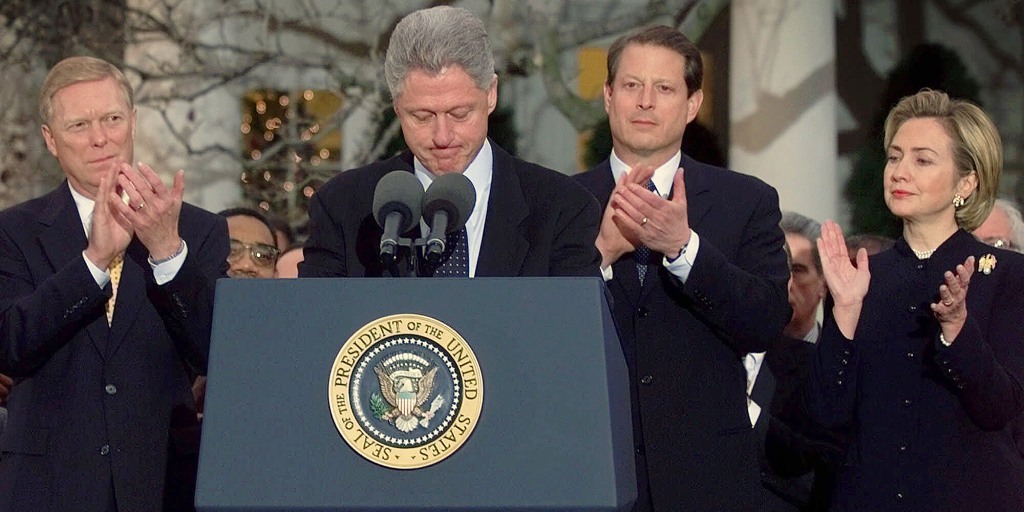
By shifting the focus from “did he lie?” to “is this a fair use of government resources?”, they successfully pivoted the conversation. In marketing, this is equivalent to a company under fire for high prices reframing the conversation to focus on the superior quality and longevity of their goods. By the time the Senate voted to acquit Clinton on both charges in February 1999, the brand had successfully positioned the impeachment as a distraction from the public’s priorities.
The Impact on Long-Term Brand Equity
The question of what Clinton was impeached for often gets buried under the weight of what happened next: his brand thrived. This outcome provides a fascinating look at the metrics of brand loyalty and the evolution of a legacy.
Approval Ratings as a Metric of Brand Loyalty
In the business world, brand loyalty is measured by repeat purchases and Net Promoter Scores (NPS). In politics, it is measured by approval ratings. Remarkably, during the height of the impeachment trial, Clinton’s job approval ratings hit their peak, reaching as high as 73%.
This phenomenon illustrates a crucial branding principle: stakeholders will forgive a brand for personal flaws if the brand continues to provide high value in their daily lives. The “peace and prosperity” of the 1990s acted as a massive buffer of brand equity. It was a “loyalty program” that paid off when the brand faced its greatest challenge. The public essentially decided that the “functional benefits” of the Clinton presidency outweighed the “emotional/ethical risks” presented by the impeachment charges.
The Aftermath: Post-Presidential Brand Strategy
Following his acquittal, the Clinton brand entered a phase of “Global Philanthropic Rebranding.” This is a common move for legacy brands looking to pivot away from a controversial past. By founding the Clinton Global Initiative, the brand moved from the “political sector” to the “impact sector.”
This shift allowed the brand to leverage its strengths—charisma, networking, and policy expertise—while minimizing the relevance of the impeachment history. It is a textbook example of “brand extension,” where a known entity moves into a new market to refresh its image and reach a different demographic of stakeholders.
Key Takeaways for Modern Brand Strategists
The lessons from the Clinton impeachment are more relevant today than ever, especially in an era of “cancel culture” and rapid-fire social media scrutiny. How a brand responds to a foundational threat determines whether it disappears or becomes a permanent fixture.
Authenticity in the Face of Controversy
While the charges involved perjury (a lack of truthfulness), the survival of the Clinton brand relied on a different kind of authenticity. The public perceived Clinton as a flawed human being who was exceptionally good at his job. Instead of trying to present a “perfect” image, the brand eventually leaned into its resilience.
For modern personal brands, the takeaway is that you don’t need to be perfect to be successful; you need to be consistent in the value you provide. Authenticity doesn’t mean never making a mistake; it means ensuring your mistakes do not compromise the core value you provide to your customers.

The Resilience of High-Performance Brands
Ultimately, Clinton was impeached for legal infractions that many perceived as personal failings, but he was acquitted in the court of public opinion because of his performance. In branding, performance is the ultimate defense.
A high-performance brand—whether it is a technology company, a luxury fashion house, or a world leader—builds up “reputational capital” during the good times. This capital is what allows them to survive the bad times. If a brand provides enough utility, inspiration, or financial benefit to its users, those users will often become its fiercest defenders when the brand is under fire.
In conclusion, “what Clinton was impeached for” is a question with two answers. Legally, it was for perjury and obstruction of justice. Strategically, however, it was a test of brand durability. By prioritizing policy performance over personal perfection and mastering the art of narrative framing, the Clinton brand provided a masterclass in crisis management that continues to influence how public figures and corporations navigate the complexities of reputation in the modern age.
aViewFromTheCave is a participant in the Amazon Services LLC Associates Program, an affiliate advertising program designed to provide a means for sites to earn advertising fees by advertising and linking to Amazon.com. Amazon, the Amazon logo, AmazonSupply, and the AmazonSupply logo are trademarks of Amazon.com, Inc. or its affiliates. As an Amazon Associate we earn affiliate commissions from qualifying purchases.