
The Yellowstone supervolcano is a name that evokes images of cataclysmic eruptions and widespread devastation. While the sheer scale of its potential power is undeniable, understanding what type of volcano it is requires delving into geological classifications and the unique processes that define these colossal volcanic systems. Contrary to simple cone-shaped volcanoes, Yellowstone’s nature is far more complex, rooted in a dynamic interaction between the Earth’s mantle and crust.
This exploration will not only address the geological classification of Yellowstone but also touch upon the implications of such a massive geological feature, drawing parallels to broader concepts of innovation, risk management, and the long-term planning often discussed within technology, brand strategy, and financial spheres. While the immediate subject is geology, the underlying principles of immense power, potential disruption, and the careful observation of complex systems resonate across diverse fields.

The Enigma of Yellowstone: More Than Just a Mountain
When we picture a volcano, many of us imagine a conical peak, perhaps with a crater at its summit, like Mount Vesuvius or Mount Fuji. This is the classic stratovolcano or composite volcano. However, the Yellowstone “volcano” doesn’t fit this mold. It’s not a single mountain but rather a vast caldera, a massive depression formed by the collapse of the ground after a tremendous eruption empties the underlying magma chamber. This caldera is the surface manifestation of a much larger and more potent geological system: a supervolcano.
Caldera Formation: A Monumental Collapse
The term “caldera” itself signifies a dramatic geological event. Imagine a balloon being inflated with water. As the water pressure builds, the balloon expands. Now, imagine a sudden, massive release of that water. The balloon’s structure, no longer supported, would collapse inwards. A caldera forms in a similar, albeit vastly more powerful, manner.
At the heart of Yellowstone lies a supermassive magma chamber located deep beneath the Earth’s surface. This chamber is not a confined space like the magma reservoir beneath a stratovolcano. Instead, it’s a vast, partially molten zone within the Earth’s crust, fueled by a mantle plume. When this magma chamber becomes sufficiently pressurized, it can lead to an eruption so immense that it expels a colossal volume of volcanic material, emptying the chamber. The overlying crust, now unsupported, then collapses into the void, creating the characteristic bowl-shaped depression we recognize as a caldera. The Yellowstone caldera is enormous, stretching approximately 55 by 72 kilometers (34 by 45 miles), a testament to the scale of its underlying plumbing system.
The Mantle Plume: The Engine of Yellowstone
The defining characteristic that elevates Yellowstone to “supervolcano” status is its connection to a mantle plume. A mantle plume is a column of abnormally hot rock that rises from deep within the Earth’s mantle. As this plume approaches the surface, it begins to melt the overlying crust, generating vast quantities of magma.
This mantle plume acts as a perpetual heat source, constantly feeding the Yellowstone magma chamber. The Earth’s crust, in this region, is relatively thin compared to other continental areas. This combination of a powerful heat source and thinner crust allows for the accumulation of enormous volumes of magma over geological timescales. The movement of the North American tectonic plate over this stationary mantle plume is what creates the series of volcanic features that have appeared across the western United States, with Yellowstone being the current hotspot. This dynamic is crucial to understanding the type of volcanic system at play – it’s not a plate boundary eruption, but a “hotspot” eruption, driven by internal Earth processes.
Supervolcanoes: A Class Apart
The term “supervolcano” is not an official geological classification in the same way that “stratovolcano” or “shield volcano” is. Instead, it’s a descriptor for volcanoes capable of producing eruptions of an extraordinary magnitude. Geologists often use the Volcanic Explosivity Index (VEI) to categorize eruptions, with VEI 8 being the highest and reserved for events that eject more than 1,000 cubic kilometers of material. Yellowstone has experienced at least three VEI 8 eruptions in its history, approximately 2.1 million, 1.3 million, and 640,000 years ago.
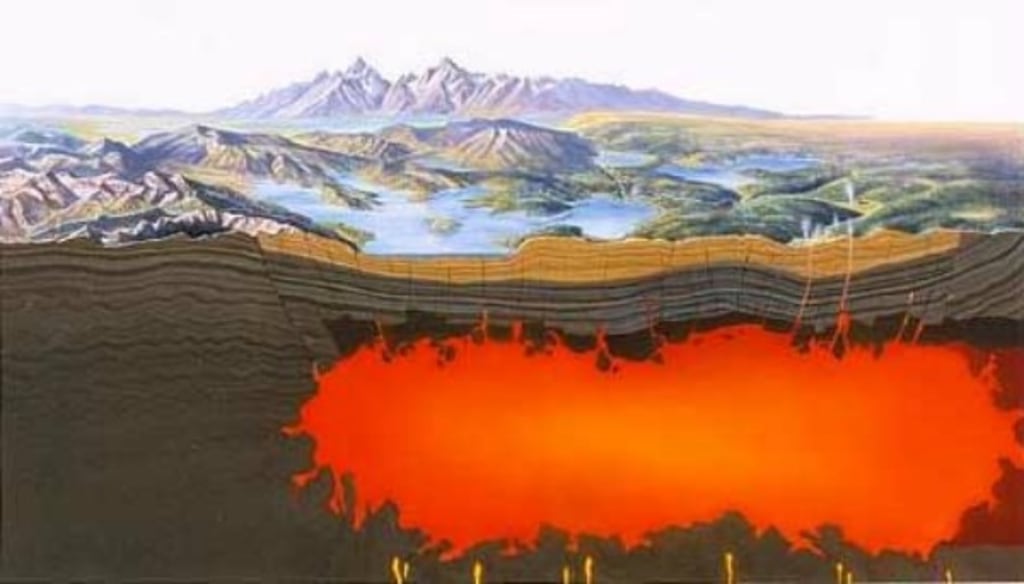
Understanding the Scale of VEI 8 Eruptions
The implications of a VEI 8 eruption are staggering. These are not localized events. They inject vast quantities of ash and gases high into the atmosphere, capable of circling the globe. This atmospheric debris can block sunlight, leading to a significant drop in global temperatures – a phenomenon known as a “volcanic winter.” The ashfall itself can cover continents, rendering vast areas uninhabitable for extended periods.
Consider the concept of disruption and systemic risk. In the tech world, a major software bug or a widespread cyberattack can bring down critical infrastructure, impacting millions. In brand strategy, a severe reputation crisis can erode years of goodwill and trust instantaneously. In personal finance, a sudden economic collapse can decimate investments. A Yellowstone supereruption represents a geological equivalent of these catastrophic disruptions, on a planetary scale. The sheer scale of potential impact necessitates a level of preparedness and understanding that transcends typical risk assessment.
The Long-Term Cycles of Activity
While the specter of a supereruption looms large, it’s crucial to understand that Yellowstone is a dormant supervolcano, not an active one in the traditional sense of frequent, large-scale eruptions. Its activity is characterized by long periods of relative quiet punctuated by these colossal events. The current manifestations of Yellowstone’s volcanic activity are far more benign: geysers, hot springs, fumaroles, and smaller hydrothermal explosions. These are all indicators of the heat and magma still present beneath the surface, but they do not signal an imminent supereruption.
This concept of long-term cycles and periods of dormancy is also relevant in other fields. In technology, innovation often follows cycles of rapid advancement followed by periods of refinement and consolidation. Brand building is a long-term endeavor, requiring consistent effort and strategic planning over years, with occasional strategic pivots. Financial markets also exhibit cyclical behavior, with boom and bust periods. Understanding these long-term rhythms is key to effective strategy and management.
Yellowstone’s Unique Geological Context: Hotspot Volcanism
Yellowstone’s classification as a supervolcano is intrinsically linked to its geological setting as a continental hotspot. Unlike volcanoes found along tectonic plate boundaries (like the Pacific Ring of Fire), hotspots are thought to be caused by plumes of hot material rising from deep within the Earth’s mantle. As a tectonic plate drifts over this stationary hotspot, a chain of volcanoes can form. The oldest, extinct volcanoes are found at one end of the chain, with the youngest and most active located above the hotspot.
The Track of the Yellowstone Hotspot
Geologists have traced the path of the Yellowstone hotspot across the North American continent. This “track” is evident in a series of calderas and volcanic fields that stretch southwest from the present-day Yellowstone caldera, dating back millions of years. This provides compelling evidence for the persistent nature of the mantle plume and its influence on the overlying crust.

Implications for Geological Monitoring and Prediction
The understanding of Yellowstone’s type of volcanism – hotspot-driven caldera – informs the extensive geological monitoring efforts in place. Scientists track ground deformation, seismic activity, and gas emissions to detect any subtle changes that might indicate increased magma movement or pressure build-up. This is akin to how technology companies monitor network traffic for anomalies or financial institutions track market indicators for potential downturns. The goal is not necessarily to predict the precise timing of a catastrophic event, which remains incredibly difficult, but to understand the underlying processes and identify warning signs.
The sheer power and scale of the Yellowstone supervolcano make it a subject of intense scientific study. Its classification as a caldera-forming hotspot volcano, capable of VEI 8 eruptions, underscores its unique geological significance. While the likelihood of a supereruption in our lifetime is extremely low, understanding its nature is crucial for appreciating the immense forces at play beneath our planet’s surface and for contextualizing the long-term, powerful processes that shape our world.
aViewFromTheCave is a participant in the Amazon Services LLC Associates Program, an affiliate advertising program designed to provide a means for sites to earn advertising fees by advertising and linking to Amazon.com. Amazon, the Amazon logo, AmazonSupply, and the AmazonSupply logo are trademarks of Amazon.com, Inc. or its affiliates. As an Amazon Associate we earn affiliate commissions from qualifying purchases.