
Navigating the landscape of retirement savings can feel like deciphering a complex financial code. Among the myriad options available, the Individual Retirement Arrangement (IRA) stands out as a fundamental tool for securing your financial future. It’s a tax-advantaged account designed specifically to help individuals save for retirement, offering benefits that can significantly boost your long-term wealth. But simply knowing you should open an IRA is only the first step; the critical question that follows is: what type of IRA is right for you?
This decision isn’t one-size-fits-all. It depends heavily on your current financial situation, your income level, your tax bracket today, and what you anticipate your tax bracket will be in retirement. Understanding the nuances of each IRA type, from the traditional workhorses to specialized options for the self-employed, is paramount to making an informed choice that aligns with your unique financial goals. This comprehensive guide will demystify the various IRA options, helping you confidently determine the best path forward for your retirement savings journey.

Understanding the Fundamentals of an IRA
Before diving into the specific types, it’s crucial to grasp the core concept of an IRA and why it’s such a powerful retirement savings vehicle.
What is an IRA?
An IRA, or Individual Retirement Arrangement (often referred to as an Individual Retirement Account), is a personal savings plan that provides tax benefits for retirement savings. Unlike employer-sponsored plans like a 401(k), an IRA is something you open and manage independently, though some employers may facilitate contributions through payroll deductions. The primary characteristic distinguishing IRAs is their tax-advantaged status, meaning your investments grow with tax benefits, either by delaying taxes until retirement or by making withdrawals tax-free. This tax advantage, combined with the power of compounding interest, makes IRAs indispensable for long-term wealth building.
Why Open an IRA?
The allure of an IRA lies in its dual benefits: tax advantages and the potential for substantial growth over time. Firstly, the tax benefits can either reduce your taxable income in the present (Traditional IRA) or allow your money to grow and be withdrawn completely tax-free in retirement (Roth IRA). This can translate into thousands, if not tens of thousands, of dollars saved in taxes over your lifetime. Secondly, money invested in an IRA grows exponentially thanks to compounding. Even modest regular contributions, when given decades to grow, can accumulate into a significant nest egg, far surpassing what you could save in a standard taxable brokerage account due to the tax efficiency. An IRA provides a dedicated, structured way to save for retirement, encouraging financial discipline and securing your future.
Contribution Limits and Eligibility
The IRS sets annual limits on how much you can contribute to an IRA. For 2024, the maximum contribution is $7,000, with an additional “catch-up” contribution of $1,000 for those aged 50 and over, bringing the total to $8,000. These limits apply across all your IRAs (e.g., if you contribute to both a Traditional and a Roth IRA, your total combined contributions cannot exceed the annual limit). To be eligible to contribute to an IRA, you must have “earned income,” such as wages, salaries, commissions, tips, or net earnings from self-employment. There are specific income phase-outs for deducting Traditional IRA contributions if you also have an employer-sponsored retirement plan, and direct contributions to a Roth IRA are subject to income limitations as well. Understanding these limits and eligibility requirements is essential to ensure compliance and maximize your savings.
Delving into the Main IRA Types: Traditional vs. Roth
The core decision for most individuals comes down to choosing between a Traditional IRA and a Roth IRA. While both are powerful savings vehicles, their tax structures are fundamentally different, catering to distinct financial situations and future expectations.
Traditional IRA: The Pre-Tax Advantage
A Traditional IRA is often described as the “tax now or tax later” option. Contributions to a Traditional IRA may be tax-deductible in the year they are made, effectively reducing your current taxable income. This immediate tax break can be particularly appealing if you are currently in a high tax bracket. The money you contribute, along with any investment earnings, grows tax-deferred. This means you don’t pay taxes on the growth year over year. Instead, both your deductible contributions and all earnings are taxed only when you withdraw them in retirement.
Key features of a Traditional IRA:
-
Tax-deductible contributions: May lower your current taxable income.
-
Tax-deferred growth: No taxes until withdrawal.
-
Taxable withdrawals in retirement: Distributions are taxed as ordinary income.
-
Required Minimum Distributions (RMDs): You must begin taking withdrawals once you reach age 73 (for those born 1950 or later), regardless of whether you need the money.
A Traditional IRA is generally a good choice if you expect to be in a lower tax bracket in retirement than you are today, as you get the tax deduction now when it’s most valuable, and pay taxes later when your income (and likely your tax rate) is lower.
Roth IRA: The Post-Tax Powerhouse
The Roth IRA operates on an opposite tax principle: you contribute money after taxes have already been paid. This means your contributions are not tax-deductible, and therefore do not lower your current taxable income. However, the incredible benefit of a Roth IRA is that all qualified withdrawals in retirement—including both your original contributions and all the investment earnings—are completely tax-free. This “tax-free growth and withdrawals” feature is what makes the Roth IRA an incredibly powerful tool, especially if you anticipate being in a higher tax bracket during retirement.
Key features of a Roth IRA:
-
Non-deductible contributions: No immediate tax break.
-
Tax-free growth and withdrawals: Qualified distributions are completely tax-free in retirement.
-
No RMDs for original owner: You are not forced to take withdrawals at a certain age, allowing your money to continue growing. This also offers more flexibility for estate planning.
-
Income limitations: Eligibility to contribute directly to a Roth IRA is subject to modified adjusted gross income (MAGI) limits. For 2024, for single filers, the phase-out range is $146,000 – $161,000; for married filing jointly, it’s $230,000 – $240,000. If your income exceeds these limits, you might still be able to contribute via the “backdoor Roth” strategy.
A Roth IRA is ideal for those who expect their income (and thus their tax bracket) to be higher in retirement, or for young professionals just starting their careers who are currently in a lower tax bracket. It’s also excellent for individuals who value the flexibility of tax-free withdrawals and the absence of RMDs.
Key Differences at a Glance
| Feature | Traditional IRA | Roth IRA |
| :——————— | :———————————————– | :——————————————– |
| Contributions | May be tax-deductible | Not tax-deductible |
| Growth | Tax-deferred | Tax-free |
| Withdrawals in Retirement | Taxable as ordinary income | Tax-free (if qualified) |
| Required Minimum Distributions (RMDs) | Start at age 73 | No RMDs for original owner |
| Income Limits for Contributions | No income limit, but deductibility has phase-outs if covered by a workplace plan | Yes, MAGI limits apply to direct contributions |
| Withdrawal of Contributions | Penalty-free after 59½, or for specific exceptions | Tax and penalty-free anytime |
Exploring Specialized IRA Options
While Traditional and Roth IRAs are the most common, other specialized IRA types cater to specific needs, particularly for business owners and the self-employed.
SEP IRA: For the Self-Employed and Small Business Owners
A Simplified Employee Pension (SEP) IRA is a retirement plan designed for self-employed individuals and small business owners. It allows employers (which, for a self-employed person, is themselves) to contribute to a retirement account for themselves and their eligible employees. SEP IRAs are relatively simple to set up and administer compared to more complex plans like 401(k)s.
Key features of a SEP IRA:
-
Higher contribution limits: You can contribute a much higher amount than a Traditional or Roth IRA. For 2024, the limit is 25% of your net self-employment earnings (or employee’s compensation) up to $69,000.
-
Employer-funded: Only the employer contributes to a SEP IRA. Employees cannot contribute their own money.
-
Tax-deductible contributions: Contributions are tax-deductible for the employer, reducing business income.
-
Tax-deferred growth: Similar to a Traditional IRA, withdrawals in retirement are taxed.
A SEP IRA is an excellent choice for solo entrepreneurs or small business owners looking for a straightforward, high-contribution retirement plan, especially if they don’t want the administrative burden of a 401(k).
SIMPLE IRA: A Simpler Solution for Small Businesses
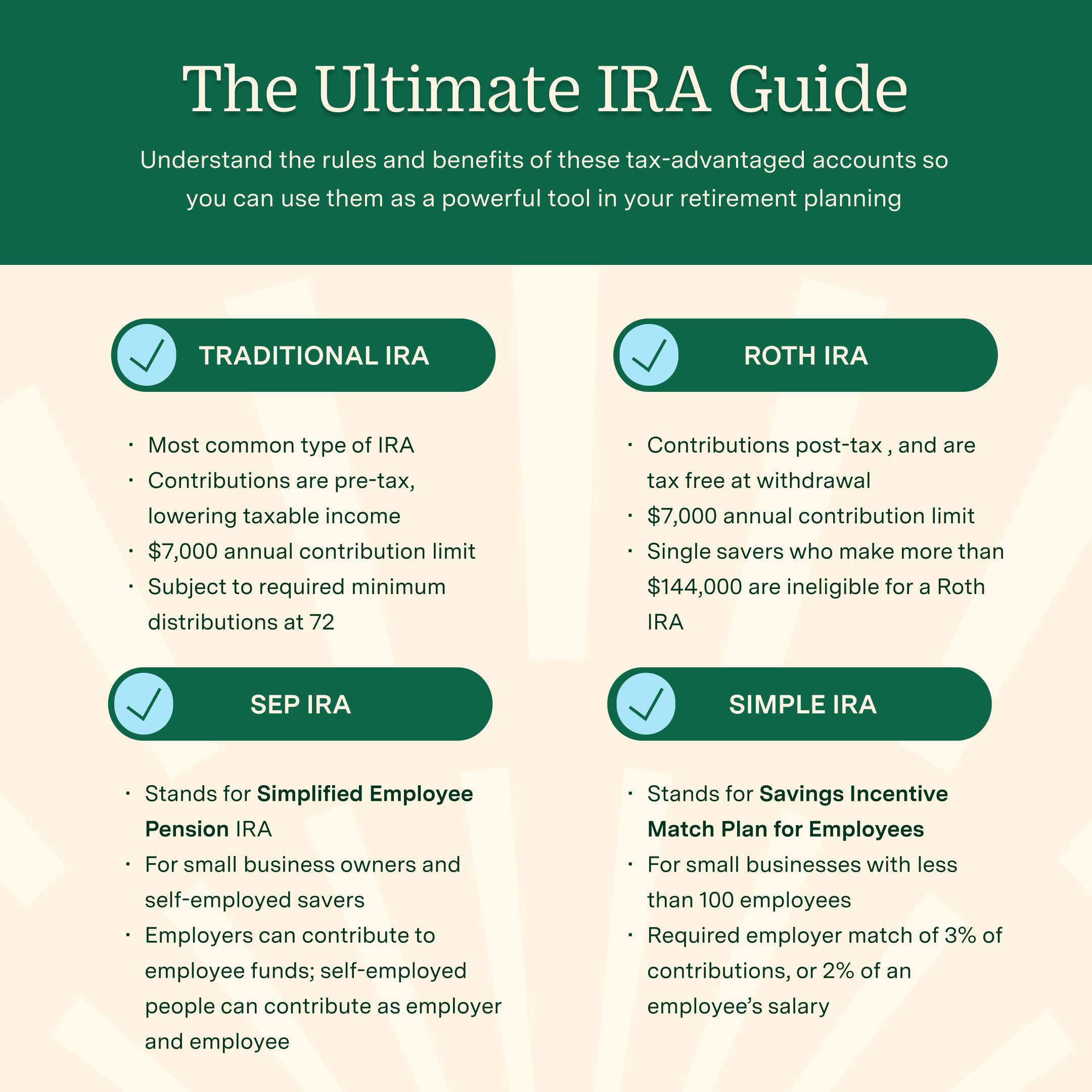
A Savings Incentive Match Plan for Employees (SIMPLE) IRA is another retirement plan option for small businesses (typically with 100 or fewer employees) that is less complex than a 401(k) but offers more flexibility than a SEP IRA. Both employers and employees can contribute to a SIMPLE IRA.
Key features of a SIMPLE IRA:
-
Both employer and employee contributions: Employees can contribute via salary deferral, and employers must make either a matching contribution or a non-elective contribution.
-
Lower contribution limits than SEP: Employee deferral limit for 2024 is $16,000, plus a catch-up contribution of $3,500 for those 50 and over. Employer contributions are additional.
-
Tax-deductible contributions: Employee contributions reduce their taxable income, and employer contributions are tax-deductible for the business.
-
Tax-deferred growth: Withdrawals in retirement are taxed.
SIMPLE IRAs are a good choice for small businesses looking for a retirement plan that allows both employer and employee contributions without the complexity and cost of a 401(k).
Spousal IRA: Maximizing Retirement for Non-Working Spouses
The Spousal IRA isn’t a separate type of IRA but rather a special provision that allows a working spouse to contribute to an IRA on behalf of a non-working or low-earning spouse. This ensures that both spouses can save for retirement, even if one doesn’t have earned income. The contribution can be made to either a Traditional Spousal IRA or a Roth Spousal IRA, subject to the usual rules and income limits of each.
Key features of a Spousal IRA:
-
Allows non-working spouse to save: Crucial for couples where one spouse stays home or has very low income.
-
Combined contribution limit: The working spouse’s income must be at least equal to the combined contributions made to both their IRA and the Spousal IRA.
-
Tax benefits: Follows the rules of the Traditional or Roth IRA it is opened as.
This option is invaluable for ensuring financial security for both partners in a marriage, enabling couples to double their retirement savings potential.
Making the Right Choice: Factors to Consider
With a clearer understanding of the different IRA types, the next step is to evaluate which one best fits your personal financial strategy. This involves considering several key factors.
Your Current Income and Tax Bracket
Your current income level and the corresponding tax bracket are significant determinants. If you are currently in a high tax bracket, a Traditional IRA’s tax-deductible contributions can provide an immediate and substantial tax saving, reducing your current taxable income. Conversely, if you are in a lower tax bracket (perhaps at the beginning of your career), the immediate deduction from a Traditional IRA might not be as impactful. In this scenario, a Roth IRA, where you forgo the immediate deduction for tax-free withdrawals in a potentially higher future tax bracket, could be more advantageous.
Your Expected Future Income and Tax Bracket
This is perhaps the most crucial “crystal ball” factor. Do you anticipate your income (and thus your tax bracket) to be higher or lower in retirement than it is today?
-
If you expect a higher tax bracket in retirement: A Roth IRA is likely your best bet. Paying taxes now at a lower rate means all future growth and withdrawals are tax-free when you’re potentially earning more and subject to higher rates.
-
If you expect a lower tax bracket in retirement: A Traditional IRA makes more sense. You get the tax deduction today when your rate is high, and you pay taxes in retirement when your rate is (hopefully) lower.
For many, especially young professionals, the expectation is usually that income will grow over their career, and potentially maintain a good level in retirement. In such cases, the Roth IRA often holds a strong appeal.
Access to Employer-Sponsored Plans (401k, etc.)
Having access to a 401(k) or similar workplace retirement plan can affect the deductibility of your Traditional IRA contributions. If you (or your spouse, if married filing jointly) are covered by a workplace retirement plan, your ability to deduct Traditional IRA contributions begins to phase out at certain income levels. There are no such income limits on contributing to a Traditional IRA, but the tax benefits may be reduced. This is not an issue for Roth IRAs (though direct contributions have their own income limits) or for SEP/SIMPLE IRAs. If you are covered by a 401(k), contributing enough to get the employer match is usually the first priority, then consider an IRA, and finally max out your 401(k).
Withdrawal Flexibility and Estate Planning
Roth IRAs offer distinct advantages in terms of withdrawal flexibility. Since contributions are made with after-tax money, you can withdraw your contributions (not earnings) at any time, tax and penalty-free, regardless of age. This provides a valuable emergency fund option, though it’s generally not advisable to dip into retirement savings unless absolutely necessary. Furthermore, Roth IRAs have no RMDs for the original owner, allowing the money to grow tax-free indefinitely and providing greater control over when distributions are taken. This also makes them excellent tools for estate planning, as beneficiaries can inherit the account and potentially continue tax-free growth for a period.
The Power of Compounding and Time Horizon
Regardless of which IRA type you choose, the most potent factor for wealth accumulation is time and the magic of compounding interest. The earlier you start contributing, the more time your investments have to grow, and the more significant the impact of even small, consistent contributions will be. Don’t delay opening an IRA because you’re unsure of the “perfect” type. Starting now, even with a modest amount, is far more important than waiting for ideal conditions. You can always adjust your strategy later, and it’s even possible to convert a Traditional IRA to a Roth IRA (a “Roth conversion”) if your circumstances change.
Opening and Managing Your IRA
Once you’ve decided on the type of IRA, the process of opening and managing it is relatively straightforward.
Where to Open an IRA?
You can open an IRA at various financial institutions:
-
Brokerage firms: Companies like Fidelity, Schwab, Vanguard, E*TRADE, or TD Ameritrade offer a wide range of investment options (stocks, bonds, mutual funds, ETFs) and often have low fees. They are typically the best choice for those who want control over their investments.
-
Banks: While some banks offer IRAs, they often primarily offer CDs or savings accounts within the IRA wrapper, which may not provide the growth potential of market-based investments.
-
Robo-advisors: Services like Betterment or Wealthfront automate investment management based on your risk tolerance and goals. They’re a good option for those who prefer a hands-off approach.
Investment Choices within an IRA
An IRA is merely the “wrapper” or account type; what you put inside it determines its growth potential. You can invest in a diverse array of assets, including:
-
Stocks: Individual company shares.
-
Bonds: Debt securities that pay interest.
-
Mutual Funds: Professionally managed portfolios of stocks, bonds, or other investments.
-
Exchange-Traded Funds (ETFs): Similar to mutual funds but trade like stocks on an exchange.
-
Certificates of Deposit (CDs): Low-risk, fixed-interest savings options.
Diversifying your investments within your IRA is crucial to manage risk and optimize returns over the long term.
Regular Review and Rebalancing
Your financial situation, goals, and market conditions will evolve. It’s essential to regularly review your IRA investments (at least annually) and rebalance your portfolio to ensure it aligns with your current risk tolerance and objectives. This might involve adjusting your asset allocation, changing fund selections, or even considering a Roth conversion if your tax situation shifts dramatically.

Conclusion
Choosing the right type of IRA is a pivotal step in crafting a robust retirement strategy. Whether you opt for the immediate tax benefits of a Traditional IRA, the long-term tax-free growth of a Roth IRA, or the specialized advantages of a SEP or SIMPLE IRA, the critical takeaway is to start saving as early as possible. Each IRA type offers unique benefits tailored to different financial scenarios. By carefully considering your current and future income, your tax bracket, and your overall financial goals, you can make an informed decision that empowers your retirement savings. Remember, while this guide provides valuable insights, consulting with a qualified financial advisor can offer personalized guidance tailored to your specific circumstances, ensuring your chosen IRA path is the optimal one for your financial future.
aViewFromTheCave is a participant in the Amazon Services LLC Associates Program, an affiliate advertising program designed to provide a means for sites to earn advertising fees by advertising and linking to Amazon.com. Amazon, the Amazon logo, AmazonSupply, and the AmazonSupply logo are trademarks of Amazon.com, Inc. or its affiliates. As an Amazon Associate we earn affiliate commissions from qualifying purchases.