
For the modern investor, the question “What time is the market closed today?” is often the first step in a complex daily ritual of financial management. While it seems like a simple inquiry, the answer is layered within the complexities of global time zones, exchange-specific regulations, and the evolving nature of electronic trading. Understanding the rhythm of the financial markets is not merely about knowing when to stop trading; it is about understanding liquidity, volatility, and the strategic windows that can make or break an investment portfolio.
In this comprehensive guide, we will explore the standard operating hours of the world’s major exchanges, the nuances of extended-hours trading, and how the timing of the “closing bell” impacts your personal finance strategy.
1. The Pulse of Wall Street: Standard Operating Hours in the United States
The U.S. stock market is the largest and most influential in the world, anchored by the New York Stock Exchange (NYSE) and the NASDAQ. For most retail investors, the “market hours” refer to the period when these two giants are open for regular business.
The Standard Session: 9:30 AM to 4:00 PM ET
The regular trading session for the U.S. stock market begins at 9:30 AM Eastern Time and concludes at 4:00 PM Eastern Time. These hours have remained remarkably consistent over the decades, providing a fixed window where liquidity is at its highest and bid-ask spreads are typically at their narrowest. When you ask if the market is closed “today,” you are usually asking if you are within or outside of this 6.5-hour window.
The Significance of the Closing Bell
The 4:00 PM ET close is more than just a stopping point; it is a critical data point for the entire financial ecosystem. The “closing price” of a stock is used to calculate mutual fund Net Asset Values (NAVs), determine the value of derivatives contracts, and serve as the benchmark for historical data analysis. The final minutes of the trading day, often referred to as the “Closing Cross” on the NASDAQ or the “Closing Auction” on the NYSE, involve a sophisticated matching process that aggregates buy and sell orders to find a single price that clears the most volume. For the disciplined investor, the close represents the final consensus on a security’s value for that day.
Why the 4:00 PM Deadline Matters for Orders
Most standard brokerage orders, such as “Market on Close” (MOC) or “Limit on Close” (LOC) orders, must be submitted before specific cut-off times (often 3:50 PM or 3:55 PM ET, depending on the exchange and broker). If you miss these windows, your order may not be executed at the official closing price, potentially exposing you to the increased volatility of the after-hours market.
2. Navigating the Global Clock: International Markets and Time Zones
Investing in the 21st century is a global endeavor. If the U.S. markets are closed, it is almost certain that an exchange somewhere else in the world is either open or preparing to open. To manage a diversified portfolio effectively, one must look beyond the Eastern Time Zone.
European Markets: The London and Euronext Connection
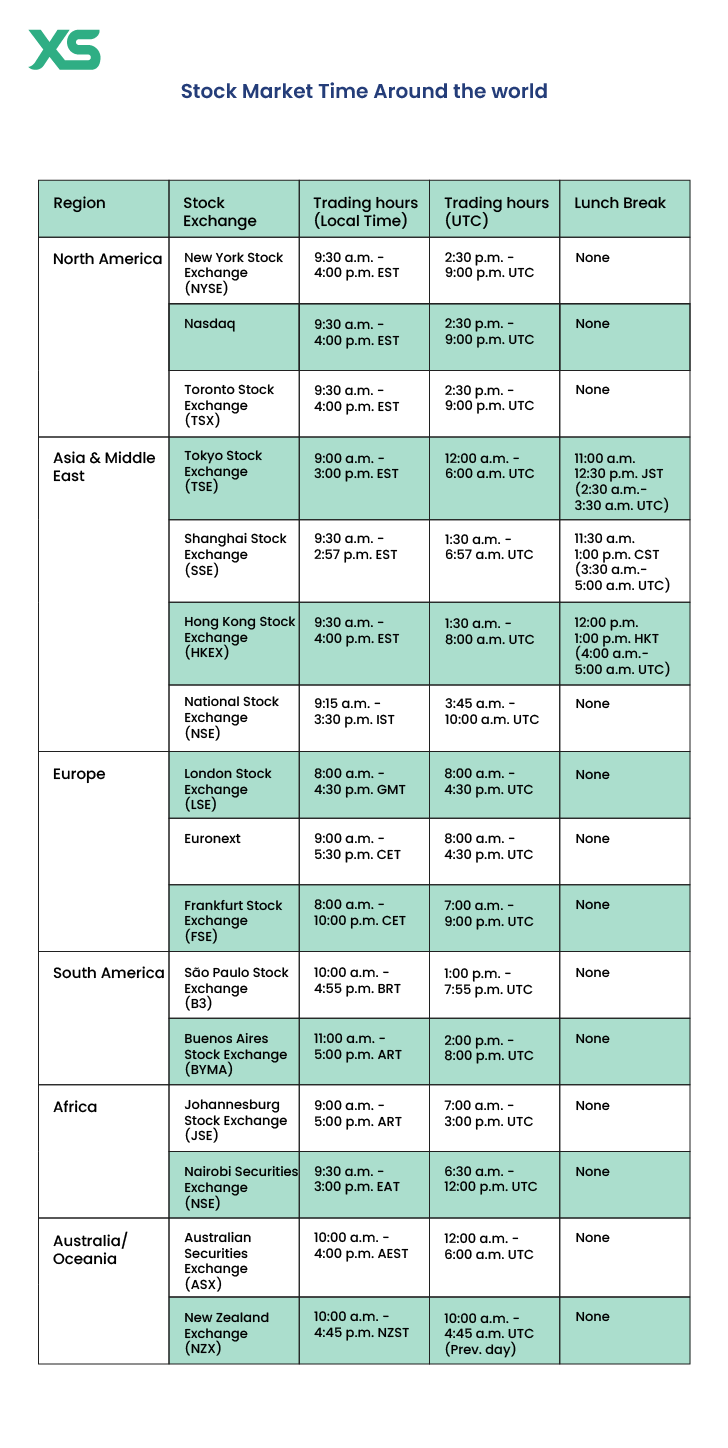
The London Stock Exchange (LSE) typically operates from 8:00 AM to 4:30 PM GMT. For investors based in North America, this means the UK markets open in the early hours of the morning (3:00 AM ET). A crucial period for volatility occurs between 9:30 AM ET and 11:30 AM ET, when both the U.S. and European markets are open simultaneously. This “overlap” often sees the highest trading volume of the day as global institutions rebalance their positions across both continents.
The Asian Powerhouses: Tokyo, Hong Kong, and Shanghai
The Asian markets operate while most of the Western world is asleep. The Tokyo Stock Exchange (TSE) generally runs from 9:00 AM to 3:00 PM JST, with a notable lunch break between 11:30 AM and 12:30 PM. Similarly, the Hong Kong Stock Exchange and the Shanghai Stock Exchange also observe midday breaks. For a “Money” focused professional, tracking these markets is essential, as the closing performance of the Nikkei or the Hang Seng often sets the tone for the U.S. market open several hours later.
Managing the “24-Hour” Cycle in Personal Finance
While equity markets have specific closing times, other asset classes do not. The Foreign Exchange (Forex) market and the Cryptocurrency market operate 24 hours a day, five to seven days a week. However, the equity market’s closing time still dictates the flow of capital. When the stock market closes at 4:00 PM ET, liquidity in other areas may shift as traders move their focus from stocks to alternative assets.
3. Beyond the Regular Session: After-Hours and Pre-Market Trading
The question “What time is the market closed?” becomes more nuanced when you consider Extended Hours Trading (EHT). Just because the physical floor of the NYSE is quiet doesn’t mean the digital servers have stopped processing trades.
How Extended Hours Work
Most major brokerages now offer access to pre-market and after-hours sessions. Pre-market trading in the U.S. can start as early as 4:00 AM ET, though most activity picks up around 8:00 AM ET. After-hours trading begins immediately at 4:00 PM ET and can run until 8:00 PM ET. These sessions are conducted via Electronic Communication Networks (ECNs), which match buyers and sellers directly without a central exchange floor.
The Risks of Trading After the Bell
While trading after the market is “closed” provides flexibility, it comes with significant risks that any prudent investor must consider:
- Lower Liquidity: There are far fewer participants in the after-hours market. This makes it harder to execute large trades without significantly moving the price.
- Wide Spreads: Because there is less competition, the difference between the bid and the ask price is much wider, meaning you often pay more to buy and receive less when you sell.
- High Volatility: Major news events, such as quarterly earnings reports or geopolitical shifts, often happen after the 4:00 PM close. This can cause massive price swings on very low volume, which may not accurately reflect where the stock will trade when the market re-opens the next morning.
Strategic Use of Extended Hours
For the sophisticated “Money” niche enthusiast, after-hours trading is best used for reacting to immediate news or hedging a position before a major overnight event. However, for the average long-term investor, the “closed” sign at 4:00 PM should generally be respected to avoid the pitfalls of a fragmented market.
4. Market Holidays and Early Closures: The Trading Calendar
If you find yourself asking why the market isn’t moving on a random Monday, the answer is likely a scheduled holiday. The U.S. stock market follows a specific calendar that includes several full-day closures and periodic early closures.
Federal Holidays and Exchange Observances
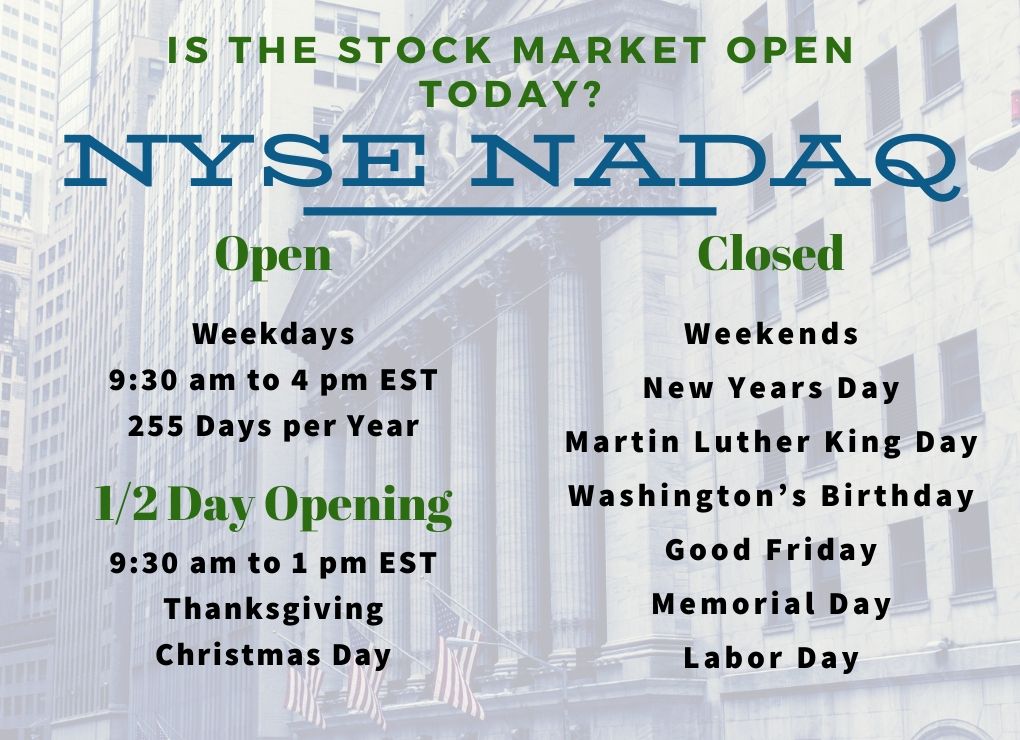
The NYSE and NASDAQ are closed on major U.S. federal holidays, including New Year’s Day, Martin Luther King Jr. Day, Presidents’ Day, Good Friday, Memorial Day, Juneteenth, Independence Day, Labor Day, Thanksgiving, and Christmas. If a holiday falls on a weekend, the market typically closes on the Friday before or the Monday after. Knowing this calendar is vital for cash flow management, as settlement cycles (the time it takes for money to move from a sale to your bank account) are delayed by market holidays.
The “Half-Day” Phenomenon
There are specific days when the market closes early, usually at 1:00 PM ET. This typically occurs on the day after Thanksgiving (Black Friday) and sometimes on Christmas Eve or July 3rd, depending on how the calendar falls. Trading volume on these days is notoriously thin, and many institutional “market makers” take the day off. For the retail investor, these sessions are often better spent observing rather than actively trading, as the lack of volume can lead to erratic price movements.
Global Variations in Holidays
It is also important to remember that different countries have different holidays. While the U.S. market might be open, the Canadian market (TSX) might be closed for Victoria Day, or the LSE might be closed for a Bank Holiday. This discrepancy can create “stale pricing” in international ETFs, where the underlying stocks aren’t trading, but the fund itself is, leading to potential tracking errors.
5. Strategic Implications: Why the Closing Time Dictates Market Behavior
The closing of the market is not just an end; it is a catalyst. Professional traders and institutional investors structure their entire day around the final 60 minutes of trade, often called the “Power Hour.”
The “Power Hour” and Institutional Rebalancing
From 3:00 PM to 4:00 PM ET, trading volume tends to spike. This is the window where institutional fund managers—who handle trillions of dollars in pension funds and ETFs—must execute their trades to ensure they track their benchmarks as closely as possible. If you are a retail investor looking for the most “fair” price, executing during this high-volume window can be beneficial, as the depth of the market is at its peak.
Using the “Close” to Inform Tomorrow’s Strategy
In personal finance and active investing, the “daily candle” (the price action from open to close) tells a story. A market that closes at its daily highs suggests strong “buying conviction,” whereas a market that “fades” into the close suggests that investors are hesitant to hold positions overnight. By analyzing how the market closes “today,” you can gain valuable insights into the likely sentiment for the market open “tomorrow.”
Conclusion: The Disciplined Approach to Timing
“What time is the market closed today?” is a question that anchors the financial world. Whether you are a long-term investor focused on retirement or a more active participant in business finance, the closing bell represents a moment of clarity in a chaotic global economy. By understanding the standard hours, the international overlaps, the risks of extended trading, and the holiday schedule, you position yourself to make more informed, deliberate, and ultimately more profitable financial decisions. Respect the clock, and the clock will help you respect your capital.
aViewFromTheCave is a participant in the Amazon Services LLC Associates Program, an affiliate advertising program designed to provide a means for sites to earn advertising fees by advertising and linking to Amazon.com. Amazon, the Amazon logo, AmazonSupply, and the AmazonSupply logo are trademarks of Amazon.com, Inc. or its affiliates. As an Amazon Associate we earn affiliate commissions from qualifying purchases.