
For investors and financial professionals, the closing bell is more than just a signal to stop trading; it is the pulse of the global economy. As the end of the year approaches, the holiday season introduces a unique set of variables to the financial markets. One of the most common questions asked by retail traders and portfolio managers alike is: “What time does the stock market close on Christmas Eve?”
Understanding the specific operating hours of the New York Stock Exchange (NYSE) and the Nasdaq during the holiday season is critical for effective liquidity management, tax planning, and risk mitigation. While the festive season often brings a “Santa Claus Rally,” it also brings shortened sessions that can catch the unprepared investor off guard.

The Logistics of Christmas Eve Trading
When Christmas Eve falls on a weekday, the major U.S. stock exchanges—the NYSE and the Nasdaq—typically observe an early closing time. This schedule is designed to allow market participants, from floor traders to clearinghouse staff, to begin their holiday celebrations while still providing a window for year-end transactions.
Primary Exchange Hours: NYSE and Nasdaq
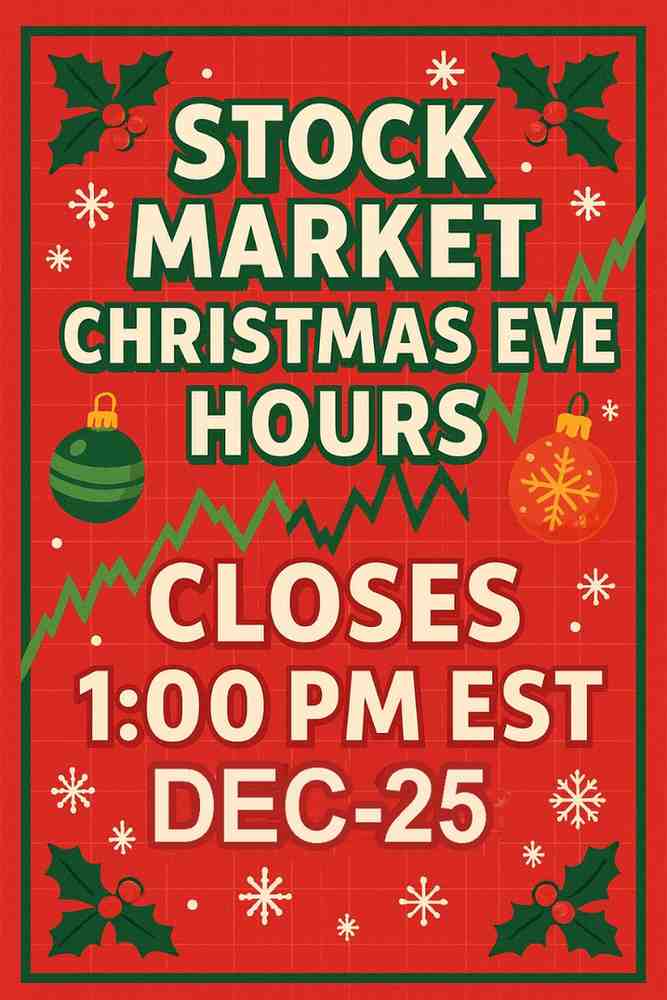
Traditionally, when December 24th falls on a Monday through Friday, the stock market opens at its usual time of 9:30 AM Eastern Time (ET) but concludes its session at 1:00 PM ET. This three-and-a-half-hour window is significantly shorter than the standard six-and-a-half-hour trading day.
It is important to note that if Christmas Eve falls on a Saturday, the markets do not observe a holiday on the preceding Friday. Conversely, if Christmas Day falls on a Saturday, the markets are closed on Friday, December 24th, in observance of the holiday. Understanding these nuances is essential for anyone managing a margin account or a portfolio with expiring options.
The Bond Market Schedule
The bond market operates under different recommendations, primarily set by the Securities Industry and Financial Markets Association (SIFMA). While the stock market closes at 1:00 PM ET, the bond market typically closes slightly later, at 2:00 PM ET, on Christmas Eve.
For fixed-income investors, this extra hour can be vital for adjusting positions in Treasury notes or corporate bonds. However, because bond trading is often less centralized than equity trading, liquidity can dry up even earlier than the official closing time, leading to wider bid-ask spreads.
International Markets and Global Synchronization
Investing is a global endeavor, and while you may be focused on the U.S. markets, the rest of the world has its own schedule. The London Stock Exchange (LSE) also traditionally closes early on Christmas Eve (usually around 12:30 PM local time). However, many Asian markets, such as those in Tokyo or Shanghai, do not observe Christmas as a public holiday and may operate under normal business hours. This discrepancy in global trading hours can create arbitrage opportunities or unexpected volatility in ADRs (American Depositary Receipts) and multinational corporations.
Why Holiday Hours Matter for Retail Investors
To the casual observer, a few lost hours of trading might seem inconsequential. However, in the world of high-frequency trading and institutional rebalancing, these shortened sessions have a profound impact on market mechanics.
Liquidity and “Thin” Markets
The most significant factor during Christmas Eve trading is the reduction in liquidity. Many institutional desks—the large banks and hedge funds that provide the majority of market volume—operate with “skeleton crews” or are closed entirely for the day. When fewer participants are buying and selling, the market becomes “thin.”
In a thin market, even a relatively small trade can cause a disproportionate move in a stock’s price. For the retail investor, this means that market orders can be dangerous. Slippage—the difference between the expected price of a trade and the price at which it is actually executed—is much more common during shortened holiday sessions.
Increased Volatility Risks
While we often associate volatility with negative news, holiday volatility can be erratic. Without the stabilizing force of high-volume institutional trading, stock prices may fluctuate based on minor news cycles or the activities of a few aggressive traders. Professional investors often advise against making major portfolio shifts during the 1:00 PM Christmas Eve close unless absolutely necessary, as the cost of execution often outweighs the benefits of the move.
The Psychological Aspect of Holiday Trading
The “Santa Claus Rally” is a well-documented phenomenon where stock prices tend to increase during the last five trading days of December and the first two days of January. This is often attributed to holiday optimism, institutional window dressing, and the absence of “perma-bears” who may have already closed their books for the year. However, relying on seasonal sentiment is a risky strategy; the shortened hours on Christmas Eve serve as a reminder that the market’s behavior is dictated more by mechanics and volume than by festive cheer.
Strategic Trading During the Final Days of December
As the year winds down, the focus of the “Money” niche shifts from aggressive growth to defensive positioning and tax optimization. The Christmas Eve session is often the final opportunity to execute trades before the year-end rush.
Tax-Loss Harvesting
One of the most critical strategies for any investor is tax-loss harvesting. This involves selling securities at a loss to offset capital gains tax liabilities. Because the IRS requires trades to be settled within the calendar year, the days surrounding Christmas are the “eleventh hour” for tax planning.
If you are looking to offset a large gain made earlier in the year, you must ensure your trades are executed before the final bells of December. Using the Christmas Eve session to finalize these moves can be a tactical choice, but again, one must be wary of the liquidity issues mentioned earlier.
Rebalancing for the New Year
The end of the year is an ideal time to review your asset allocation. If a particular sector—such as technology or energy—has outperformed significantly, your portfolio may be “top-heavy” in that area. Rebalancing involves selling a portion of your winners and buying underperforming assets to return to your target allocation.
Strategic investors use the lower-volume days of late December to set their “buy” and “sell” limit orders. By using limit orders rather than market orders, you protect yourself from the price swings that characterize the Christmas Eve 1:00 PM close.
Dividend Reinvestment and Cash Positions
For those focused on passive income, the end of the year is a time to track dividend payouts. Many companies issue special year-end dividends. Understanding the market hours ensures you know exactly when your cash positions will be updated. Maintaining a healthy cash “cushion” going into the New Year allows you to capitalize on potential “January Effect” bargains when the full market volume returns.
Technical Aspects of Shortened Trading Days
The backend of the financial world doesn’t stop just because the trading floor is quiet. There are several technical considerations that affect how your money moves during the holidays.
Order Execution and Expiration
If you have “Good ‘Til Canceled” (GTC) orders or specific options contracts, the early close on Christmas Eve affects their expiration and execution. For example, if an order is set to expire at the end of the trading day, it will expire at 1:00 PM ET rather than the standard 4:00 PM ET. Retail traders using automated platforms should double-check their settings to ensure their strategies aren’t disrupted by the abbreviated schedule.
Post-Market and Pre-Market Trading
While the “official” close is 1:00 PM ET, extended-hours trading still exists, though it is also typically truncated. Most brokerages will end their after-hours sessions early on Christmas Eve. This means the window for reacting to any late-breaking corporate news is extremely narrow. If you are a trader who relies on the after-hours market to manage risk, the holiday schedule requires a heightened level of alertness.
Settlement Cycles (T+1)
With the recent transition to a T+1 settlement cycle in the U.S. markets, trades now settle one business day after the transaction. However, because Christmas Day is a federal holiday and a bank holiday, the settlement clock pauses. A trade executed on the morning of Christmas Eve will not settle until the next full business day when both the exchanges and the banking systems are operational. This is a vital consideration for investors who need immediate access to their capital for year-end expenses.
Financial Planning Beyond the Ticker
The shortened hours on Christmas Eve are a metaphor for the broader financial philosophy of the season: reflection and preparation. While the “what time” is a logistical question, the “why” and “how” are about long-term wealth management.
Setting Realistic Expectations
The final week of the year is rarely the time for “moonshot” investments. Instead, it is a period for consolidating gains and ensuring your financial house is in order. Professional wealth managers use this time to communicate with clients about the upcoming year’s outlook, interest rate projections, and inflation expectations. The quiet of the Christmas Eve market is the perfect time for an individual investor to perform a personal “financial audit.”
Preparing for the January Effect
Historically, small-cap stocks have tended to outperform the broader market in January. This is often attributed to investors returning to the market after selling for tax losses in December. By understanding the closing times and market dynamics of late December, you can position your portfolio to catch the early momentum of the New Year.
In conclusion, while the stock market closes at 1:00 PM ET on Christmas Eve, the work of a savvy investor continues. By respecting the nuances of holiday liquidity, leveraging tax-advantaged strategies, and keeping a close eye on the unique volatility of shortened sessions, you can ensure that your portfolio remains robust as you head into the New Year. The holiday close isn’t just an end to the trading day; it’s the final opportunity to refine your financial strategy for the year ahead.
aViewFromTheCave is a participant in the Amazon Services LLC Associates Program, an affiliate advertising program designed to provide a means for sites to earn advertising fees by advertising and linking to Amazon.com. Amazon, the Amazon logo, AmazonSupply, and the AmazonSupply logo are trademarks of Amazon.com, Inc. or its affiliates. As an Amazon Associate we earn affiliate commissions from qualifying purchases.