
The S&P 500 is often cited as the definitive barometer of the American economy. When news anchors mention that “the market is up,” they are almost always referring to the Standard & Poor’s 500 Index. But for the individual investor, the question “What stocks are in the S&P 500?” is more than just a matter of curiosity; it is a fundamental inquiry into the mechanics of modern wealth creation.
Comprising 500 of the largest publicly traded companies in the United States, this index represents approximately 80% of the total value of the U.S. stock market. To understand what stocks are in the S&P 500 is to understand the titans of industry—from the technology giants that power our smartphones to the healthcare firms developing the next generation of life-saving medicine. This article explores the composition, selection criteria, and strategic importance of the stocks within this prestigious index.

The Architecture of the S&P 500: Selection and Eligibility
Contrary to popular belief, the S&P 500 is not simply a list of the 500 largest companies in America by pure mathematical ranking. Instead, it is a curated index managed by the S&P Dow Jones Indices Index Committee. The selection process is rigorous, ensuring that only the most influential and financially stable corporations represent the “pulse” of the market.
Market Capitalization Requirements
To be eligible for the S&P 500, a company must meet a specific market capitalization threshold. As of 2024, this threshold typically sits above $15.8 billion, though this figure is adjusted periodically to reflect market conditions. This ensures that the index only contains “large-cap” stocks. While “mid-cap” and “small-cap” companies are vital to the economy, they belong in the S&P MidCap 400 or the S&P SmallCap 600, respectively.
Liquidity and Public Float
Size alone isn’t enough. A stock must be highly liquid, meaning it is easy to buy and sell without causing massive price swings. The committee looks at the ratio of annual dollar value traded to the float-adjusted market capitalization. Furthermore, the “public float”—the portion of shares available to the public rather than held by insiders—must be at least 50%. This prevents companies with restricted ownership from skewing the index’s performance.
Financial Viability and Earnings
One of the most significant hurdles for a company entering the S&P 500 is the “earnings” requirement. A candidate must have positive as-reported earnings over the most recent quarter, as well as over the most recent four quarters summed together. This rule acts as a quality filter, keeping speculative or struggling companies out of the index until they have proven their ability to generate profit.
Sector Diversification: The Eleven Pillars of the Index
When looking at what stocks are in the S&P 500, it is helpful to view them through the lens of the Global Industry Classification Standard (GICS). This framework divides the 500 companies into eleven distinct sectors, providing a balanced snapshot of the diversified U.S. economy.
Information Technology and Communication Services
In the modern era, Technology is the heavyweight champion of the S&P 500, often making up nearly 30% of the index’s total weight. This includes software giants like Microsoft, hardware leaders like Apple and Nvidia, and semiconductor manufacturers. Closely related is the Communication Services sector, which houses companies like Alphabet (Google) and Meta (Facebook), representing the backbone of the digital information age.
Healthcare and Financials
The Healthcare sector is a perennial powerhouse, featuring pharmaceutical giants like Johnson & Johnson and Eli Lilly, alongside insurance providers and medical device manufacturers. The Financial sector, meanwhile, represents the plumbing of the global economy. This includes “Too Big to Fail” banks like JPMorgan Chase and Bank of America, as well as payment processors like Visa and Mastercard.
Consumer Discretionary and Staples
The index also tracks how Americans spend their money. The Consumer Discretionary sector includes “wants”—companies like Amazon, Tesla, and Home Depot—whose performance often fluctuates with consumer confidence. In contrast, Consumer Staples includes “needs”—companies like Procter & Gamble and Walmart—which tend to remain stable even during economic downturns because people still need to buy groceries and household goods.
The Power of the “Magnificent Seven” and Market-Cap Weighting
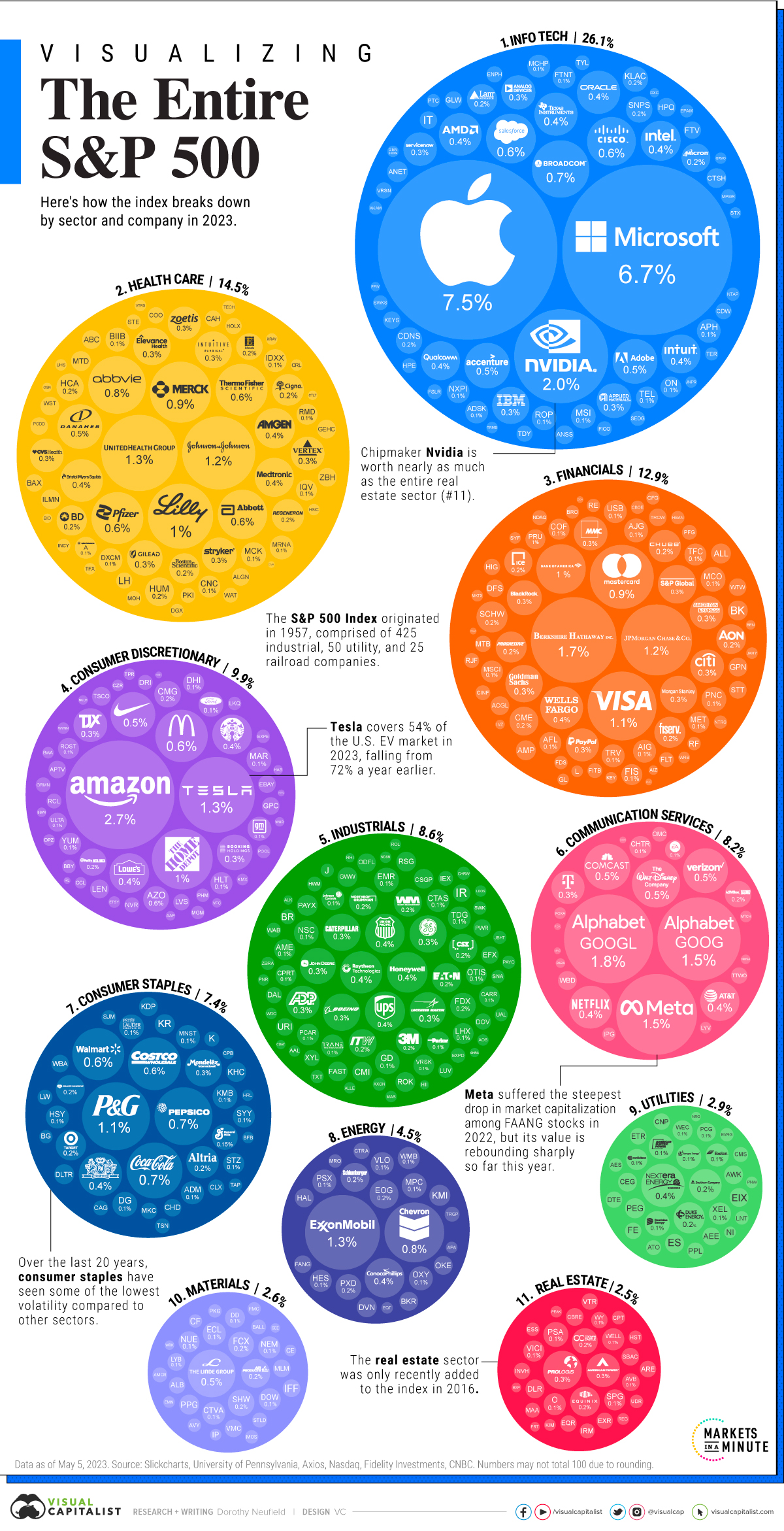
To truly understand what stocks are in the S&P 500, one must understand how those stocks are weighted. The S&P 500 is a “market-cap-weighted” index, meaning that the larger the company, the more influence it has on the index’s daily movement.
The Dominance of Tech Giants
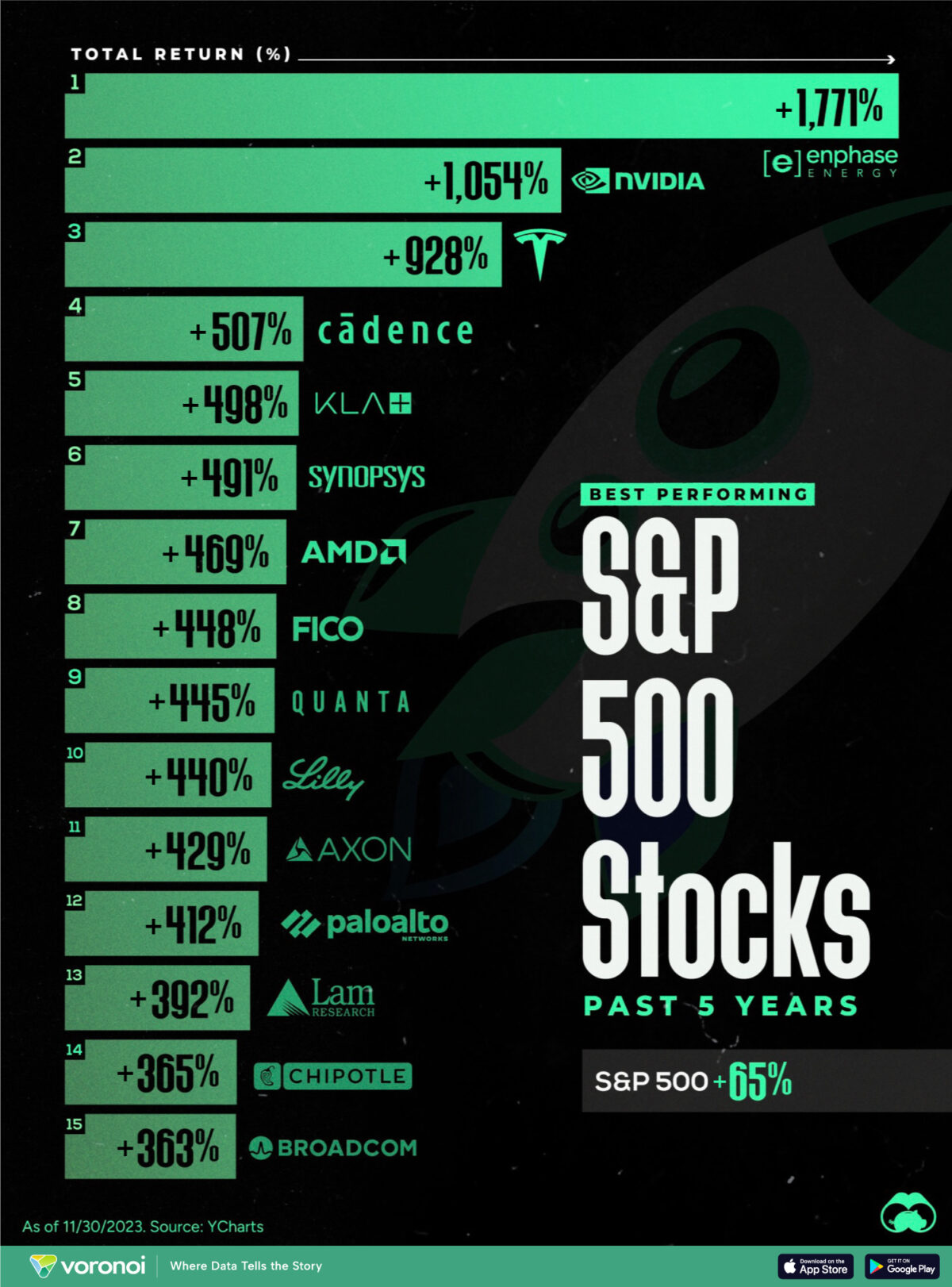
In recent years, a small group of stocks known as the “Magnificent Seven” has come to dominate the index. These include Apple, Microsoft, Alphabet, Amazon, Nvidia, Meta, and Tesla. Because these companies have market caps in the trillions or high hundreds of billions, their performance can move the entire index. If these seven stocks have a good day, the S&P 500 can finish in the green even if 300 other smaller companies in the index are down.
The Concentration Risk Debate
This weighting system creates a unique dynamic for investors. When you buy an S&P 500 index fund, you aren’t putting equal amounts of money into 500 companies. Instead, a significant portion of every dollar you invest goes into the top 10 companies. Financial analysts often debate whether this concentration is a risk or a reward. On one hand, it allows investors to ride the wave of the world’s most successful innovators; on the other hand, it makes the index vulnerable if the tech sector experiences a sharp correction.
Historical Shifts in Leadership
The list of stocks in the S&P 500 is never static. In the 1980s, the index was dominated by energy companies like ExxonMobil and industrial giants like General Electric. In the 1990s, telecommunications and early tech took the lead. This evolution is a feature, not a bug; it ensures that the index reflects the current leaders of the economy rather than clinging to the “dinosaurs” of the past.
The Rebalancing Process: How Stocks Enter and Exit
The S&P 500 is a living entity. Every quarter, the Index Committee meets to rebalance the list. This “survival of the fittest” mechanism is one of the reasons why the S&P 500 has historically been such a strong long-term investment.
The Addition of New Disruptors
When a company achieves significant scale and meets all financial criteria, it is added to the index. A famous recent example was Tesla’s inclusion in late 2020. Because so many trillions of dollars track the S&P 500, the addition of a new stock often triggers a massive wave of buying as institutional funds are forced to purchase the shares to match the index’s new composition.
Deletions and the “Fall from Grace”
Conversely, companies that no longer meet the criteria—usually due to a declining market cap, bankruptcy, or a merger—are removed. For example, once-mighty brands like Bed Bath & Beyond or Macy’s have seen their influence wane and were eventually moved to mid-cap or small-cap indices. This automated “pruning” ensures that an investor in the S&P 500 is always holding the 500 most relevant large-cap companies in the U.S.
The Role of Corporate Actions
Mergers and acquisitions also play a role in changing the list. When one S&P 500 company acquires another, a slot opens up. The committee then selects a new company from a “waiting list” of eligible candidates to fill the 500th spot. This constant turnover means that the S&P 500 is a self-cleaning portfolio.
Investing in the S&P 500: Strategies for Wealth Building
For the vast majority of people, the goal of knowing what stocks are in the S&P 500 is to figure out how to profit from them. Fortunately, you don’t need to buy 500 individual stocks to participate in their growth.
Index Funds and ETFs
The rise of “Passive Investing” has made the S&P 500 accessible to everyone. Exchange-Traded Funds (ETFs) like State Street’s SPY, Vanguard’s VOO, and BlackRock’s IVV allow investors to own a fractional share of all 500 companies with a single trade. These funds have incredibly low expense ratios, often less than 0.05%, meaning almost all of your returns stay in your pocket rather than going to a fund manager.
The Power of Compounding
The historical average annual return of the S&P 500 is approximately 10% (before inflation). By investing in the stocks within the S&P 500, an investor is essentially betting on the continued growth and ingenuity of the American corporate sector. Over decades, the dividends paid by these 500 companies, when reinvested, can lead to exponential wealth growth.
Conclusion: A Mirror of Economic Progress
The S&P 500 is more than just a list of stocks; it is a testament to the dynamic nature of capitalism. It captures the rise of new industries and the sunset of old ones. By understanding what stocks are in the S&P 500—and the rigorous standards they must meet to stay there—investors can gain confidence in using this index as the foundation of their financial future. Whether you are a seasoned pro or a novice saver, the 500 companies within this index represent the primary engine of global commercial success.
aViewFromTheCave is a participant in the Amazon Services LLC Associates Program, an affiliate advertising program designed to provide a means for sites to earn advertising fees by advertising and linking to Amazon.com. Amazon, the Amazon logo, AmazonSupply, and the AmazonSupply logo are trademarks of Amazon.com, Inc. or its affiliates. As an Amazon Associate we earn affiliate commissions from qualifying purchases.