
In the landscape of mechanical engineering and industrial maintenance, precision is the primary differentiator between a successful assembly and a structural failure. Selecting the correct drill bit for a 3/8 bolt is not merely a matter of finding a tool that “fits”; it is a technical decision that involves understanding tolerances, material science, and the specific application of the fastener. Whether you are working in aerospace, automotive manufacturing, or high-end fabrication, the technology behind hole-making determines the integrity of the joint and the longevity of the hardware.
The Engineering Standards for Clearance Holes
When a bolt is used to fasten two components together, it typically passes through a “clearance hole.” This hole is designed to be slightly larger than the bolt’s nominal diameter to allow for easy assembly and to account for minor misalignments. For a 3/8-inch bolt, which has a decimal diameter of 0.375 inches, the selection of the drill bit depends on the required “fit” category as defined by engineering standards like ASME B18.2.8.

Standard and Loose Clearance Fits
For most general industrial applications, a “Normal Fit” is the standard. This requires a 13/32-inch drill bit. With a decimal equivalent of 0.4063 inches, the 13/32-bit provides a clearance of approximately 0.0313 inches. This gap is sufficient to allow the bolt to slide through freely while maintaining enough material around the hole to support the bolt head or washer.
In scenarios where precision is less critical or where multiple bolts must align across a large surface area, a “Loose Fit” may be utilized. In this case, a 7/16-inch drill bit (0.4375 inches) is the preferred choice. This provides a generous clearance of 0.0625 inches, facilitating faster assembly in high-volume production environments where tight tolerances might lead to logjams on the assembly line.
Close Clearance and High-Precision Fits
In high-tech manufacturing, such as CNC machining or precision robotics, a “Close Fit” is often required to minimize mechanical play and ensure that the bolt remains centered within the hole. For a 3/8 bolt, a 25/64-inch drill bit (0.3906 inches) is used. This leaves only 0.0156 inches of clearance. While this requires higher accuracy during the drilling process, it significantly improves the load distribution across the fastener and reduces the likelihood of “shaking” or vibration-induced loosening over time.
Technical Specifications for Tapping and Threading
The requirements change drastically if the goal is not to pass the bolt through a hole, but to thread the bolt directly into a piece of material. This process, known as tapping, requires a “tap drill” that is smaller than the bolt’s nominal diameter. The drill bit must leave enough material for the tap to cut internal threads that will mesh perfectly with the 3/8 bolt.
3/8-16 UNC (Coarse Thread) Applications
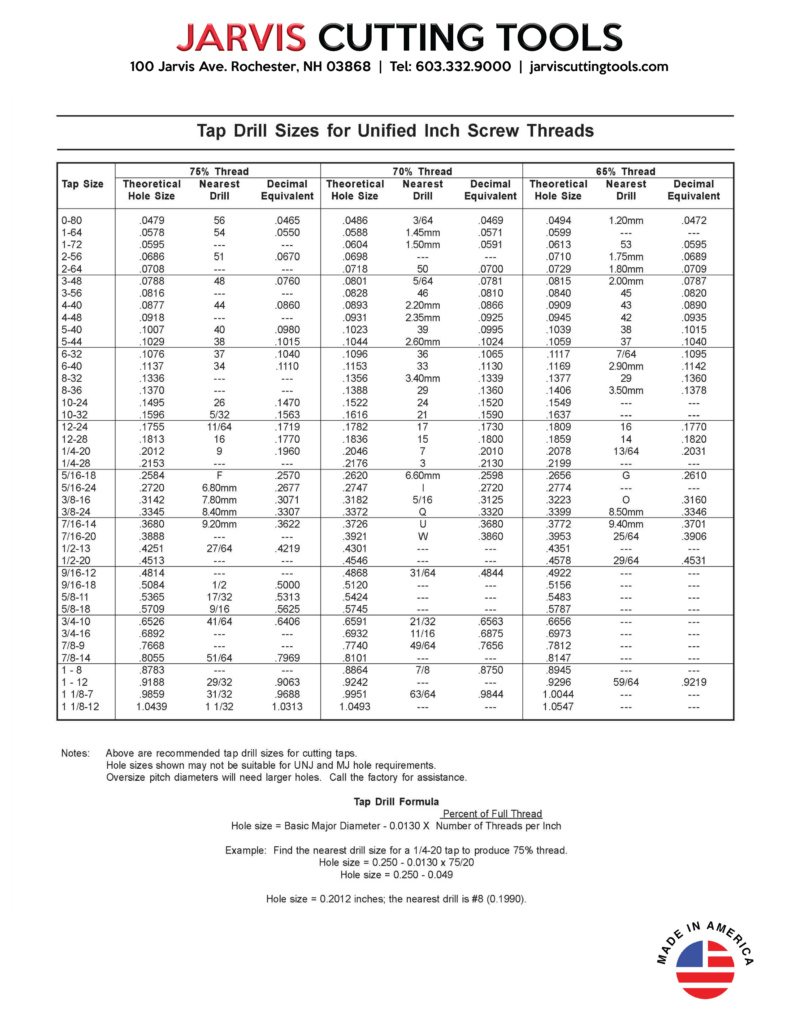
The 3/8-16 Unified Coarse (UNC) thread is one of the most common fasteners in North American industrial tech. To create these threads, engineering charts specify a 5/16-inch drill bit.
The physics behind this selection is precise: a 5/16-bit (0.3125 inches) leaves just enough wall material to allow the tap to cut threads that represent approximately 75% of the full thread depth. This 75% threshold is the “sweet spot” in mechanical design; it provides maximum holding strength while minimizing the torque required to cut the threads, thereby reducing the risk of tool breakage during the manufacturing process.
3/8-24 UNF (Fine Thread) Applications
For applications involving higher tension or where thin-walled materials are used, the 3/8-24 Unified Fine (UNF) thread is the preferred technology. Because the threads are shallower and more frequent, a larger tap drill is required compared to the coarse version.
The standard drill bit for a 3/8-24 tap is a “Letter Q” bit, which has a decimal diameter of 0.3320 inches. If a lettered bit set is unavailable, a 21/64-inch bit (0.3281 inches) is often used as a close substitute, though it results in a slightly higher thread percentage that can be more difficult to tap in harder metals like stainless steel or titanium.
Material Science and Drill Bit Technology
Understanding the size of the hole is only half of the technical equation. The “tech” of the drill bit itself—its composition, geometry, and coating—determines whether the hole will be accurate and whether the tool will survive the operation.
High-Speed Steel (HSS) and Cobalt Alloys
High-Speed Steel remains the baseline technology for most drilling tasks. However, when dealing with 3/8 bolts in industrial settings, HSS is often augmented with alloys. Cobalt drill bits (M35 or M42 grade) are engineered specifically for high-heat applications. When drilling holes for bolts in hardened steel, the addition of 5% to 8% cobalt allows the bit to maintain its structural integrity at temperatures that would soften standard steel bits. This is critical for maintaining hole diameter consistency; a bit that overheats and “walks” or dulls will create an oversized or tapered hole that compromises the bolt’s fit.
Specialized Coatings: TiN and Carbide Tipping
Modern boring technology utilizes advanced coatings to reduce friction and increase surface hardness. Titanium Nitride (TiN) coatings, recognizable by their gold color, increase the lubricity of the bit. This tech allows for higher RPMs and faster feed rates, which is essential for optimizing cycle times in automated manufacturing.
For the most demanding environments—such as drilling through cast iron or high-silicon aluminum—solid carbide or carbide-tipped bits are the gold standard. While more brittle than steel, carbide bits maintain a sharp edge significantly longer and can be operated at much higher speeds, leveraging the precision of CNC technology to produce holes with tolerances measured in the ten-thousandths of an inch.
Digital Precision and Tooling Integration
As we move further into the era of Industry 4.0, the process of selecting a drill bit for a 3/8 bolt is increasingly integrated with digital tools and software-driven hardware.
Digital Calipers and Micrometers
The reliance on stamped markings on a drill bit is being replaced by digital verification. Professional technicians utilize digital calipers to measure the actual diameter of the drill bit and the bolt before the first hole is ever bored. This accounts for manufacturing variances and tool wear. In a high-precision environment, a 13/32-bit that has been sharpened multiple times may no longer meet the decimal specifications required for a “Normal Fit,” necessitating a replacement to ensure the structural integrity of the project.
Integration with CAD/CAM Software
In modern fabrication, the transition from a digital design in Computer-Aided Design (CAD) software to the physical hole is seamless. Engineers specify the 3/8 bolt and the desired fit (Close, Normal, or Loose) within the software. The Computer-Aided Manufacturing (CAM) system then automatically selects the appropriate tool from the machine’s carousel.
This digital workflow eliminates human error in bit selection. The software also calculates the optimal “Speeds and Feeds”—the rotational speed of the bit and the rate at which it enters the material—based on the specific drill bit technology being used. This ensures that the 3/8 bolt hole is perfectly vertical, perfectly sized, and free of burrs or thermal damage.
Maintenance and Geometric Accuracy
The final technical consideration in the drilling process is the maintenance of the tools themselves. A drill bit is a sophisticated cutting instrument, and its geometry must be preserved to ensure that a 3/8 bolt fits as intended.
Point Angles and Centering
Most standard drill bits feature a 118-degree point angle, which is suitable for general-purpose work. However, for harder materials, a 135-degree split-point bit is superior technology. The split-point design prevents the bit from “wandering” across the material surface upon contact, ensuring that the hole for the 3/8 bolt is placed exactly where the digital blueprints dictate.

The Role of Cutting Fluids and Heat Dissipation
To maintain the accuracy of the hole, heat must be managed. The use of synthetic coolants and cutting oils is a critical part of the drilling “stack.” These fluids serve a dual purpose: they reduce the friction between the bit and the workpiece, and they help evacuate chips from the hole. If chips (the spirals of metal removed during drilling) are not properly evacuated, they can be “re-cut” by the bit, effectively widening the hole and turning a “Close Fit” into an unusable “Loose Fit.”
By adhering to these technical standards and leveraging modern material science, the simple act of drilling a hole for a 3/8 bolt becomes a precise, repeatable, and highly engineered process. Whether utilizing a 13/32 bit for clearance or a 5/16 bit for tapping, the intersection of mathematical precision and tool technology remains the foundation of modern mechanical assembly.
aViewFromTheCave is a participant in the Amazon Services LLC Associates Program, an affiliate advertising program designed to provide a means for sites to earn advertising fees by advertising and linking to Amazon.com. Amazon, the Amazon logo, AmazonSupply, and the AmazonSupply logo are trademarks of Amazon.com, Inc. or its affiliates. As an Amazon Associate we earn affiliate commissions from qualifying purchases.