
Achieving precisely cut threads is a cornerstone of robust mechanical assemblies, from consumer electronics casings to industrial machinery. The foundation of any successful tapping operation lies in selecting the correct pilot drill bit size. For a 5/8-inch tap, this precision is paramount, as an incorrectly sized hole can lead to weak threads, tap breakage, or an outright failure of the fastening point. Understanding the underlying principles and adhering to best practices ensures optimal thread engagement and structural integrity.
The Critical Relationship Between Tap and Drill Bit Size
The process of tapping involves cutting internal threads into a pre-drilled hole, known as the pilot hole. The drill bit used for this pilot hole must be carefully selected to allow the tap to cut the thread’s crests while leaving enough material for the thread’s roots to form properly. This balance is crucial for achieving the desired thread strength and a smooth tapping experience.

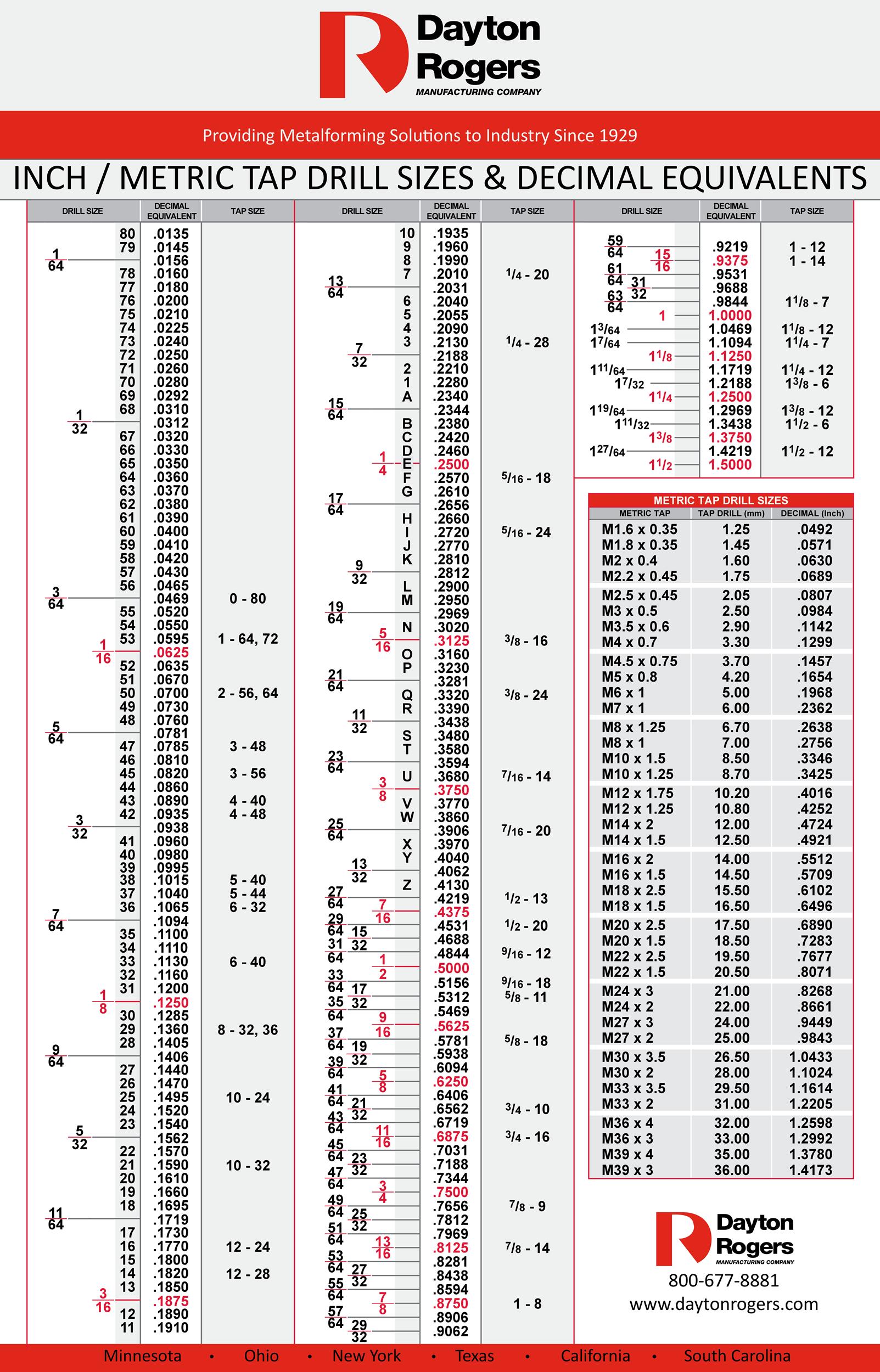
Deciphering Tap Drill Charts
Tap drill charts are indispensable resources that provide the recommended pilot hole sizes for various tap specifications. These charts are universally used in machining and fabrication workshops. They typically list standard coarse (UNC – Unified National Coarse) and fine (UNF – Unified National Fine) threads, along with their corresponding drill bit sizes. The standard recommendations are designed to achieve approximately 75% thread engagement, which is widely considered the optimal balance between thread strength and ease of tapping. Higher percentages of engagement offer marginal increases in strength but significantly increase the torque required and the risk of tap breakage.
Factors Influencing Drill Bit Selection Beyond the Chart
While tap drill charts provide a solid starting point, several other factors can influence the final drill bit selection:
- Thread Type: As mentioned, UNC and UNF threads require different drill bit sizes for the same nominal diameter. For a 5/8-inch tap, you must first determine if it’s a 5/8-11 UNC (11 threads per inch, coarse) or a 5/8-18 UNF (18 threads per inch, fine). Each will have a distinct pilot hole requirement.
- Material Hardness: Softer materials (e.g., aluminum, plastics) can sometimes benefit from a slightly larger pilot hole to reduce material deformation and tapping torque. Conversely, harder materials (e.g., hardened steel, titanium) may necessitate a slightly smaller pilot hole to ensure sufficient material for strong threads, though this increases the risk of tap breakage if not carefully managed.
- Desired Thread Engagement: While 75% is standard, specific applications might call for more or less engagement. For example, thin materials might need closer to 60% to prevent excessive stress on the material, while critical structural components might aim for closer to 80-85% (with increased risk).
- Tap Condition and Type: Worn taps or those with less aggressive cutting geometries might benefit from a slightly larger hole. Different tap types (e.g., forming taps vs. cutting taps) also have different pilot hole requirements.
Calculating the Ideal Pilot Hole for a 5/8 Tap
Let’s address the core question directly. The pilot hole size for a 5/8-inch tap depends entirely on its thread pitch.
Standard UNC/UNF Threads for 5/8 Taps
- For a 5/8-11 UNC Tap: The standard recommended drill bit size is 17/32 inch. This translates to approximately 0.53125 inches.
- For a 5/8-18 UNF Tap: The standard recommended drill bit size is 37/64 inch. This translates to approximately 0.578125 inches.
It is crucial to verify the specific thread pitch of your 5/8-inch tap before drilling. Mismatched drill bit sizes are a common cause of poor threads or tool damage.
Material Considerations and Their Impact on Drill Size
The choice of drill bit material and geometry is as important as its size, especially when working with different workpiece materials.
- High-Speed Steel (HSS) Bits: Good for general-purpose drilling in softer metals and wood.
- Cobalt Bits: Preferred for harder metals like stainless steel, as cobalt improves heat resistance and hardness.
- Carbide Bits: Excellent for very hard or abrasive materials, offering superior heat resistance and rigidity, but more brittle.
- Material Type Specifics:
- Mild Steel/Aluminum: Typically follow the standard chart recommendations for 75% thread engagement.
- Stainless Steel: Due to work hardening tendencies, a slightly larger pilot hole (e.g., 80% engagement) might be considered to reduce tapping torque and prevent tap breakage, especially in through-holes. High-quality cobalt drills are recommended.
- Cast Iron: Can be abrasive; carbide or coated HSS drills are often used. Standard pilot hole size usually works well.
- Plastics: Require specific drill geometries to prevent melting or tearing. A slightly larger pilot hole might be necessary to accommodate material expansion and contraction, and to reduce stress on the plastic during tapping.
The Tapping Process: Beyond Just the Drill Bit
Once the correct pilot hole is drilled, the journey to perfect threads is not complete. The tapping process itself requires precision, the right tools, and proper technique.
Choosing the Right Tap: Taper, Plug, and Bottoming Taps
Taps come in different styles, each designed for specific applications:
- Taper Taps: Feature a long, gradual taper on the cutting edge (8-10 threads tapered). They are ideal for starting threads, especially in tough materials or when hand tapping, as they require less torque.
- Plug Taps: Have a shorter, less aggressive taper (3-5 threads tapered). They are the most common general-purpose taps and can be used to finish threads started by a taper tap or to tap through-holes.
- Bottoming Taps: Have almost no taper (1-1.5 threads tapered). They are used to cut threads to the very bottom of a blind hole after a taper or plug tap has already started the thread. Never attempt to start a thread with a bottoming tap.

For a 5/8-inch tap, you’ll likely start with a taper or plug tap, especially in blind holes, and may finish with a bottoming tap if threads are needed to the full depth.
Lubrication and Cutting Speed: Essential for Success
- Lubrication: A high-quality cutting fluid is critical for most metals. It reduces friction, dissipates heat, and helps clear chips, extending tap life and improving thread quality. Specific cutting fluids are formulated for different materials (e.g., sulfurized oil for steel, kerosene for aluminum). For plastics, sometimes no lubricant is needed, or just a little water/alcohol.
- Cutting Speed: Tapping should always be done at a slow, controlled speed. For larger taps like 5/8-inch, especially in harder materials, very slow RPMs are necessary. Manual tapping with a tap wrench allows for precise control and feel. When machine tapping, refer to manufacturer guidelines for appropriate RPMs.
Technique for Straight and Clean Threads
- Pilot Hole Preparation: Deburr the entry point of the pilot hole to prevent chips from marring the first threads and to help the tap start smoothly.
- Starting Straight: Ensure the tap is perfectly perpendicular to the workpiece. A tap guide or a drill press (with the machine off, using the chuck to hold the tap) can assist in maintaining alignment. For hand tapping, apply even downward pressure while turning clockwise for the first few turns.
- Chip Evacuation: After every half to full turn forward (clockwise for right-hand threads), back the tap up by a quarter to half turn (counter-clockwise). This breaks chips and allows cutting fluid to reach the cutting edges, preventing chip packing and tap breakage.
- Consistent Pressure: Maintain steady, even pressure throughout the tapping process. Avoid excessive force, which can lead to misalignment or breakage.
- Patience: Tapping is a slow, methodical process. Rushing will almost inevitably lead to damaged threads or broken taps.
Common Pitfalls and Troubleshooting
Even with careful planning, issues can arise during tapping. Knowing how to identify and address them is key to successful outcomes.
Oversized vs. Undersized Holes
- Oversized Pilot Hole: Results in shallow threads with less than 75% engagement. While easier to tap, the threads will be weaker and more prone to stripping. In critical applications, this means starting over.
- Undersized Pilot Hole: Leads to excessive material for the tap to remove. This dramatically increases tapping torque, can cause the tap to bind, and significantly increases the risk of tap breakage. If detected early, you might be able to re-drill with the correct size.
Tap Breakage and Prevention
Tap breakage is a common, frustrating, and costly problem.
- Causes: Undersized pilot holes, dull taps, inadequate lubrication, chip packing, excessive force, misalignment, or sudden impacts.
- Prevention: Use the correct drill size, a sharp tap, ample lubrication, regular chip evacuation, a tap guide, and consistent, controlled pressure.
- Removal: Removing a broken tap is notoriously difficult. Specialized tap extractors, EDM (Electrical Discharge Machining), or careful drilling with carbide bits are common methods. Prevention is always better.
Dealing with Imperfect Threads
- Rough Threads: Can indicate a dull tap, insufficient lubrication, or chips not being properly evacuated. Ensure your tap is sharp and use plenty of cutting fluid.
- Tapered Threads: Often caused by misalignment during the initial turns. Use a tap guide or drill press to ensure the tap starts perfectly straight.
- Stripped Threads: Usually the result of an oversized pilot hole or applying too much force to an already cut thread. The only solution is often to repair the hole using a thread repair kit (e.g., Helicoil) or to machine for a larger tap.
Advanced Considerations for Specialized Applications
For complex projects or high-stress environments, a deeper understanding of thread mechanics can yield superior results.
Through-Holes vs. Blind Holes
- Through-Holes: Offer the advantage of chip evacuation through the bottom of the hole, reducing packing. Plug taps are often sufficient, though a taper tap might still be preferred for initial cuts in hard materials.
- Blind Holes: Require careful attention to chip evacuation, as chips have nowhere to go but back up the flutes. This makes chip packing a higher risk. Often, a sequence of taper, plug, and then bottoming tap is used to achieve full thread depth without breakage. Ensure there’s enough clearance at the bottom for the tap.
Thread Engagement and Strength
While 75% thread engagement is standard, understanding its implications is important. Beyond 75%, the increase in thread strength is minimal, while the risk of tap breakage and the required torque rise significantly. In certain soft materials, 60% engagement can be adequate and easier to achieve. For highly critical applications in very strong materials, achieving 80-85% might be attempted, but with extreme caution and specialized tooling.
Metric Equivalents and Conversions
While 5/8-inch is an imperial measurement, it’s worth noting that in a global manufacturing context, one might encounter metric taps. The same principles of pilot hole selection, based on diameter and pitch, apply. For converting imperial to metric or vice-versa, precise conversion charts or calculators are essential to maintain accuracy. Always double-check specifications to avoid costly mistakes in mixed imperial/metric setups.
By meticulously adhering to these technical guidelines, from selecting the precise drill bit for your 5/8 tap to mastering the tapping technique, you ensure the creation of strong, reliable threads essential for the integrity and performance of any mechanical component.
aViewFromTheCave is a participant in the Amazon Services LLC Associates Program, an affiliate advertising program designed to provide a means for sites to earn advertising fees by advertising and linking to Amazon.com. Amazon, the Amazon logo, AmazonSupply, and the AmazonSupply logo are trademarks of Amazon.com, Inc. or its affiliates. As an Amazon Associate we earn affiliate commissions from qualifying purchases.