
To the casual observer, the question “what shape is a football?” might seem to have a simple answer. Depending on where you are in the world, you might describe a sphere or a prolate spheroid. However, from a technological and engineering perspective, the shape of a football is a complex variable that has been meticulously optimized through decades of material science, computational fluid dynamics (CFD), and manufacturing innovation.
The shape of the ball is not merely a tradition; it is a high-tech solution to the problems of aerodynamics, player control, and data collection. As we move further into the digital age, the “shape” of the football is being redefined by internal sensors and smart materials that transform a simple piece of sports equipment into a sophisticated IoT (Internet of Things) device.

The Prolate Spheroid vs. The Sphere: A Masterclass in Geometric Engineering
The two primary shapes identified as “footballs”—the American gridiron ball and the association football (soccer)—represent two different philosophies of physics and technological intent.
The Aerodynamics of the Prolate Spheroid
The American football is a prolate spheroid, a shape characterized by its elongated axis and pointed ends. This design is a technological response to the need for distance and accuracy in a forward pass. Unlike a sphere, which encounters significant air resistance (drag) regardless of its orientation, a prolate spheroid is designed to be thrown with a spiral.
Engineers use the principle of gyroscopic stability to ensure the ball maintains its trajectory. When a quarterback applies a high-RPM (revolutions per minute) spin, the ball acts like a gyroscope, resisting the “wobble” caused by wind resistance. Modern tech-driven training tools now use high-speed cameras and motion-capture software to analyze the exact degree of tilt in this shape, ensuring that the “aerodynamic profile” is maintained throughout the flight.
Computational Fluid Dynamics (CFD) in Soccer Ball Design
The soccer ball, while appearing to be a perfect sphere, is technically a series of curved polygons. Historically, the 32-panel truncated icosahedron was the industry standard. However, software-led design has revolutionized this.
Using CFD software, manufacturers like Adidas and Nike simulate how air flows over the seams of the ball. If a ball is too smooth, it becomes unpredictable (as seen with the 2010 Jabulani); if it is too rough, it experiences too much drag. The shape we see today is a result of “aero-grooves” and micro-textures designed in digital environments to ensure that the boundary layer of air remains attached to the ball longer, reducing the “knuckleball” effect and rewarding technical precision.
Material Science: Transitioning from Leather to Thermobonded Synthetics
The physical “shape” of a football is only as good as the materials that hold it together. The transition from organic leather to high-performance synthetics represents one of the most significant tech leaps in sports history.
From “Pigskin” to Polyurethane
Traditional leather balls were prone to water absorption. In rainy conditions, a leather football would gain weight, altering its center of gravity and ruining its aerodynamic properties. This led to the development of multi-layered synthetic skins.
Modern footballs utilize an outer layer of polyurethane (PU) or Ethylene-vinyl acetate (EVA). These materials are engineered at a molecular level to be hydrophobic (water-repellent) and elastic. This ensures that the ball retains its precise geometric shape even after being subjected to the force of a 70-mph strike. The “memory” of these materials allows the ball to deform upon impact—increasing the contact area with the foot or hand for better grip—and then instantly snap back to its intended mathematical shape.
Thermal Bonding and the Death of the Stitch
For decades, the shape of a football was held together by hand-stitched seams. However, stitching creates inconsistencies; every stitch is a potential point of failure or a site for water ingress.
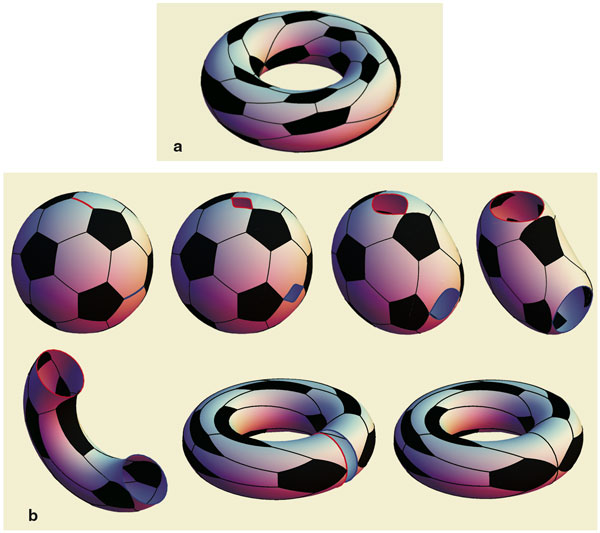
The introduction of thermal bonding technology changed the game. By using heat-activated adhesives to fuse panels together in a mold, manufacturers can create a perfectly seamless surface. This technological shift allows for fewer panels (dropping from 32 to as few as 8 or even 6 in some designs) without sacrificing the spherical shape. This reduction in seams leads to a more consistent flight path, as the “surface roughness” is distributed more evenly across the ball’s topography.
The Digital Core: Integrating IoT and Sensor Technology into the Ball’s Interior
In the current tech landscape, the most important aspect of a football’s shape isn’t just the outside—it’s what is suspended in the center. The “Smart Ball” era has arrived, turning the football into a data-generating hub.
Microchips and IMU Sensors
During the 2022 FIFA World Cup, the “Al Rihla” ball contained a “Connected Ball” system. Suspended in the exact geometric center of the ball by a system of tension wires is a 500Hz inertial measurement unit (IMU) motion sensor.
This sensor tracks every touch, kick, and header with millisecond precision. Because the tech is housed in a “suspension system,” it does not affect the ball’s weight or balance. This allows the ball to communicate its spatial coordinates to a network of local positioning anchors around the stadium. For the first time, the “shape” of the ball’s movement is being mapped in 3D space in real-time, providing the data necessary for semi-automated offside technology and advanced broadcast analytics.
The Role of Tech in Professional Officiating
The integration of sensors within the ball’s shape has solved one of the oldest problems in sports: the “ghost goal” or the “invisible touch.” In American football, there are ongoing trials to use similar RFID (Radio Frequency Identification) chips to determine the exact “spot” of the ball during a pile-up. When the physical shape of the ball is obscured by players, the digital “shape”—broadcast via radio waves—allows officials to see through the chaos. This is a prime example of how digital security and data integrity are becoming foundational to the integrity of the sport itself.
The Future of Football Tech: 3D Printing and Sustainable Engineering
As we look toward the next decade, the technology used to define the shape of a football is shifting toward additive manufacturing and circular economy principles.
Airless Prototypes and Lattice Structures
One of the biggest technological pain points for any football is the bladder—the internal air-filled chamber that maintains the shape. If the bladder leaks, the tool becomes useless. Researchers are currently experimenting with 3D-printed “airless” footballs.
By using complex lattice structures made of high-rebound polymers, engineers can create a ball that mimics the bounce and flight of a pressurized sphere without needing any air at all. These 3D-printed shapes are “generatively designed,” meaning an AI algorithm determines the most efficient way to distribute material to achieve the desired weight and stiffness. This tech could lead to a football that never goes flat and maintains its perfect shape for years.
Eco-friendly Polymers and the Tech-Driven Supply Chain
The “Brand Tech” of the future is also focused on sustainability. Modern manufacturing is moving toward “bio-based” materials derived from recycled plastics and plant fibers. The challenge for tech firms is to ensure that these sustainable materials perform identically to petroleum-based synthetics.
Advanced molecular testing and stress-testing simulations are used to ensure that a ball made from recycled ocean plastic can withstand the same 2,000-cycle “shot-put” test that professional-grade balls undergo. The result is a product that maintains its high-performance shape while significantly reducing the carbon footprint of the global sports industry.

Conclusion: The Geometry of Innovation
So, what shape is a football? It is a prolate spheroid or a sphere, yes—but more accurately, it is a high-performance aerodynamic shell, a vessel for cutting-edge sensors, and a triumph of material engineering.
From the use of computational fluid dynamics to perfect the flight of a soccer ball to the integration of 500Hz sensors for real-time data tracking, the “shape” of the football is constantly being refined by the latest trends in technology. As we move toward 3D-printed, airless, and fully connected equipment, the football will continue to be a primary example of how tech can take a simple, ancient game and elevate it into a data-driven, precision-engineered spectacle. The shape isn’t just about the game; it’s about the science of what’s possible.
aViewFromTheCave is a participant in the Amazon Services LLC Associates Program, an affiliate advertising program designed to provide a means for sites to earn advertising fees by advertising and linking to Amazon.com. Amazon, the Amazon logo, AmazonSupply, and the AmazonSupply logo are trademarks of Amazon.com, Inc. or its affiliates. As an Amazon Associate we earn affiliate commissions from qualifying purchases.