
The concept of “middle class” is a cornerstone of socioeconomic discussion, influencing policy, economic analysis, and individual aspirations. Yet, its definition is far from static. It’s a fluid designation, shaped by economic realities, geographic location, and even cultural perceptions. Understanding the income range that signifies middle-class status is crucial for individuals seeking to gauge their financial standing, for policymakers aiming to craft equitable solutions, and for businesses understanding their consumer base. This exploration delves into the multifaceted nature of middle-class income, examining how it’s defined, the factors that influence it, and what it truly signifies in today’s economic landscape.

The Shifting Sands of Middle-Class Income Definitions
The income required to be considered “middle class” is not a universally agreed-upon figure. It varies significantly depending on the source of the definition, the methodology used, and the specific context being considered. This variability stems from several key factors, making a single, definitive answer elusive.
Defining the Benchmarks: Government vs. Think Tanks vs. Individual Perception
Government agencies, academic institutions, and independent think tanks often employ different criteria to define income brackets. Government definitions, such as those used by the U.S. Census Bureau or the Congressional Budget Office, are frequently tied to specific policy objectives, like poverty thresholds or the distribution of income. These definitions often rely on absolute income levels or relative income compared to the median.
For instance, some government definitions might classify households within a certain percentage of the median household income as middle class. Others might use a more granular approach, establishing distinct income bands. These official figures, while authoritative, can sometimes feel disconnected from the lived financial realities of many households.
Think tanks and research organizations often conduct their own analyses, which can be more nuanced. They might incorporate factors beyond mere income, such as wealth, education levels, or occupational status, to paint a more holistic picture of the middle class. These studies can provide deeper insights into the economic stratification of society but may not always align with governmental classifications.
Beyond these institutional definitions lies the realm of individual perception. What one person considers “middle class” can be heavily influenced by their personal experiences, their upbringing, and their neighbors’ financial situations. This subjective interpretation can create a disconnect between statistical definitions and how people actually feel about their own economic status. This disconnect is a critical aspect of understanding the social and psychological implications of income classification.
The Median as a Guiding Light: How Income Percentiles Shape the Definition
The median household income serves as a common and powerful benchmark in defining the middle class. The median is the midpoint income, meaning half of all households earn more, and half earn less. Using the median as a reference point allows for a relative definition that adjusts to changing economic conditions. As the overall economy grows and incomes rise, the median income also increases, effectively raising the bar for what constitutes middle class.
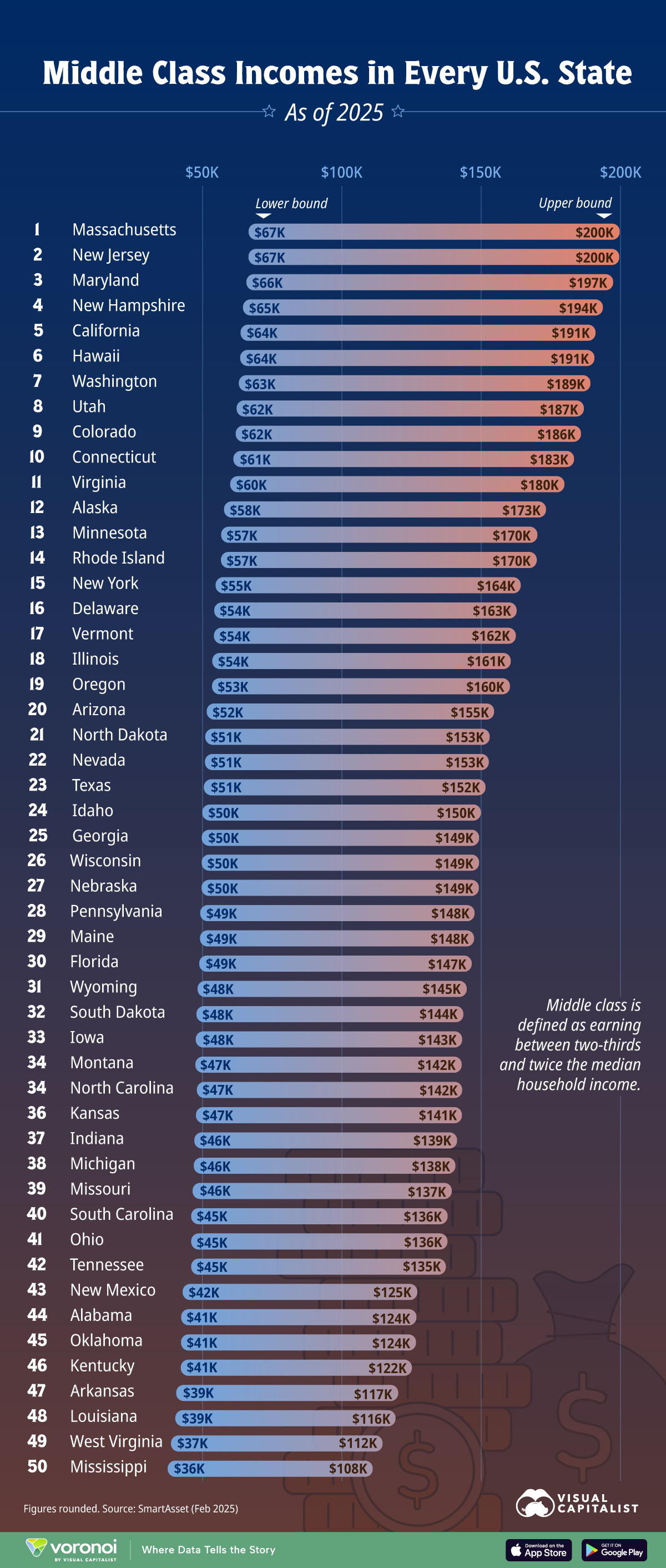
A widely adopted approach is to define the middle class as households earning between two-thirds and double the median household income. This broad range acknowledges that there isn’t a single income level, but rather a spectrum. For example, if the median household income is $70,000, a range from approximately $46,667 (two-thirds) to $140,000 (double) might be considered middle class.
However, even this seemingly straightforward approach has its complexities. The exact percentage points used to delineate the lower and upper bounds can vary. Some definitions might use a narrower range, focusing on a tighter band around the median, while others might extend further to capture a broader swath of the population. The choice of these percentages often reflects the aims of the analysis – whether it’s to understand the core middle class or to include those aspiring to it or recently departed from it.
Geographic Disparities: The Cost of Living as a Crucial Modifier
One of the most significant factors influencing the income range of the middle class is the vast difference in the cost of living across geographic regions. What might afford a comfortable middle-class lifestyle in a rural area or a city with a lower cost of living could be insufficient to maintain the same standard in a major metropolitan area with exorbitant housing prices, transportation costs, and daily expenses.
Consider the difference between income levels in New York City or San Francisco compared to those in smaller towns in the Midwest. A household earning $100,000 might feel financially strained in a high-cost-of-living area, struggling to afford adequate housing and save for the future. In contrast, the same income in a lower-cost region could provide a significantly more comfortable and secure existence, allowing for greater discretionary spending and savings.
Therefore, any discussion about middle-class income must account for regional cost-of-living adjustments. Income figures alone are insufficient without considering purchasing power. This means that the income required to be “middle class” can be substantially higher in some areas than in others. This disparity highlights the importance of localized economic analysis when discussing income classifications and their implications for individuals and communities.
The Multidimensional Nature of Middle-Class Status Beyond Income
While income is a primary indicator, defining the middle class solely by a dollar amount overlooks its multifaceted nature. The concept encompasses more than just financial capacity; it also includes lifestyle, aspirations, and social standing. Understanding these broader dimensions provides a more complete picture of what it means to be middle class.
Beyond the Paycheck: The Role of Assets, Debt, and Wealth Accumulation
Income is a flow of money over a period, but wealth is a stock of assets. The presence of significant savings, investments, or homeownership can provide a buffer against financial shocks and contribute to a sense of economic security that might not be reflected solely in annual income. A household with a modest income but substantial savings may feel more financially stable and thus more “middle class” than a household with a higher income but significant debt.

Conversely, high levels of debt, even with a seemingly comfortable income, can create financial precarity. Student loans, mortgages, and consumer debt can significantly impact a household’s net worth and their ability to build wealth over time. Therefore, a comprehensive definition of middle-class status often considers not just income, but also net worth, which is assets minus liabilities. This broader perspective acknowledges that financial well-being is a product of both earning capacity and responsible financial management.
Lifestyle and Aspirations: The Social and Cultural Components of Class
The middle class is often associated with certain lifestyle markers and aspirations. These can include access to quality education for children, opportunities for leisure and recreation, the ability to own a home, and a general sense of upward mobility. The pursuit of these goals and the feeling of being able to achieve them are integral to the middle-class identity.
Cultural capital, which includes knowledge, skills, education, and tastes, also plays a role in defining class. Middle-class individuals often possess a certain level of educational attainment and engage in activities that are socially valued, such as attending cultural events or participating in community organizations. These aspects contribute to social cohesion and a shared sense of identity within the middle class.
Furthermore, aspirations for oneself and one’s children are powerful motivators. The belief that hard work and education will lead to a better future is a hallmark of middle-class aspirations. When these aspirations feel attainable, it reinforces a sense of middle-class belonging. Conversely, when upward mobility seems increasingly difficult, it can lead to feelings of disillusionment and a questioning of one’s place in the socioeconomic structure.
The “Safety Net” Factor: The Comfort of a Financial Cushion
A defining characteristic of the middle class is often the existence of a financial “safety net.” This safety net can manifest in various forms: emergency savings accounts, health insurance, retirement plans, and life insurance. These provisions offer a degree of protection against unexpected events like job loss, illness, or accidents, preventing a single setback from derailing a household’s financial stability.
The ability to weather financial storms without falling into significant hardship is a key differentiator. Households that lack this safety net, even if their income is within a certain range, may experience a greater sense of vulnerability and insecurity, potentially aligning them more with lower-income strata in terms of their lived financial experience. The peace of mind that comes with knowing you can handle a crisis is a significant, albeit often unquantified, aspect of middle-class well-being.
Navigating the Income Landscape: Tools and Strategies for Financial Well-being
Understanding the nebulous definition of the middle class can be daunting. However, individuals can take proactive steps to assess their own financial standing and work towards greater economic security, regardless of their current income bracket.
Assessing Your Financial Position: Tools for Income and Wealth Tracking
For individuals seeking to understand where they fit within the income spectrum, various tools and resources can be invaluable. Online income calculators, often available through government agencies or financial news outlets, can help estimate your position relative to national or regional median incomes. These tools typically require inputting your household income, family size, and location to provide an estimated classification.
Beyond income, tracking assets and liabilities is crucial for a holistic financial assessment. Personal finance apps and budgeting software can help you monitor your spending, track your savings, and understand your net worth over time. Regularly reviewing bank statements, investment portfolios, and debt obligations provides a clear picture of your financial health. This self-awareness is the first step in making informed financial decisions.
Building a Secure Future: Strategies for Income Growth and Wealth Accumulation
Regardless of whether one identifies as middle class, lower class, or upper class, strategies for income growth and wealth accumulation are universally beneficial. Investing in skills development and education can lead to higher earning potential. Pursuing career advancement, exploring side hustles, or starting a business are all avenues for increasing income.
For wealth accumulation, consistent saving and smart investing are paramount. Even small, regular contributions to retirement accounts, such as 401(k)s or IRAs, can grow significantly over time due to the power of compounding. Diversifying investments across different asset classes can help mitigate risk and enhance returns. Furthermore, managing debt effectively, particularly high-interest debt, frees up more resources for saving and investing.
The Role of Financial Literacy and Planning in Achieving Middle-Class Goals
Financial literacy is not just about understanding numbers; it’s about developing the knowledge and confidence to make sound financial decisions. This includes understanding concepts like budgeting, saving, investing, debt management, and insurance. Access to reliable financial education resources, workshops, and advisors can empower individuals to take control of their finances.
Developing a comprehensive financial plan is essential for achieving long-term goals, whether they are related to homeownership, retirement, or funding education. A well-structured plan acts as a roadmap, guiding financial decisions and ensuring that resources are allocated effectively. Regular review and adjustment of this plan are also critical, as life circumstances and economic conditions evolve. By focusing on these foundational principles, individuals can navigate the complexities of the economy and strive for greater financial security and a stronger middle-class standing.
Conclusion: The Evolving Meaning of Middle Class in a Dynamic Economy
The quest to define the income range of the middle class is an ongoing endeavor, reflecting the dynamic nature of economies and societies. It’s a concept that resists simple, rigid definitions, instead demanding consideration of a multitude of factors. Income is undoubtedly a primary determinant, but it is interwoven with the cost of living, asset accumulation, debt levels, lifestyle aspirations, and the psychological comfort derived from financial security.
As economic landscapes shift, driven by technological advancements, globalization, and changing policy environments, the boundaries of the middle class will continue to evolve. What constitutes a middle-class income today may be significantly different a decade from now. Therefore, staying informed about economic trends, understanding personal financial health, and actively engaging in strategies for income growth and wealth accumulation are crucial for navigating this evolving terrain. Ultimately, the pursuit of middle-class status is not just about reaching a certain income threshold, but about achieving a level of financial stability, opportunity, and well-being that allows for a secure and fulfilling life.
aViewFromTheCave is a participant in the Amazon Services LLC Associates Program, an affiliate advertising program designed to provide a means for sites to earn advertising fees by advertising and linking to Amazon.com. Amazon, the Amazon logo, AmazonSupply, and the AmazonSupply logo are trademarks of Amazon.com, Inc. or its affiliates. As an Amazon Associate we earn affiliate commissions from qualifying purchases.