
The electrifying performances of Carlos Alcaraz on the tennis court have captured the imagination of fans worldwide. His explosive power, agile footwork, and fearless shot-making have propelled him to the pinnacle of the sport at an incredibly young age. While much attention is rightly paid to his physical prowess and mental fortitude, a crucial, yet often overlooked, element of his success lies in the sophisticated technology that complements his game: his tennis racket. In the hyper-competitive world of professional tennis, even the smallest advantage can make a significant difference, and the choice of equipment is paramount. For Alcaraz, this means a meticulously selected tool that amplifies his natural talent and allows him to execute his aggressive, all-court style.

Understanding the technology embedded within Alcaraz’s racket is not just about satisfying fan curiosity; it offers a fascinating glimpse into the intersection of sports science, material engineering, and high-performance athletic equipment. This article will delve into the specifics of the racket technology that empowers Carlos Alcaraz, exploring the materials, design principles, and technological innovations that make his weapon of choice so effective.
The Evolution of Professional Tennis Racket Technology
The modern tennis racket is a far cry from its wooden predecessors. Over the decades, technological advancements have revolutionized racket design, leading to lighter, stronger, and more powerful frames capable of imparting greater spin and control. This evolution has been driven by a relentless pursuit of performance enhancement, catering to the increasingly demanding physical and technical requirements of professional tennis.
From Wood to Advanced Composites
Historically, tennis rackets were constructed from wood, a material that offered a natural feel but limited in terms of power and consistency. The advent of aluminum in the mid-20th century marked the first significant shift, offering greater strength and a larger sweet spot. However, the true game-changer arrived with the introduction of graphite and other composite materials.
- Graphite Composites: These materials, often blended with carbon fibers, fiberglass, and Kevlar, provide an exceptional strength-to-weight ratio. They allow manufacturers to create rackets that are both incredibly strong and remarkably light, enabling players to generate higher swing speeds and more powerful shots. The stiffness of graphite composites also contributes to improved energy transfer from the swing to the ball, maximizing power.
- Aerodynamics and Frame Design: Beyond materials, the shape and profile of the racket frame have undergone significant technological refinement. Modern frames are designed with advanced aerodynamic principles in mind. Thicker beams, for instance, can increase power and stability, while thinner beams might offer more feel and maneuverability. The head shape and dimensions are also crucial, influencing the size of the sweet spot and the overall responsiveness of the racket. Innovations like “open” and “closed” string patterns further allow players to fine-tune the balance between spin generation and control.
The Role of String Technology
While the frame is the foundation, the strings are the critical interface between the racket and the ball. String technology has also seen dramatic advancements, moving beyond natural gut to a variety of synthetic materials, each with unique characteristics.
- Polyester (Poly) Strings: These are the dominant choice for professional players like Alcaraz due to their exceptional ability to grip the ball and impart spin. Poly strings are typically stiffer than other synthetic options, allowing for greater control and consistency on powerful strokes. Their durability also makes them a practical choice for the rigors of professional play.
- String Tension and Sweet Spot Optimization: The tension at which strings are mounted within the frame is another critical technological parameter. Higher tensions generally offer more control, while lower tensions provide more power and comfort. Players and their stringers meticulously experiment with tension to find the optimal balance for their game. Furthermore, the sweet spot, the area on the stringbed that provides the most power and control, is a key area of focus in racket design, with technological advancements aiming to enlarge and stabilize this crucial zone.
Unpacking Carlos Alcaraz’s Racket: The Babolat Pure Aero Series
Carlos Alcaraz is famously a brand ambassador for Babolat, and his weapon of choice belongs to their renowned Pure Aero line. While specific model modifications are often kept proprietary, the core technology and design philosophy of the Pure Aero series are well-documented and provide significant insight into why it’s a perfect fit for Alcaraz’s explosive style. The Pure Aero line is engineered to maximize power and spin, two of Alcaraz’s most potent weapons.
Core Technologies: FSI Spin and Aeromodular Design
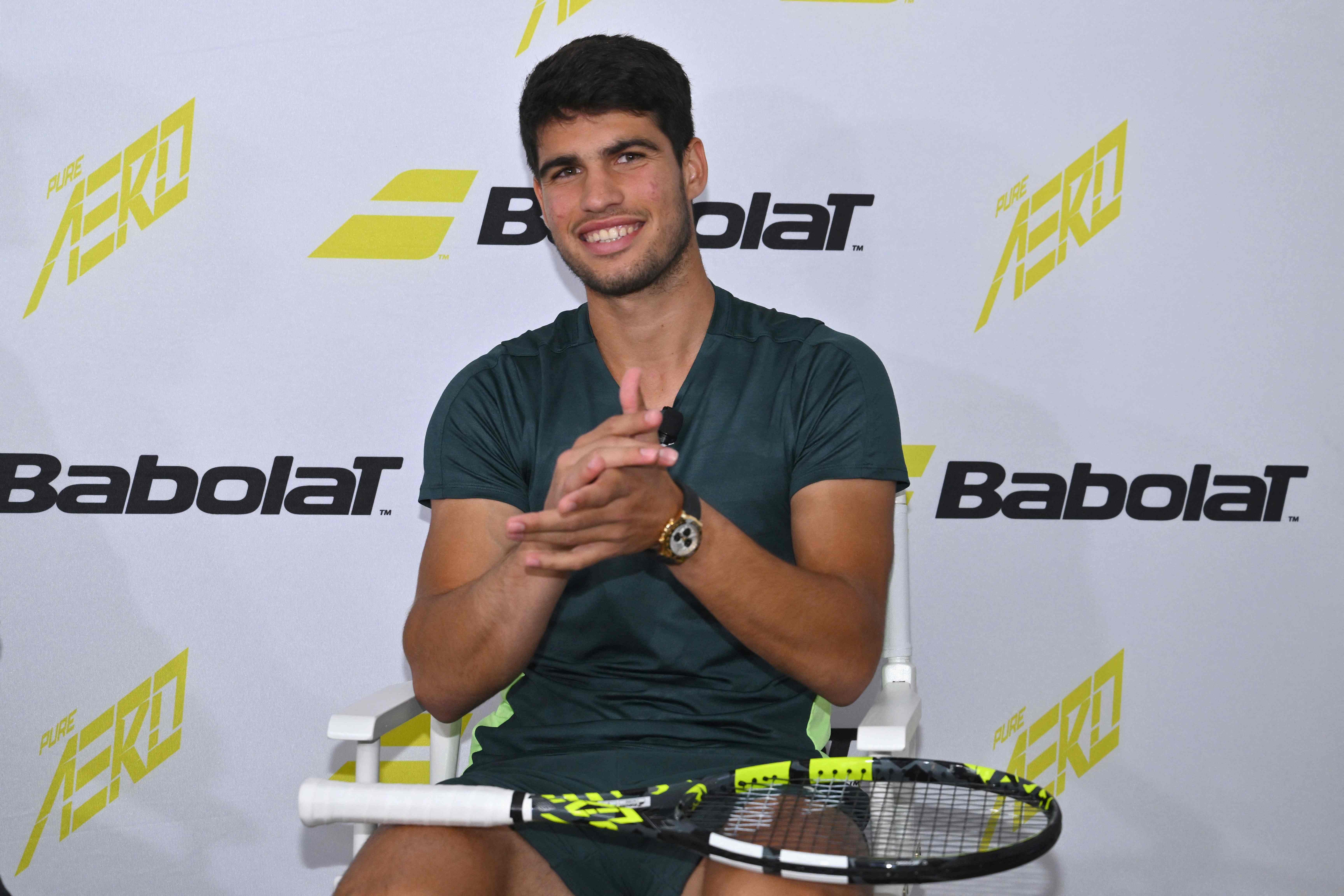
Babolat has incorporated several key technologies into the Pure Aero rackets, which are undoubtedly leveraged by Alcaraz. These technologies are not merely marketing buzzwords; they represent tangible engineering solutions aimed at enhancing player performance.
- FSI Spin Technology (Frame String Interaction Spin): This technology involves optimizing the spacing of the string holes and the length of the main strings. By increasing the string movement within the grommets, FSI Spin allows the strings to “bite” into the ball more effectively, generating significantly more topspin. For Alcaraz, who relies heavily on aggressive topspin to dictate play and keep his opponents on the defensive, this feature is indispensable. The ability to generate prodigious spin allows him to hit with power while still keeping the ball within the lines, a hallmark of his game.
- Aeromodular Design: The frame beam design of the Pure Aero is aerodynamically optimized to cut through the air more efficiently. This “aeromodular” concept reduces air resistance, allowing for faster racket head speed. This, in turn, translates directly into more power and spin. For a player like Alcaraz, who possesses exceptional racket head speed, the enhanced aerodynamics further amplify his natural ability, making his serves and groundstrokes even more formidable. The thinner beam profile, characteristic of the Pure Aero, contributes to this speed advantage.
Material Composition and Frame Construction
The specific blend of materials and the way the frame is constructed are also crucial technological aspects of Alcaraz’s racket. While Babolat doesn’t reveal the exact proprietary mixes used for their top professionals, the general principles of the Pure Aero construction are clear.
- High Modulus Graphite: The Pure Aero series predominantly utilizes high modulus graphite. This advanced composite material offers a superior strength-to-weight ratio, providing a stiff and powerful frame without being excessively heavy. The stiffness ensures that the energy from the swing is efficiently transferred to the ball, maximizing power output.
- Cortex Dampening System: To counter the potential harshness associated with stiffer frames and the higher tensions often used by professional players, Babolat incorporates its Cortex Dampening System. This technology aims to filter out unwanted vibrations while preserving the feel of the ball. For Alcaraz, this means he can unleash his full power without compromising comfort or suffering from excessive arm fatigue, allowing him to maintain peak performance throughout long matches. The precise calibration of this system is a testament to the technological sophistication involved in professional tennis equipment.
Customization and Technological Adaptation for Elite Performance
While the stock Pure Aero racket offers a highly advanced technological platform, professional athletes like Carlos Alcaraz often engage in a degree of customization to tailor their equipment precisely to their unique playing style and physical attributes. This customization process itself is a sophisticated application of technological understanding.
Beyond the Standard: Grip Size, Balance, and Weight Tuning
Professional players rarely use rackets straight off the shelf. The subtle adjustments made to grip size, balance, and weight can have a profound impact on how the racket feels and performs in their hands.
- Grip Size and Overgrip Application: The grip size is a fundamental aspect of a player’s connection to their racket. An improperly sized grip can lead to loss of control, discomfort, and even injury. Alcaraz likely uses a specific grip size that allows for optimal palm contact and wrist maneuverability. Furthermore, the application of overgrips is not just about comfort; it can subtly alter the thickness and tackiness of the grip, allowing for minute adjustments in feel and control. This seemingly simple step involves an understanding of ergonomics and tactile feedback.
- Balance and Swingweight Optimization: The balance point of a racket, measured from the butt cap, dictates its maneuverability and stability. A head-heavy racket feels more powerful but can be harder to swing quickly, while a head-light racket offers greater maneuverability. Professional players meticulously tune the balance and “swingweight” (the perceived weight when swinging the racket) of their frames. This can be achieved through various methods, including adding weight strategically to different parts of the frame or modifying the grip. For Alcaraz, this would be optimized to facilitate his rapid swings and aggressive shot selection.
- String Tension and Customization: As mentioned earlier, string tension is a critical variable. While Babolat might provide a general recommendation for their rackets, Alcaraz and his stringer will likely experiment extensively to find the precise tension that maximizes his spin, power, and control for different conditions and opponents. This requires a deep understanding of how string tension interacts with the frame’s stiffness and the ball’s impact dynamics.

The Role of Data Analytics and Feedback
In the modern era of professional sports, data analytics plays an increasingly vital role, and this extends to equipment choices. While not always explicitly advertised, it’s highly probable that Alcaraz’s team utilizes various technological tools to gather data on his performance with his racket.
- Swing Analysis Technology: Sophisticated sensors and high-speed cameras can capture data on racket head speed, swing path, angle of impact, and ball speed. Analyzing this data can reveal subtle inefficiencies or areas for improvement, leading to fine-tuning of racket specifications. This feedback loop between performance data and equipment adjustment is a testament to the scientific approach now employed in professional tennis.
- Material Science and Prototyping: While Alcaraz uses a specific model, it’s also worth considering that professional athletes are often involved in the R&D process for future racket iterations. Their feedback, combined with advanced material science and engineering, helps shape the next generation of tennis technology. This collaborative approach ensures that equipment remains at the cutting edge, providing players with the best possible tools to excel. The continuous pursuit of incremental technological advantages is what separates the good from the truly great.
In conclusion, Carlos Alcaraz’s choice of racket is far more than a simple brand endorsement. It’s a strategic decision rooted in a deep understanding of tennis technology. The Babolat Pure Aero, with its advanced materials, aerodynamic design, and spin-enhancing features, provides the technological foundation for his extraordinary game. Furthermore, the meticulous customization and likely use of data analytics highlight the sophisticated interplay between athlete and equipment. As Alcaraz continues to dominate the tennis world, the technology within his racket will remain a silent, yet powerful, partner in his pursuit of greatness.
aViewFromTheCave is a participant in the Amazon Services LLC Associates Program, an affiliate advertising program designed to provide a means for sites to earn advertising fees by advertising and linking to Amazon.com. Amazon, the Amazon logo, AmazonSupply, and the AmazonSupply logo are trademarks of Amazon.com, Inc. or its affiliates. As an Amazon Associate we earn affiliate commissions from qualifying purchases.