
The demographic landscape of the United States is fundamentally defined by its immigrant population. While the question “what percent of immigrants are in the United States” often surfaces in political debates, its most profound implications are found within the realm of “Money”—specifically regarding labor markets, tax revenue, entrepreneurship, and national GDP. Currently, foreign-born individuals account for approximately 13.7% to 14.3% of the total U.S. population, a figure that represents nearly 46 million people.
From a financial perspective, this demographic is not merely a census statistic; it is a massive economic engine. Understanding the percentage of immigrants in the U.S. is the first step in decoding the complex fiscal dynamics that drive American prosperity, influence investment trends, and sustain the solvency of social safety nets.
The Macroeconomic Blueprint: Demographics and the National Balance Sheet
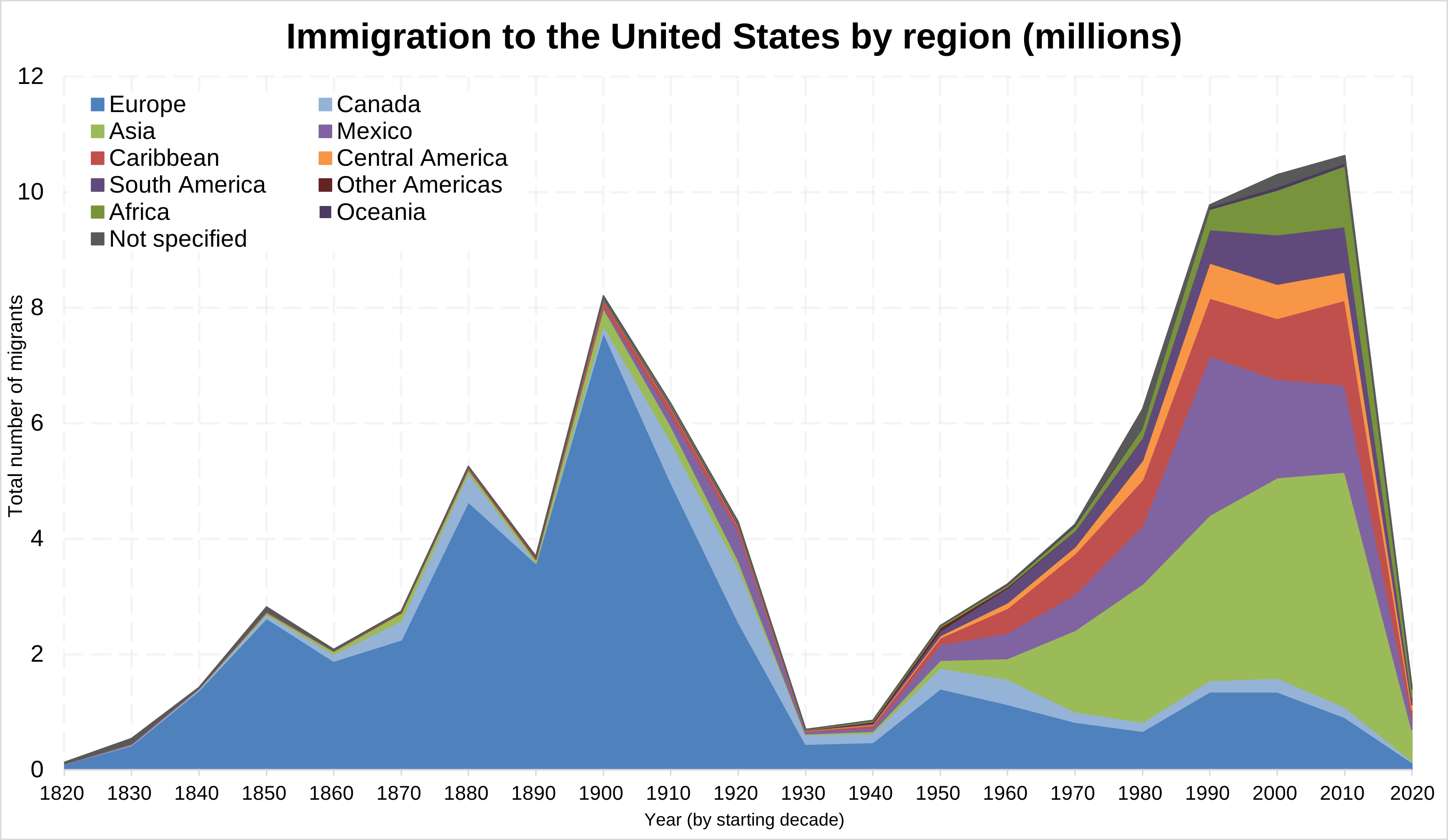
The percentage of immigrants in the U.S. has fluctuated over the last century, hitting a low in 1970 (around 4.7%) and steadily climbing to today’s levels, which approach the historical highs of the late 19th century. In financial terms, this upward trajectory correlates with periods of significant industrial and technological expansion.
Current Percentages and Historical Context
To understand the current financial landscape, one must look at the data provided by the U.S. Census Bureau and the American Community Survey. With immigrants making up roughly 14% of the population, they represent a disproportionately high percentage of the active workforce—nearly 17%. This “over-representation” in the workforce is a critical driver of the U.S. Gross Domestic Product (GDP). Economists suggest that without this influx of human capital, the U.S. would face the same stagnation seen in aging economies like Japan or parts of Western Europe.
Regional Economic Distributions
The concentration of this population is not uniform, which creates localized economic “hotspots.” States like California, Texas, Florida, and New York host the highest percentages of immigrants, and subsequently, these states lead the nation in GDP contribution. For investors and business owners, these demographics signal high-growth consumer markets and diverse labor pools. Analyzing these regional percentages allows financial planners to predict real estate trends and retail demand with greater accuracy.
Labor Market Dynamics and Wealth Creation
The financial value of the immigrant population is most visible in the labor market. Whether in high-tech Silicon Valley or the agricultural heartlands, the “percent of immigrants” in specific sectors often dictates the viability and profitability of those industries.
Bridging the Skills Gap in High-Value Sectors
In the “Money” niche, we often look at the “Human Capital” index. Immigrants represent a significant portion of the STEM (Science, Technology, Engineering, and Math) workforce. By filling critical gaps in high-value sectors, immigrant professionals drive innovation that leads to patent filings, venture capital investment, and corporate expansion. This specialized labor pool is essential for maintaining the U.S. dollar’s status as a global leader, as it ensures that the most profitable companies in the world remain headquartered on American soil.
The Entrepreneurial Spirit: Startups and Small Business Revenue
Beyond being employees, immigrants are prolific job creators. According to data from the Small Business Administration, immigrants are more likely to start a business than the native-born population. Nearly 45% of Fortune 500 companies were founded by immigrants or their children. From a personal finance and investment perspective, this illustrates a high level of “Economic Mobility.” These businesses generate trillions of dollars in annual revenue and employ millions of Americans, proving that the 14% population share translates into a much larger percentage of the nation’s business equity.
Fiscal Contributions: Taxes, Social Security, and Public Spending

A common focal point in business finance is the net fiscal impact of any given demographic. When examining the immigrant population, the data reveals a robust contribution to the public coffer that often goes overlooked in casual conversation.
Net Tax Contribution vs. Public Service Utilization
Immigrant households contribute billions of dollars in federal, state, and local taxes every year. In 2021 alone, immigrant-led households paid an estimated $524.7 billion in total taxes. This includes income tax, property tax, and sales tax. Even undocumented immigrants, who make up a subset of the total immigrant percentage, contribute an estimated $11.6 billion annually in state and local taxes. For the “Money” enthusiast, this represents a massive, non-dilutive revenue stream for the government that helps fund infrastructure and public services without increasing the tax burden on the average citizen.
Solvency of Social Safety Nets
Perhaps the most critical financial role played by the immigrant population is the stabilization of Social Security and Medicare. Because immigrants tend to be younger and arrive at the peak of their working years, they pay into these systems for decades. The Social Security Administration has noted that unauthorized immigrants alone have contributed up to $13 billion a year into the social security trust fund—funds they are largely ineligible to withdraw. This “surplus” is a vital component in delaying the projected insolvency of these massive federal programs.
Investing in the Future: The Purchasing Power of Immigrant Communities
The financial influence of the immigrant population extends deep into the consumer economy. As their numbers grow, so does their collective “Purchasing Power,” a metric that tracks the total income available for spending and saving after taxes.
Real Estate and Consumer Spending Trends
The purchasing power of immigrants in the U.S. is currently estimated to be over $1.3 trillion. This capital moves markets. In the real estate sector, immigrants are a primary driver of demand for first-time homeownership. By entering the market and purchasing residential property, they help stabilize home values and contribute to the growth of neighborhood-level economies. For investors in Real Estate Investment Trusts (REITs) or consumer staples, the immigrant demographic represents a loyal and expanding customer base.
Remittances and Global Financial Connectivity
While much focus is on domestic spending, the “Money” niche must also consider the global flow of capital. Immigrants in the U.S. send billions in remittances to their home countries. While this is an outflow of cash, it creates a “Global Financial Bridge.” It fosters international trade, increases the demand for U.S. financial tools and apps (FinTech), and strengthens the banking corridors between the U.S. and emerging markets. This connectivity is a cornerstone of modern international business finance.
Strategic Financial Outlook for the Next Decade
As the percentage of immigrants in the United States continues to be a central pillar of the nation’s growth strategy, the financial world must adapt to leverage this demographic shift.
Adapting Financial Tools for a Diverse Demographic
The financial services industry is already evolving to meet the needs of this 14% of the population. We are seeing a rise in specialized banking products, multi-language investment platforms, and credit-building tools designed for those without a traditional domestic credit history. For the savvy investor or entrepreneur, this niche—financial inclusion for the foreign-born population—represents one of the most significant “Side Hustle” and “Business Finance” opportunities of the 21st century.
Long-Term GDP Growth and Inflation Management
Finally, from the perspective of national monetary policy, the immigrant population serves as a buffer against inflation and a catalyst for growth. By providing a steady supply of labor and high-level skills, they help prevent “wage-push inflation” in over-stretched industries. As the U.S. navigates the complexities of the post-pandemic economy, the immigrant population remains one of the few reliable levers for sustainable, long-term GDP growth.
In conclusion, while the answer to “what percent of immigrants are in the United States” is a simple statistic—roughly 14%—the financial reality is far more expansive. This group represents the backbone of the modern American economy, driving innovation, sustaining the tax base, and providing the entrepreneurial energy necessary for the nation to compete on the global stage. For anyone focused on “Money,” whether through personal finance or corporate strategy, the immigrant demographic is not just a part of the economy; it is the engine of its future.
aViewFromTheCave is a participant in the Amazon Services LLC Associates Program, an affiliate advertising program designed to provide a means for sites to earn advertising fees by advertising and linking to Amazon.com. Amazon, the Amazon logo, AmazonSupply, and the AmazonSupply logo are trademarks of Amazon.com, Inc. or its affiliates. As an Amazon Associate we earn affiliate commissions from qualifying purchases.