
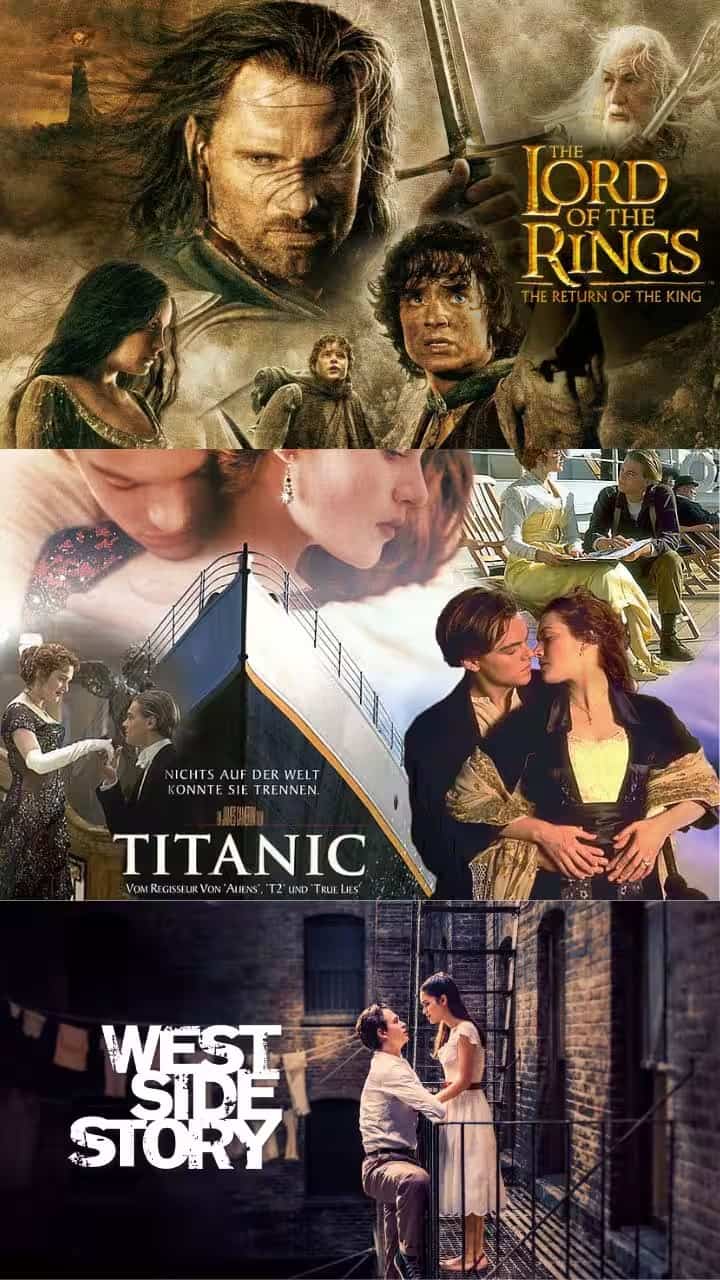
In the world of high-stakes entertainment, the Academy Awards represent more than just artistic validation; they are a critical financial barometer. For studios, investors, and producers, the pursuit of the “Big Gold Man” is a calculated business move designed to maximize Return on Investment (ROI) and solidify the long-term value of intellectual property. When we ask which movie has won the most Academy Awards, we are looking at a three-way tie between Ben-Hur (1959), Titanic (1997), and The Lord of the Rings: The Return of the King (2003). Each of these films secured 11 Oscars, but more importantly, each represents a different era of financial risk-taking and massive capital deployment.

To understand the magnitude of these achievements, one must look past the red carpet and into the balance sheets. The intersection of critical acclaim and commercial success is where the most significant wealth in Hollywood is generated.
The Three Titans of Oscar History: A Financial Breakdown
The “11-Oscar Club” consists of films that were not merely critical darlings but were massive industrial undertakings. From a business finance perspective, these films were “too big to fail” projects that required unprecedented levels of capital expenditure.
Ben-Hur (1959): The Capital-Intensive Studio Savior
In the late 1950s, Metro-Goldwyn-Mayer (MGM) was facing a financial crisis. The rise of television was eroding theatrical audiences, and the studio needed a “black swan” event to stay solvent. They invested a then-unheard-of $15 million into Ben-Hur. Adjusted for inflation, this was a massive gamble on a single asset.
The financial strategy was clear: create a spectacle that could not be replicated on a small screen. The investment paid off. Ben-Hur earned $147 million in its initial release, providing a massive liquidity injection that saved MGM from bankruptcy. Its 11 Academy Awards served as a global marketing tool, ensuring the film remained a high-value asset in the studio’s library for decades, generating continuous licensing revenue through television broadcasts and home media.
Titanic (1997): High Risk, Astronomical Return
Titanic is perhaps the greatest case study in high-risk cinematic investing. Production delays and a ballooning budget that eventually reached $200 million led many financial analysts to predict a disaster of maritime proportions for 20th Century Fox and Paramount. At the time, it was the most expensive movie ever made.
However, the film’s 11 Academy Awards coincided with a box office run that defied standard economic models of decay. Usually, a film’s revenue drops significantly after the opening weekend. Titanic maintained a steady cash flow for months, fueled by the prestige of its awards sweep. It became the first film to gross $1 billion, and eventually over $2.2 billion. The ROI on Titanic remains a benchmark for the industry, proving that massive capital outlays, when paired with universal critical acclaim, can result in exponential profit margins.
The Lord of the Rings: The Return of the King (2003): Franchise Maturity
Unlike the previous two, The Return of the King was the culmination of a long-term investment strategy. New Line Cinema took a massive financial risk by greenlighting all three films in the trilogy simultaneously, a move that required a combined budget of nearly $300 million.
By the time the third installment swept all 11 categories for which it was nominated, the franchise had already proven its worth. However, the Oscar sweep functioned as a final “seal of quality” that boosted the film’s total gross past the $1.1 billion mark. From a wealth-building perspective, the Oscars transformed the Lord of the Rings into a “blue-chip” intellectual property, paving the way for further investments in the Hobbit trilogy and subsequent streaming rights deals worth hundreds of millions.
The Economics of the “Oscar Bump”
The “Oscar Bump” is a documented financial phenomenon where a film sees a significant increase in revenue following its nominations and subsequent wins. For independent films and smaller studio projects, this can be the difference between a net loss and a massive profit.
Incremental Revenue Growth
When a film is nominated for Best Picture, studios often re-release the movie in theaters or expand its screen count. This allows for a second “opening weekend” effect. Analysts estimate that a Best Picture win can add anywhere from $20 million to $50 million to a film’s domestic box office total. In the era of streaming, this “bump” translates into higher placement on platforms like Netflix or Max, driving subscriber retention and increasing the per-view valuation of the content.

For the record-holders, the 11 wins acted as a global catalyst. In international markets, where Hollywood marketing might not always reach every demographic, the “Academy Award Winner” label serves as a universal brand of quality, reducing the cost of customer acquisition (CAC) in foreign territories.
Post-Theatrical Distribution and Licensing Power
The financial life of a movie extends far beyond the cinema. Academy Awards significantly increase the “residual value” of a film. When a movie like Titanic or The Return of the King enters the licensing market for cable TV, international syndication, or SVOD (Subscription Video on Demand) platforms, the price tag is significantly higher because of its Oscar pedigree. These films are seen as “evergreen assets”—low-risk investments for broadcasters because they have a proven track record of attracting audiences.
The Cost of Prestige: Analyzing FYC Campaign Budgets
Winning an Oscar is rarely an organic process; it is the result of a highly sophisticated marketing campaign. “For Your Consideration” (FYC) campaigns are a specialized sector of the film business that involves millions of dollars in strategic spending.
The Campaign Budget
To secure 11 Academy Awards, a studio must be willing to spend. It is not uncommon for a major contender to spend between $5 million and $20 million on an Oscar campaign. This capital is allocated toward:
- Private Screenings: Renting venues in Los Angeles, New York, and London for Academy members.
- Advertising: Full-page ads in Variety, The Hollywood Reporter, and digital trade publications.
- Talent Travel: Financing “press tours” where actors and directors participate in Q&As to build rapport with voters.
From a business perspective, this is a marketing expense with a high potential for ROI. If a $10 million campaign leads to a Best Picture win that generates an additional $50 million in revenue, the 5x return on marketing spend is an easy decision for a CFO to approve.
The “Sweep” Strategy
In the cases of Ben-Hur, Titanic, and The Return of the King, the studios employed a “sweep” strategy. This involves positioning the film as a technical and artistic marvel across all departments—costume design, sound editing, visual effects, and directing. By dominating the technical categories, a film builds momentum for the “Big Five” (Picture, Director, Actor, Actress, Screenplay). Financially, winning technical awards is just as important as the major categories because it validates the high production budget and justifies the investment in cutting-edge technology.
Strategic Investment in Technical Excellence
The films with the most Oscar wins share a common trait: they pushed the boundaries of what was technologically possible at the time. This required significant Research and Development (R&D) investment.
- CGI and Visual Effects: Titanic and The Return of the King invested heavily in digital effects. Weta Digital (created for The Lord of the Rings) became a massive financial entity in its own right, providing services for dozens of other films and generating secondary revenue for its founders.
- Scale and Logistics: Ben-Hur invested in thousands of extras and massive physical sets. While the upfront costs were high, the “production value” on screen served as a moat, making it difficult for competitors to produce anything of similar quality, thus protecting the film’s market share.
Investing in technical excellence is a form of defensive business strategy. By setting the gold standard, these films ensure they remain relevant for decades, preventing them from becoming “dated” and losing their commercial appeal.
Conclusion: The Bottom Line on Award-Winning Cinema
What movie has won the most Academy Awards? While the answer is a three-way tie between Ben-Hur, Titanic, and The Return of the King, the deeper answer lies in the financial courage required to create them. These films were not just artistic triumphs; they were monumental business achievements that successfully managed massive budgets, high-risk production schedules, and aggressive marketing campaigns.
For an investor or a business professional, the lesson of the 11-Oscar club is clear: prestige is a powerful financial asset. The Academy Award is more than a trophy; it is a multiplier of revenue, a protector of IP value, and a catalyst for long-term wealth creation in the global media marketplace. When a movie achieves a sweep of this magnitude, it transcends the medium of film to become a permanent, high-yielding asset in the portfolio of the studio that dared to fund it.
aViewFromTheCave is a participant in the Amazon Services LLC Associates Program, an affiliate advertising program designed to provide a means for sites to earn advertising fees by advertising and linking to Amazon.com. Amazon, the Amazon logo, AmazonSupply, and the AmazonSupply logo are trademarks of Amazon.com, Inc. or its affiliates. As an Amazon Associate we earn affiliate commissions from qualifying purchases.