
The Dow Jones Industrial Average (DJIA), often referred to simply as “the Dow,” stands as one of the most recognizable financial benchmarks in the world. Since its inception in 1896, it has served as a primary pulse-check for the American economy. While most casual observers hear the daily fluctuations of “the points” on the evening news, few truly understand the internal mechanics, the specific companies, and the unique weighting system that define this elite index. To understand what makes up the Dow Jones Industrial Average is to understand a curated slice of American corporate dominance.
The Foundation of the Blue-Chip Benchmark
The Dow is not a broad market index like the S&P 500 or the Nasdaq Composite. Instead, it is a price-weighted index composed of 30 “blue-chip” companies. These companies are leaders in their respective industries and are characterized by their stability, long-term growth, and significant influence on the global marketplace. The term “Industrial” in the index’s name is largely a historical relic; while the original index was dominated by heavy industry—think coal, iron, and railroads—the modern Dow encompasses technology, healthcare, finance, and consumer services.
A Legacy of Evolution
When Charles Dow first published the index, it consisted of only 12 companies. Today, the 30 components are selected by a committee at S&P Dow Jones Indices. Unlike other indices that use automated mathematical formulas based on market capitalization, the Dow is managed by human oversight. The committee looks for companies with an excellent reputation, demonstrated sustained growth, and interest to a large number of investors.
This selective nature means the Dow is designed to represent the “broadest possible cross-section” of the U.S. economy, excluding the transportation and utilities sectors, which have their own dedicated Dow Jones indices. Because there are only 30 slots, the removal or addition of a company is a major financial event, signaling a shift in the perceived trajectory of the American economy.
The Criteria for Inclusion
There are no rigid quantitative rules for a company to join the Dow, but there are certain unspoken prerequisites. A candidate must be incorporated and headquartered in the United States, and a plurality of its revenue should ideally come from domestic operations, though most Dow components are massive multinationals. Most importantly, the stock must be listed on the NYSE or the NASDAQ. The committee seeks to maintain a balance across sectors, ensuring that no single industry—such as tech or energy—overwhelms the index’s movement.
The Mechanics of the Index: Price-Weighting and the Divisor
The most distinctive feature of what makes up the Dow is its weighting system. Most modern indices use market-capitalization weighting, where a company’s influence is determined by its total market value (share price multiplied by total shares outstanding). The Dow, however, is price-weighted. This means that stocks with a higher absolute share price have a greater impact on the index’s value than stocks with a lower share price, regardless of the company’s actual size.
The Power of the Share Price
In a price-weighted system, a $1 move in a $300 stock has the same impact on the index as a $1 move in a $30 stock. However, a 1% move in the $300 stock is a $3 change, whereas a 1% move in the $30 stock is only $0.30. Consequently, the $300 stock wields ten times the influence over the index’s daily point swing. This creates a unique dynamic where companies like UnitedHealth Group or Goldman Sachs, which often carry high share prices, can move the entire index more than massive giants like Apple or Walmart if those companies have lower nominal share prices due to frequent stock splits.
The Role of the Dow Divisor
One might wonder how the index remains consistent when companies perform stock splits or when one company is replaced by another. If the Dow were a simple average of 30 stock prices, a 2-for-1 stock split would cause the index to “crash” overnight because one component’s price was suddenly cut in half.
To prevent this, the index uses the “Dow Divisor.” The Divisor is a continuously adjusted numerical value that accounts for corporate actions like splits, spin-offs, and component changes. Instead of dividing the sum of the 30 stock prices by 30, the sum is divided by this ever-changing Divisor. As of recent years, the Divisor has fallen below 1.0 (currently around 0.15), which means that every $1 change in a component’s price actually translates into a multi-point move in the overall index.

The 30 Pillars: Sector Diversity and Component Selection
The actual “makeup” of the Dow is a revolving door of corporate excellence. While some companies have remained for decades, others are cycled out as their industry relevance wanes. For instance, General Electric was an original member in 1896 and had a nearly continuous run until it was removed in 2018, signaling the decline of the traditional massive industrial conglomerate.
Sectoral Representation
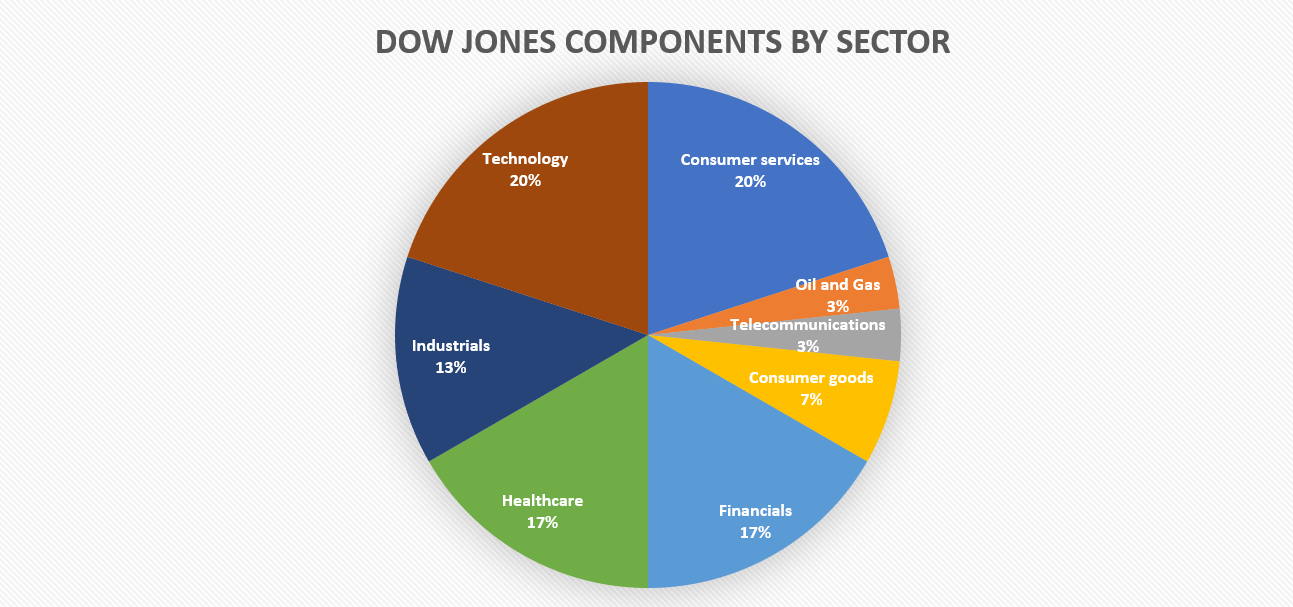
To provide a snapshot of the economy, the Dow is currently balanced across several key sectors:
-
Information Technology: Represented by giants like Microsoft, Apple, and Salesforce. These companies ensure the index reflects the digital transformation of the global economy.
-
Health Care: With components like UnitedHealth Group, Amgen, and Johnson & Johnson, this sector accounts for a significant portion of the Dow’s weighting, reflecting the high cost and high value of the medical industry.
-
Financials: The inclusion of JPMorgan Chase, Visa, and American Express ensures the index tracks the health of the banking and payments systems.
-
Consumer Discretionary and Staples: From the retail dominance of Walmart and Home Depot to the consumer reach of Coca-Cola and Procter & Gamble, these stocks track the spending power of the American public.
Recent Shifts and Modernization
The composition of the Dow is constantly being updated to reflect the “new economy.” A recent significant change was the inclusion of Amazon, which replaced Walgreens Boots Alliance. This move was crucial because it increased the index’s exposure to e-commerce and cloud computing, areas where the previous composition was arguably underweight. Similarly, the addition of Nvidia to replace Intel marked a pivotal shift, acknowledging that the future of computing and industry lies in Artificial Intelligence and high-performance GPUs rather than traditional PC processors.
Criticisms and the Question of Relevance
Despite its fame, the Dow is often criticized by financial professionals for its narrow scope and its “antiquated” weighting system. Because it only tracks 30 companies, critics argue it is not a “true” representation of the thousands of stocks trading in the U.S. market.
The Price-Weighting Debate
The most common criticism is that price-weighting is arbitrary. If a company decides to split its stock, its influence on the Dow drops significantly, even though its market value remains the same. This can lead to situations where the “biggest” company in the world is not the most influential company in the index. For example, a company with a $500 billion market cap and a $400 share price will have more “pull” in the Dow than a $3 trillion company with a $150 share price.
Why the Dow Still Matters
Proponents of the Dow argue that despite its quirks, it remains remarkably correlated with the S&P 500 over long periods. Because the 30 companies are so large and their fortunes are so intertwined with the global economy, their collective performance tends to mirror the broader market. Furthermore, the Dow’s focus on high-quality, profitable, and established “blue chips” makes it an excellent indicator of the stability of the industrial and commercial core of the United States. For many investors, the Dow represents “the establishment”—the companies that have the cash flow to weather recessions and pay consistent dividends.
Leveraging the Dow for Personal Investment Strategies
For the individual investor, understanding what makes up the Dow provides a roadmap for building a stable, dividend-oriented portfolio. Because the Dow components are selected for their stability and reputation, they are often the bedrock of conservative investment strategies.
Index Funds and ETFs
The most direct way to invest in the Dow is through Exchange-Traded Funds (ETFs) that track the index, such as the SPDR Dow Jones Industrial Average ETF Trust (ticker: DIA), often called “Diamonds.” By purchasing shares of this ETF, an investor gains exposure to all 30 companies in their specific weightings. This provides instant diversification across sectors like tech, healthcare, and finance through a single asset.
The “Dogs of the Dow” Strategy
A popular investment strategy involving the index’s makeup is the “Dogs of the Dow.” This strategy involves buying the ten stocks in the DJIA with the highest dividend yield at the beginning of each year. The theory is that these companies are temporarily undervalued, and their high yields reflect a “low” stock price that is likely to rebound. By focusing on the 30 elite companies of the Dow, investors using this strategy are betting on the “mean reversion” of some of the strongest companies in the world.

Conclusion: A Curated View of Capitalism
The Dow Jones Industrial Average is more than just a number; it is a carefully curated selection of 30 corporate titans. Its makeup—governed by the Dow Divisor and a price-weighted logic—offers a unique, albeit narrow, lens through which to view financial health. While it may not capture every corner of the market, the Dow remains the ultimate symbol of American corporate endurance. Whether through the inclusion of AI leaders like Nvidia or retail powerhouses like Amazon, the Dow continues to evolve, ensuring that it remains the most storied and discussed index in the history of finance.
aViewFromTheCave is a participant in the Amazon Services LLC Associates Program, an affiliate advertising program designed to provide a means for sites to earn advertising fees by advertising and linking to Amazon.com. Amazon, the Amazon logo, AmazonSupply, and the AmazonSupply logo are trademarks of Amazon.com, Inc. or its affiliates. As an Amazon Associate we earn affiliate commissions from qualifying purchases.