
The S&P 500 is often cited as the definitive barometer of the United States stock market and, by extension, the health of the American economy. When financial news anchors discuss whether “the market” is up or down, they are almost certainly referring to the Standard & Poor’s 500 Index. For the modern investor, understanding the internal mechanics of this index is not merely an academic exercise; it is a fundamental requirement for building a resilient portfolio. Despite its name, the S&P 500 is not just a list of the 500 largest companies in America. It is a curated, float-adjusted, market-capitalization-weighted index that follows a rigorous set of rules to ensure it represents the leading industries of the U.S. economy.
The Architecture of the Index: Selection Criteria and Weighting
To understand what makes up the S&P 500, one must first understand that it is a managed index. Unlike a simple list that might automatically include companies based on size alone, the S&P 500 is governed by the S&P Dow Jones Indices Index Committee. This committee follows specific eligibility criteria to ensure the index remains “investable” and representative of the large-cap sector.
Market Capitalization Requirements
The primary hurdle for any company seeking entry into the S&P 500 is its unadjusted market capitalization. As of the most recent updates, a company must usually have a market cap of $15.8 billion or greater, though this threshold is periodically adjusted to reflect market conditions. This ensures that the index only contains “large-cap” companies—those with the scale and stability to impact the broader economy.
Financial Viability and Liquidity
Size is not the only factor. A company must be financially healthy to earn a spot. One of the most stringent rules is the requirement for positive as-reported earnings over the most recent quarter, as well as the sum of the most recent four consecutive quarters. This prevents “flash-in-the-pan” startups that may have high valuations but no actual profits from entering the index prematurely. Furthermore, the stock must be highly liquid, meaning it must be easy to buy and sell without moving the price significantly. Specifically, the ratio of annual dollar value traded to float-adjusted market capitalization should be greater than 0.75.
Market Cap Weighting vs. Float Adjustment
The S&P 500 is a market-capitalization-weighted index. This means that companies with higher valuations have a more significant impact on the index’s performance. However, it uses a “float-adjusted” calculation. This means the index only counts the shares that are available to the public for trading, excluding shares held by control groups, other companies, or government agencies. This ensures that the index accurately reflects the portion of the company that investors can actually own.
The Eleven Sectors: The Engine of the Economy
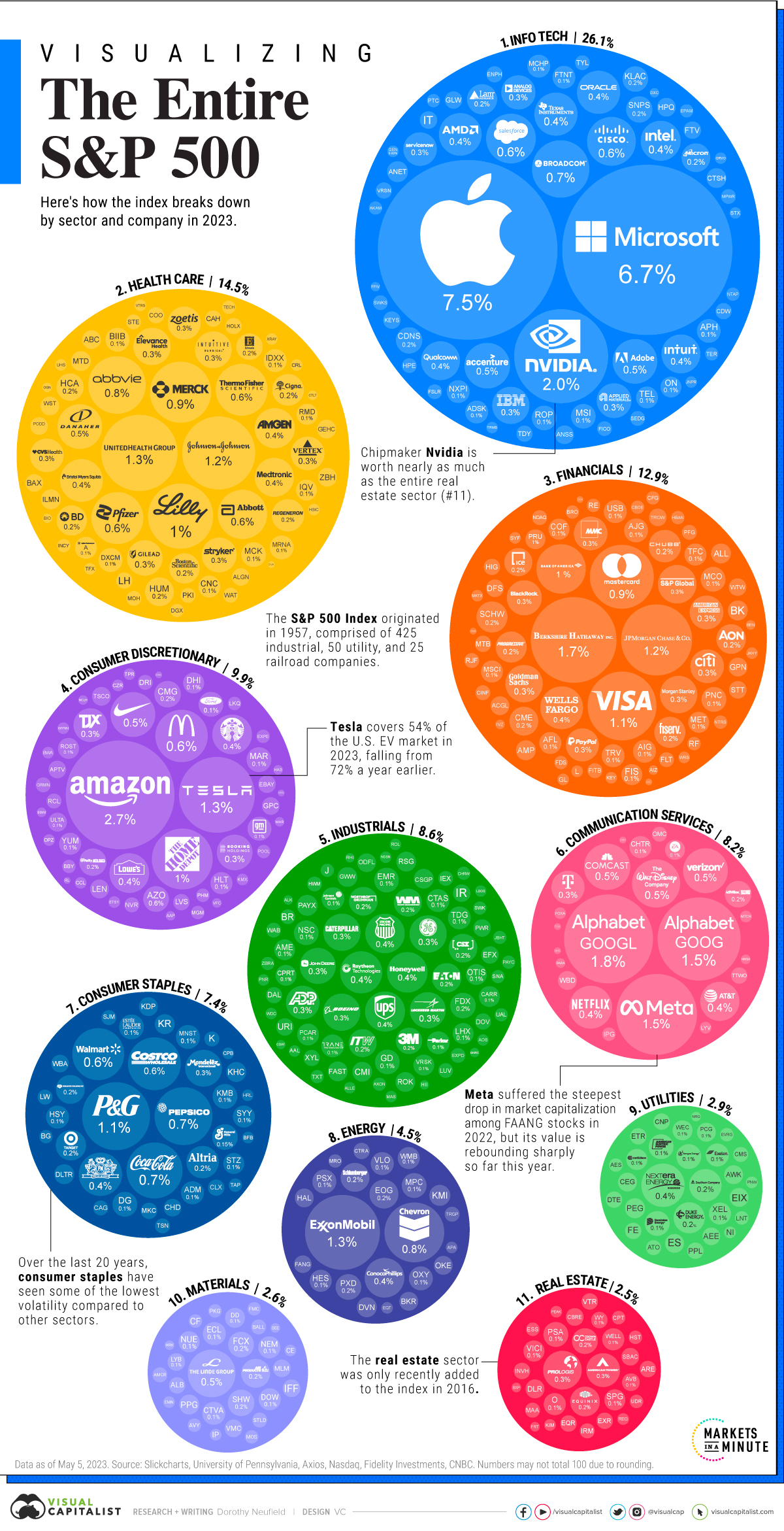
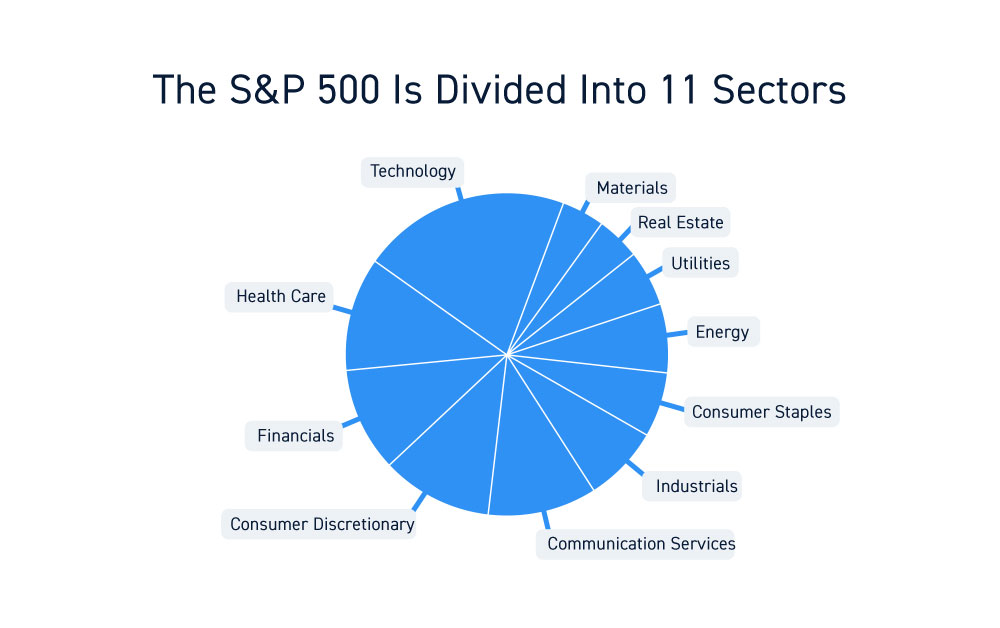
The S&P 500 is categorized into eleven distinct sectors according to the Global Industry Classification Standard (GICS). This classification allows investors to see which parts of the economy are thriving and which are facing headwinds. The balance of these sectors has shifted dramatically over the decades, reflecting the transition from an industrial economy to a digital one.
Information Technology and Communication Services
In the 21st century, the Technology sector has become the dominant force within the S&P 500. This sector includes hardware, software, and semiconductor companies. Closely related is the Communication Services sector, which houses social media giants and telecommunications firms. Together, these sectors often account for more than 30% of the index’s total weight. Their influence is so profound that the performance of just a handful of tech companies can often dictate the direction of the entire index.
Financials and Healthcare
The Financials sector, consisting of banks, insurance companies, and asset managers, was traditionally the heavyweight of the index. While it has been overtaken by Tech, it remains a critical pillar of the S&P 500. Similarly, the Healthcare sector—comprising pharmaceutical giants, biotech firms, and healthcare providers—acts as a defensive core. Because people require medical care regardless of economic conditions, this sector often provides stability during market downturns.
Consumer Discretionary vs. Consumer Staples
The index distinguishes between things we want and things we need. The Consumer Discretionary sector includes companies like e-commerce retailers and automotive manufacturers, which thrive when consumers have extra cash. On the other hand, Consumer Staples includes producers of food, beverages, and household goods. These are the “recession-proof” companies that keep the index grounded when discretionary spending slows down.
Energy, Industrials, and Others
The remaining sectors—Industrials, Materials, Energy, Utilities, and Real Estate—provide the physical infrastructure of the country. While some of these sectors, like Utilities and Real Estate, represent a smaller percentage of the total market cap, they offer essential diversification. The Energy sector, in particular, can be highly volatile, swinging the index based on global oil and gas prices.
The Phenomenon of Concentration: The Top-Heavy Reality
One of the most discussed aspects of what makes up the S&P 500 today is the extreme concentration of wealth in its top holdings. While the index contains 500 companies (and occasionally 503 or 504 separate stock symbols due to multiple share classes), the top 10 companies often account for nearly 30% of the index’s total value.
The Rise of the “Magnificent Seven”
The term “Magnificent Seven” has been coined to describe the handful of mega-cap tech stocks—including Apple, Microsoft, Alphabet (Google), Amazon, Nvidia, Meta (Facebook), and Tesla—that have dominated market returns in recent years. Because the S&P 500 is market-cap weighted, as these companies grow, their “gravity” within the index increases. For an investor, this means that buying an S&P 500 index fund is essentially a heavy bet on the continued success of big tech.
Risks and Rewards of Concentration
Concentration brings a unique set of risks. If the tech sector faces a regulatory crackdown or a cyclical downturn, the S&P 500 will suffer more significantly than a more evenly distributed index might. However, this concentration has also been the primary driver of the index’s historic returns over the last decade. The efficiency of these mega-cap companies in generating massive cash flows has made the S&P 500 one of the most successful investment vehicles in history.
Maintaining the Index: Rebalancing and Evolution
The S&P 500 is not a static list; it is a living organism that evolves with the economy. The Index Committee conducts quarterly rebalancing (in March, June, September, and December) to ensure the weightings are accurate and that the companies still meet the criteria.
Additions and Deletions
When a company’s market cap falls or its financial health deteriorates, it is removed from the index and replaced by a rising star. This “survivorship bias” is actually a benefit for investors. It means the index is constantly pruning the laggards and adding the winners. Famous examples include the addition of Tesla in 2020, which was one of the most anticipated entries in the index’s history, requiring billions of dollars in trades by index funds to accommodate the new member.
The Role of Corporate Actions
Mergers, acquisitions, and spin-offs also change the makeup of the index. If two companies in the S&P 500 merge, a vacancy is created, and the committee must select a new constituent from the “S&P Total Market Index” to fill the spot. This constant turnover ensures that the S&P 500 remains a modern reflection of the corporate landscape rather than a relic of the past.
How to Invest: Turning Knowledge into Strategy
Knowing what makes up the S&P 500 is the first step toward utilizing it as a wealth-building tool. Because it is so difficult for active fund managers to consistently beat the S&P 500, many investors choose to simply “own the index.”
Index Funds and ETFs
The most common way to invest in the S&P 500 is through Exchange-Traded Funds (ETFs) or mutual funds that track the index. Funds like the SPDR S&P 500 ETF Trust (SPY) or the Vanguard S&P 500 ETF (VOO) buy shares in all 500 companies in their exact index weightings. This allows an individual investor to own a tiny slice of the 500 most powerful companies in the world with a single transaction and extremely low fees.
The Equal-Weight Alternative
For investors worried about the concentration of mega-cap tech stocks, there is the option of “Equal-Weight” S&P 500 funds. These funds give each of the 500 companies a 0.2% weighting, regardless of their size. This strategy provides more exposure to smaller, “value” companies and reduces the impact of a potential tech bubble burst, though it may trail the standard index during periods of tech dominance.
In conclusion, the S&P 500 is far more than a simple list of stocks. It is a carefully curated collection of America’s most successful enterprises, governed by strict financial rules and weighted to reflect the reality of the market. Its composition tells the story of the American economy—from its industrial roots to its digital future. By understanding the sectors, the selection process, and the concentration of the index, investors can make more informed decisions about how to position their capital for long-term growth.
aViewFromTheCave is a participant in the Amazon Services LLC Associates Program, an affiliate advertising program designed to provide a means for sites to earn advertising fees by advertising and linking to Amazon.com. Amazon, the Amazon logo, AmazonSupply, and the AmazonSupply logo are trademarks of Amazon.com, Inc. or its affiliates. As an Amazon Associate we earn affiliate commissions from qualifying purchases.