
Understanding the equity structure of Tesla, Inc. requires a deep dive into the holdings of its most prominent figure, Elon Musk. As the CEO and the driving force behind the company’s transition from a niche electric vehicle startup to a global powerhouse in energy and transportation, Musk’s financial stake is more than just a personal fortune—it is a barometer for investor confidence and a significant factor in the company’s governance. For investors and financial analysts, the exact number of shares Musk holds, and the nature of those holdings, provides critical insight into his “skin in the game” and his long-term commitment to the Tesla mission.
The Evolution of Musk’s Equity in Tesla
Elon Musk was not the original founder of Tesla, but he was the primary financier in its early days, leading the Series A funding round in 2004. Since then, his ownership has evolved through various rounds of private funding, the 2010 initial public offering (IPO), and several high-stakes performance-based compensation packages. Unlike traditional CEOs who receive a base salary, Musk’s compensation has been almost entirely tied to the company’s market capitalization and operational milestones.
The Early Investment and IPO
In the mid-2000s, Musk invested millions of his own fortune, earned from the sale of PayPal, into Tesla. By the time the company went public in June 2010 at a price of $17 per share (pre-split), Musk was already the largest shareholder. Over the following decade, his stake grew not through traditional cash purchases, but through the realization of performance milestones set by the Board of Directors. These milestones were designed to align his personal wealth with the company’s valuation, a strategy that has proven immensely successful for long-term shareholders.
The 2018 CEO Performance Award
The most significant shift in Musk’s ownership came via the 2018 CEO Performance Award. This unprecedented compensation plan consisted of a 10-year grant of stock options that vested in 12 tranches. Each tranche was linked to specific increases in Tesla’s market cap and revenue or EBITDA targets. To unlock all tranches, Tesla’s market cap had to reach $650 billion—a figure that seemed astronomical at the time but was eventually surpassed. This plan was designed to give Musk a massive incentive to scale the company, potentially bringing his ownership back toward the 25% mark he has often cited as necessary for maintaining influence over the company’s AI and robotics future.
Current Holdings and Ownership Percentage
As of the most recent SEC filings and proxy statements in 2024, Elon Musk’s ownership of Tesla is a combination of common stock held directly and a massive cache of exercisable stock options. Calculating the exact “number” of shares can be complex because it depends on whether one counts only outstanding shares or the “fully diluted” amount that includes unexercised options.
Breaking Down the Numbers
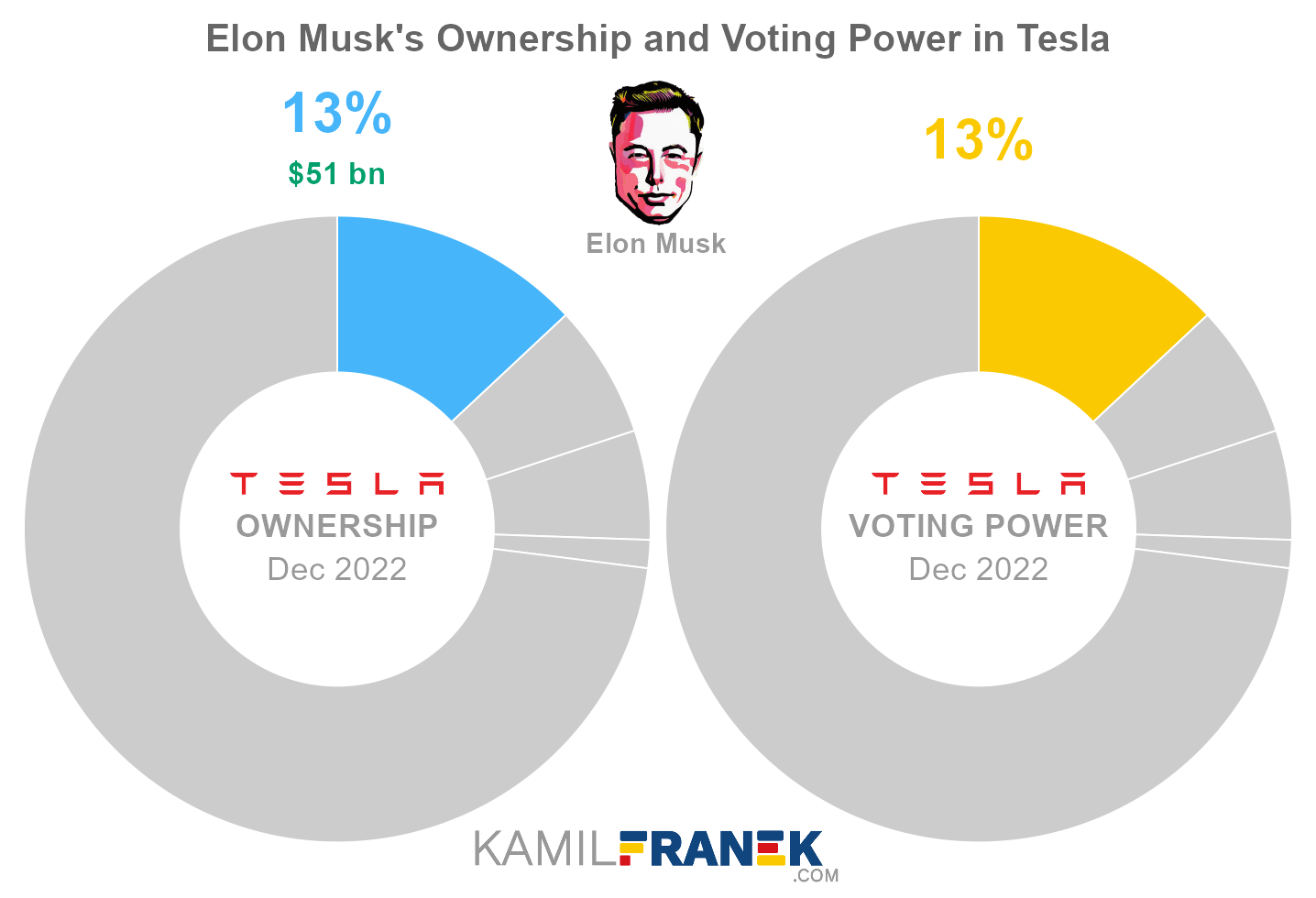
Recent disclosures indicate that Elon Musk owns approximately 411 million shares of Tesla common stock. This represents roughly 12.9% of the total outstanding shares. However, this number does not tell the full story of his economic interest. When including the options he has earned through the 2018 pay package, his potential ownership stake rises significantly. If Musk were to exercise all of his vested options, his total stake would climb toward 20.5%.
The distinction between common stock and options is vital for investors. Common stock provides immediate voting rights, whereas options represent the right to purchase stock at a predetermined price (the strike price). For Musk, these options are deeply “in the money,” meaning the market price of Tesla is significantly higher than the price he would pay to exercise them, representing tens of billions of dollars in unrealized gains.
Direct vs. Indirect Ownership
Musk holds the majority of his shares through the Elon Musk Revocable Trust. This is a common structure for high-net-worth individuals, providing flexibility in estate planning while maintaining full control over the assets. Additionally, it is important to note that a portion of Musk’s shares are “pledged” as collateral for personal loans. According to Tesla’s financial disclosures, Musk has used his equity to secure credit lines, a practice that allows him to access liquidity without selling shares and triggering capital gains taxes. While this is a standard practice among billionaire founders, it is a point of scrutiny for some institutional investors who worry about the potential for forced liquidations if the stock price were to experience a catastrophic drop.
The Impact of the Twitter (X) Acquisition on Tesla Holdings

One of the most volatile periods for Musk’s Tesla ownership occurred in 2022, during his $44 billion acquisition of the social media platform Twitter (now X). To fund the purchase, Musk had to liquidate a substantial portion of his Tesla holdings, leading to significant downward pressure on the stock price and concern among the “Tesla faithful.”
Liquidation Events of 2022
Throughout 2022, Musk sold nearly $40 billion worth of Tesla stock in several tranches. These sales were a departure from his previous stance of “last in, last out,” where he suggested he would be the last person to sell the company’s stock. The liquidations reduced his stake from approximately 17% of outstanding shares to the current 12.9%. For the market, these sales were a double-edged sword: they provided the necessary capital for the X acquisition but also introduced a period of “key man risk,” where investors worried that Musk’s focus and capital were being diverted away from Tesla’s core mission.
The Margin Loan Strategy
Initially, Musk intended to use margin loans secured by his Tesla shares to fund the Twitter deal. However, as the tech market faced a downturn in late 2022, he pivoted away from heavy margin borrowing in favor of direct equity sales. This move was likely intended to protect his remaining stake from a “margin call,” which occurs when a lender demands additional collateral or the sale of assets to cover a loan if the value of the pledged stock falls below a certain threshold. By selling shares outright, Musk de-leveraged his position, though at the cost of a smaller percentage of ownership in the automaker.
Future Projections: Stock Options and the 25% Goal
The future of Musk’s ownership is currently at a crossroads, influenced by both legal battles and his own stated desires for the company’s governance. The central conflict revolves around his goal of achieving 25% voting control to safely steer Tesla toward becoming a leader in Artificial General Intelligence (AGI) and robotics.
The Delaware Court Ruling
In early 2024, a Delaware judge voided Musk’s 2018 $56 billion pay package, ruling that the process for approving the plan was “deeply flawed” and that the board was not sufficiently independent. This ruling threw Musk’s future equity into question. If the ruling stands and a new compensation plan is not reached, Musk could lose the right to tens of millions of shares he earned over the last six years. This would effectively cap his ownership at his current 12.9% (excluding other older options), far below the 25% threshold he desires.
Musk’s Push for Greater Control
Musk has been vocal on social media about his discomfort with expanding Tesla’s AI capabilities—such as Optimus (the humanoid robot) and Full Self-Driving (FSD)—unless he has enough voting power to ensure the technology is used responsibly and to prevent a hostile takeover by “dubious interests.” To reach 25% ownership from his current position, Musk would need a significant new compensation grant or would need to purchase shares on the open market—the latter being unlikely given the sheer capital required. This tension between the CEO and the legal/governance framework of the company remains a primary focal point for financial analysts heading into the next fiscal year.
What Musk’s Stake Means for Investors
For the individual investor, the size of Elon Musk’s stake in Tesla is a testament to the company’s “Founder-Led” advantage. Finance research often suggests that companies where founders retain a significant equity stake tend to outperform the broader market due to long-term thinking and a willingness to take calculated risks that professional “hired hand” CEOs might avoid.
Alignment of Interests
Musk’s wealth is almost entirely tied to the performance of Tesla (along with SpaceX and X). This alignment of interests means that when shareholders lose money, Musk loses significantly more. This “skin in the game” is often cited as the reason for Tesla’s aggressive R&D spending and its “first-principles” approach to manufacturing. However, the high concentration of ownership also brings “Key Person Risk.” Because so much of the company’s value is tied to Musk’s vision and his specific shares, any personal financial instability or a decision to move on from the company could lead to extreme volatility.
Institutional Ownership vs. Musk’s Stake
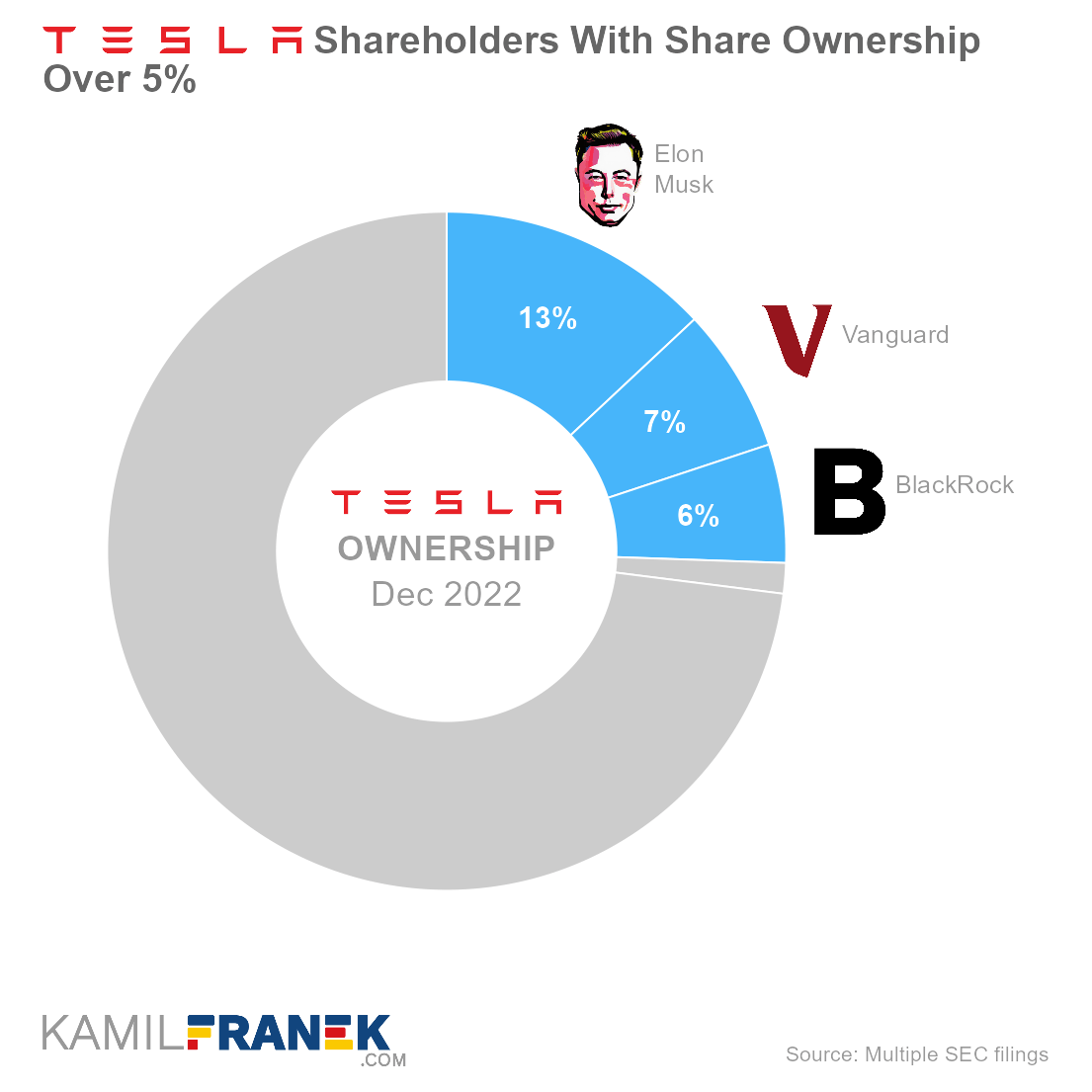
While Musk is the largest individual shareholder, institutional investors like Vanguard, BlackRock, and State Street also hold massive positions in Tesla, often through index funds. These institutions provide a stabilizing force, but they also act as a check on Musk’s power. The recent legal challenges to his pay package were driven by smaller shareholders, but the outcome will depend on how institutional giants view the balance between rewarding Musk’s past success and ensuring modern corporate governance standards.
In conclusion, Elon Musk currently owns approximately 411 million shares of Tesla, representing roughly 13% of the company, with the potential to reach over 20% through vested options. While his stake has been diluted by the acquisition of X and legal challenges to his compensation, he remains the most significant force in the company’s financial and strategic landscape. For those navigating the world of Tesla as an investment, keeping a close eye on Musk’s Form 4 filings with the SEC remains one of the most important aspects of fundamental analysis.
aViewFromTheCave is a participant in the Amazon Services LLC Associates Program, an affiliate advertising program designed to provide a means for sites to earn advertising fees by advertising and linking to Amazon.com. Amazon, the Amazon logo, AmazonSupply, and the AmazonSupply logo are trademarks of Amazon.com, Inc. or its affiliates. As an Amazon Associate we earn affiliate commissions from qualifying purchases.