
The journey into software development often begins with a single, paralyzing question: “Where do I start?” With hundreds of programming languages in existence, the choice can feel overwhelming for a beginner. However, the goal of your first language is not necessarily to pick the “best” one, but to pick the one that provides the clearest path to understanding fundamental concepts like logic, data structures, and algorithmic thinking. By choosing the right tool, you can minimize the friction of the learning curve and build the confidence necessary to tackle more complex systems later.
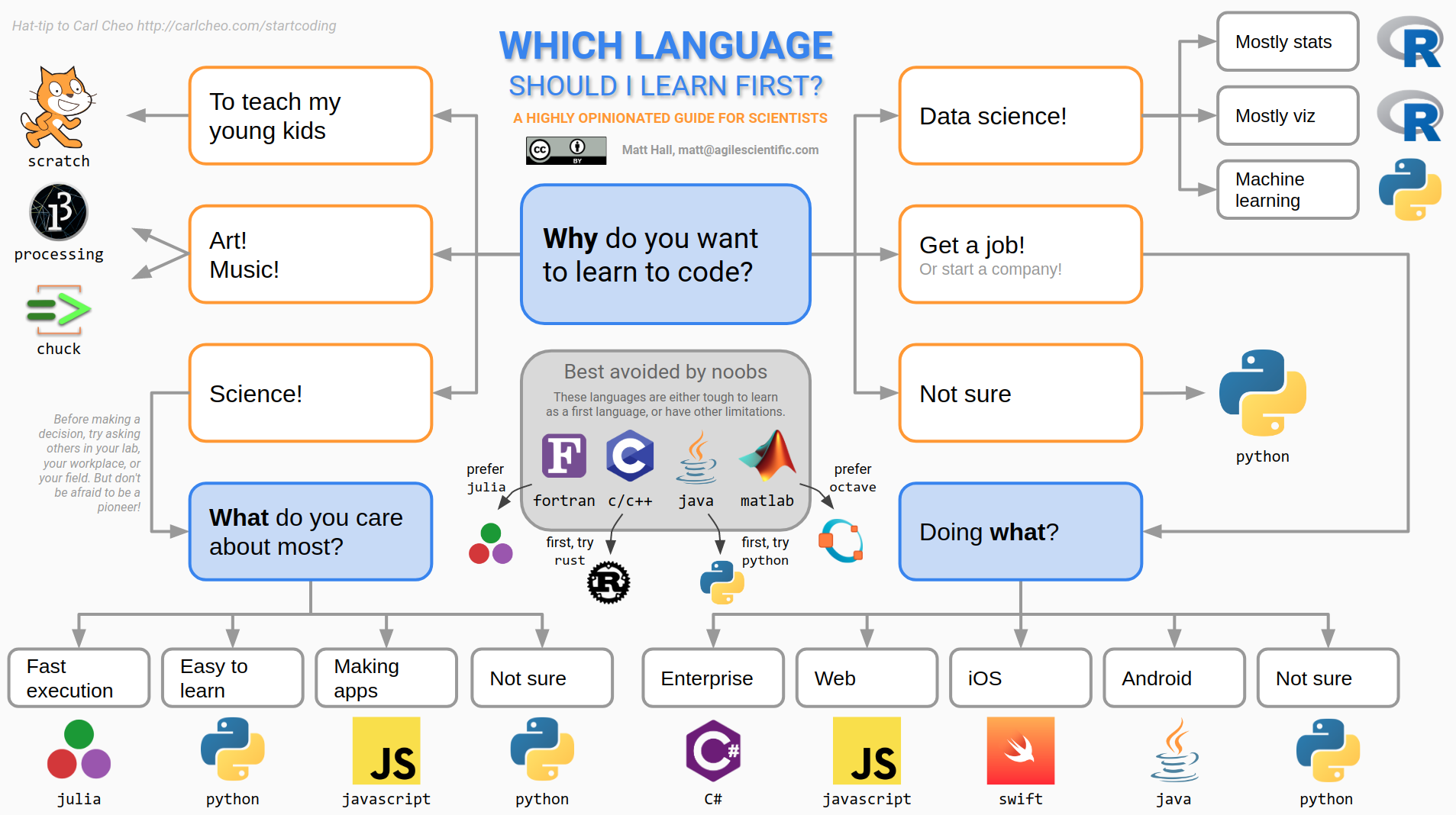
Defining Your Objective: The “Why” Dictates the “What”
Before writing your first line of code, you must establish what you want to build. Programming is a tool, not a monolith; the language you choose should be an extension of your primary interest.
Web Development and the Visual Web
If your interest lies in creating websites, interactive interfaces, or browser-based applications, the path is relatively straightforward. You should begin with the foundational trio: HTML, CSS, and JavaScript. While HTML and CSS are markup and styling languages respectively, JavaScript is the engine that makes the web dynamic. Learning JavaScript first allows you to see the results of your code instantly in a web browser. It is the language of the modern web, and mastering it provides an immediate feedback loop that is highly motivating for beginners.
Data Science and Scientific Computing
For those drawn to statistics, artificial intelligence, and machine learning, Python is the undisputed champion. Python is designed for readability; its syntax mimics the English language, which lowers the barrier to entry significantly. Beyond its simplicity, Python boasts a massive ecosystem of libraries like Pandas, NumPy, and TensorFlow. By learning Python first, you are not just learning syntax; you are entering a community that is leading the charge in data analysis and automated intelligence.
Systems Programming and Performance
If your fascination lies in the “how” rather than the “what”—specifically, how software interacts with hardware, memory management, and high-performance computation—you might consider C or C++. These languages are more demanding. They require a deeper understanding of how the computer manages memory and processes data. While the learning curve is steeper, starting here provides you with a “low-level” foundation that makes every other language you learn later feel significantly easier.
The Case for Python: The Beginner’s Gold Standard
For the majority of aspiring developers who do not have a specific niche in mind, Python remains the most recommended starting point. Its popularity is not merely a trend; it is a structural advantage for those new to the craft.
Readability and Syntax
Many languages require boilerplate code—extra lines of text required to satisfy the compiler—before you can output a simple “Hello, World.” Python strips this away. By focusing on indentation and clean structure, Python forces the learner to write code that is inherently readable. This allows you to focus on the logic of the problem rather than the syntax of the language.
Versatility Across Domains
A Python developer can pivot into web development with frameworks like Django or Flask, jump into automation with scripting, or pivot toward data science. This versatility means that your time investment is protected; you are not locking yourself into a single, narrow professional lane by starting with Python.
A Robust Community and Ecosystem
When you encounter a bug, and you will, the sheer number of Python users ensures that the solution is already on a forum like Stack Overflow. For a beginner, the ability to find answers quickly prevents the kind of frustration that leads to quitting. The extensive documentation and abundance of tutorials mean that you will rarely feel stranded.
Transitioning from Learning to Building
The mistake many beginners make is falling into “tutorial hell,” where they watch hours of videos without actually writing code. Once you have a basic grasp of variables, loops, and functions in your chosen language, you must shift your focus toward project-based learning.
The Power of Small Projects
Do not attempt to build the next social media empire as your first project. Start with small, manageable utilities:
- A calculator.
- A task-tracking CLI tool.
- A simple web scraper that pulls weather data.
- A guessing game.
These projects teach you how to decompose a large problem into small, solvable units. They also expose you to the reality of the development lifecycle: writing code, testing it, encountering errors, debugging, and finally shipping a working product.
Version Control: The Professional Habit
Regardless of the language you choose, you should learn Git as early as possible. Git is a version control system that allows you to save “snapshots” of your code, revert to previous versions if you break something, and collaborate with others. Treating your code like a professional project from day one will distinguish you from the hobbyist who treats code as a disposable script.
Avoiding the “Language Hopping” Trap
One of the greatest enemies of a beginner is the illusion that the next language will be easier or better. You may spend a week with Python, feel stuck, and assume that switching to JavaScript will solve your problems. This is known as “language hopping,” and it is detrimental to your progress.
Mastery of Concepts Over Syntax
Programming is primarily about problem-solving. A “for loop” in Python functions conceptually the same way as a “for loop” in C++, Java, or Go. Once you understand the underlying concept of iteration, you can apply it anywhere. If you constantly switch languages, you never get the chance to master these core concepts. Stick to one language until you are comfortable building a complete project from scratch, and only then consider adding a second tool to your arsenal.
The T-Shaped Developer Approach
Your goal should be to become a “T-shaped” professional. This means having a broad understanding of the tech landscape (the horizontal bar of the T) but developing deep, expert-level knowledge in one specific language or domain (the vertical bar). By choosing one language and sticking to it until you are proficient, you establish the vertical depth that employers and technical mentors value most.
Choosing for the Future: Long-Term Viability
When selecting your first language, consider the longevity of your choice. Languages like Java and C# have been enterprise staples for decades. They are verbose and strict, but they provide a solid foundation for understanding object-oriented programming (OOP). If your goal is to land a job at a large, established corporation, these languages are excellent starting points.
Conversely, newer languages like Rust or Go are gaining traction for their performance and safety features. While they are more challenging for a total novice, they represent the future of systems-level engineering. However, for a beginner, the “hottest” language is rarely the right one. You want a language with proven stability, a deep pool of educational resources, and a wide array of professional applications.
Ultimately, the choice of your first language is the beginning of a lifelong process of learning. The technology industry moves fast; you will almost certainly learn a second, third, and fourth language throughout your career. Your first language is simply the bridge that takes you from someone who consumes technology to someone who builds it. Pick a path that interests you, commit to it with a project-based mindset, and prioritize the logic over the syntax. In the end, the best language to learn is the one you will actually use to build something you care about.
aViewFromTheCave is a participant in the Amazon Services LLC Associates Program, an affiliate advertising program designed to provide a means for sites to earn advertising fees by advertising and linking to Amazon.com. Amazon, the Amazon logo, AmazonSupply, and the AmazonSupply logo are trademarks of Amazon.com, Inc. or its affiliates. As an Amazon Associate we earn affiliate commissions from qualifying purchases.