
In the world of technology, data science, and software engineering, we often find ourselves utilizing complex frameworks and high-level abstractions to solve problems. However, the most sophisticated artificial intelligence models and the most seamless graphics engines are built upon fundamental mathematical principles. One of the most essential, yet frequently overlooked, concepts is the x-intercept.
While many of us first encountered the x-intercept in a middle-school algebra classroom, its application in the modern tech stack is profound. Whether you are a data scientist calculating the “break-even” point of a predictive model, a game developer programming collision detection, or a software engineer optimizing a search algorithm, understanding the x-intercept is crucial. This article explores the technical definition of the x-intercept and delves into its diverse applications across the technology landscape.

The Mathematical Foundation of the X-Intercept in Computing
At its simplest level, the x-intercept is the point where a graph or a line crosses the horizontal axis—the x-axis. In a two-dimensional Cartesian coordinate system, this point always has a y-coordinate of zero. Mathematically, if we have a function $f(x)$, the x-intercept occurs at the value of $x$ where $f(x) = 0$.
Defining the X-Intercept in a Digital Coordinate System
In software development, particularly in computer graphics and UI/UX design, the coordinate system is the map upon which all visual elements are placed. While standard mathematics puts the origin (0,0) in the center, many digital environments (like HTML/CSS or game engines like Unity) place the origin in the top-left corner.
Despite these variations in orientation, the logic remains the same: identifying the intercept allows a program to determine where an object meets a specific boundary. For a developer, the x-intercept is more than just a dot on a graph; it is a “trigger point” or a “root” that signifies a change in state.
Linear Equations and Function Visualization
In the tech sector, we rely heavily on linear equations ($y = mx + b$) to represent trends. The “b” represents the y-intercept (where the trend starts), but the x-intercept represents the “root” or the solution to the equation. When we are programming algorithms that require a target value to be zero—such as balancing a budget in a fintech app or neutralizing a signal in audio processing—we are essentially solving for the x-intercept.
Practical Applications in Software Development and Graphics
The transition from theoretical math to functional code is where the x-intercept truly shines. Modern software relies on spatial awareness and logical boundaries, both of which are rooted in coordinate geometry.
Collision Detection in Game Engines
If you have ever played a video game, you have witnessed x-intercept logic in action. Collision detection is the computational process of determining when two objects in a digital space touch or overlap. When a character moves across a screen, the engine constantly calculates the trajectory of that movement.
If the trajectory is modeled as a function, the “walls” or “floors” of the game level serve as the axes. The x-intercept helps the engine determine the exact moment a projectile hits a vertical boundary. By calculating these intercepts in real-time, developers can create realistic physics and responsive environments.
User Interface (UI) Design and Responsive Layouts
Responsive web design is another area where intercept logic is applied. Developers use “breakpoints”—specific pixel widths where the website layout changes to fit a screen. While this is often handled by CSS media queries today, the underlying logic involves calculating where a container’s width (the x-value) meets the limits of the viewport. Understanding how elements intersect with the boundaries of a screen is fundamental to creating a seamless user experience across devices, from ultra-wide monitors to compact smartphones.
The X-Intercept in Data Science and Machine Learning
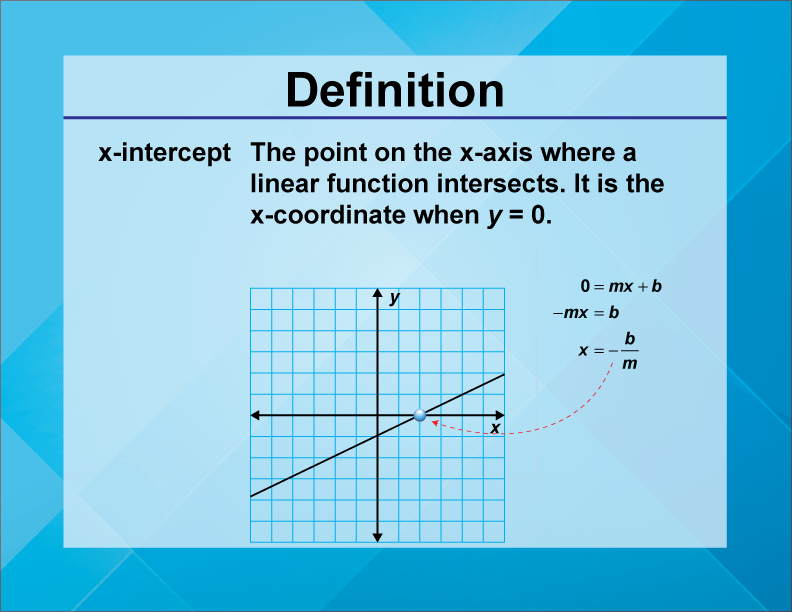
In the niche of data science, the x-intercept is rarely called by its simple name. Instead, it is often referred to as a “root,” a “zero,” or a “null point.” Regardless of the terminology, it is a cornerstone of predictive modeling.
Linear Regression: The Starting Point of Prediction
Linear regression is one of the most common AI tools used to predict future outcomes based on historical data. When a data scientist plots a “line of best fit” through a scatter plot of data points, they are creating a mathematical model.
In this context, the x-intercept can represent a critical threshold. For example, if a tech company is modeling the relationship between “Ad Spend” and “Net Profit,” the x-intercept on the “Ad Spend” axis could indicate the point where profit drops to zero, helping the company identify the maximum amount they can spend before they start losing money. It provides a definitive “zero-out” point that guides strategic decision-making.
Optimization and Root-Finding Algorithms
Machine learning models are trained using optimization algorithms like Gradient Descent. The goal of these algorithms is to minimize “loss”—the difference between the model’s prediction and the actual reality.
Finding the x-intercept of a derivative function is a primary method for locating the “minimum” or “maximum” of a function. In simpler terms, to make an AI as accurate as possible, the software must find the point where the error rate (y) is zero. Finding that intercept is the “Holy Grail” of model training, ensuring the algorithm is as efficient and precise as possible.
Analyzing Trends: Why the X-Intercept Matters in Business Intelligence Tools
Modern Business Intelligence (BI) platforms like Tableau, PowerBI, and Google Looker Studio transform raw tech data into visual insights. Within these tools, the x-intercept serves as a vital marker for performance metrics.
Break-even Analysis in SaaS Metrics
For Software as a Service (SaaS) companies, the “Time to Recover CAC” (Customer Acquisition Cost) is a vital metric. By plotting the cumulative revenue of a customer over time, the x-intercept represents the “Break-even Point.”
Until the line crosses that horizontal axis (the x-intercept), the customer is a net loss for the company. Tech executives use this intercept to determine the health of their business model. If the x-intercept is too far to the right (meaning it takes too long to reach zero), the company may need to pivot its pricing strategy or reduce its operational overhead.
Predictive Analytics and Forecasting
When tech firms forecast future growth, they use time-series analysis. If a trend line is declining, the x-intercept becomes a “warning sign.” It represents the theoretical date when a metric—such as “Active User Count” or “System Memory Storage”—will hit zero. By identifying this intercept in advance, DevOps teams and product managers can intervene before a system failure or a total loss of the user base occurs.
Future Tech: Beyond 2D Intercepts in Multi-Dimensional AI
As we move toward a future dominated by three-dimensional environments (the Metaverse, AR/VR) and multi-dimensional data (Deep Learning), the concept of the x-intercept is evolving.
In a 3D coordinate system, we don’t just look for an x-intercept; we look for the point where a plane intersects with an axis ($x, 0, 0$). In high-dimensional vector spaces—used by Large Language Models (LLMs) like GPT-4—data points are represented in hundreds of dimensions. While we can no longer “see” the x-intercept in these complex models, the mathematical logic remains the same. The “zero points” in these high-dimensional spaces help the AI categorize information, distinguish between different languages, and even identify the sentiment of a piece of text.

Conclusion: The Quiet Power of Fundamental Mathematics
The x-intercept may seem like a basic remnant of secondary education, but in the fast-paced world of technology, it is a foundational tool. It is the point of impact in a game, the break-even point in a business model, and the optimization goal in a machine learning algorithm.
For tech professionals, mastering these fundamental concepts is what separates a coder from an engineer. By understanding the “why” and “where” of the x-intercept, we can build more robust software, more accurate models, and more insightful data visualizations. As technology continues to advance into the realms of quantum computing and spatial web, the humble x-intercept will remain a constant—a reliable anchor in an ever-shifting digital sea.
aViewFromTheCave is a participant in the Amazon Services LLC Associates Program, an affiliate advertising program designed to provide a means for sites to earn advertising fees by advertising and linking to Amazon.com. Amazon, the Amazon logo, AmazonSupply, and the AmazonSupply logo are trademarks of Amazon.com, Inc. or its affiliates. As an Amazon Associate we earn affiliate commissions from qualifying purchases.