
In the world of sophisticated investing, few instruments offer as much potential for rapid wealth accumulation—or as much risk for sudden capital erosion—as leveraged exchange-traded funds (ETFs). At the forefront of this category is UPRO, the ticker symbol for the ProShares UltraPro S&P 500. For investors looking to amplify their exposure to the flagship index of the American economy, UPRO provides a powerful, albeit complex, tool.
UPRO is designed to provide three times (3x) the daily performance of the S&P 500 Index. This means that if the S&P 500 rises by 1% on a given day, UPRO is engineered to rise by approximately 3%. Conversely, if the index falls by 1%, UPRO is expected to decline by 3%. Understanding the mechanics, risks, and strategic applications of this fund is essential for any investor considering adding leverage to their portfolio.

Understanding the Mechanics of UPRO
To appreciate what UPRO is, one must first understand how it achieves its leveraged status. Unlike a traditional ETF like SPY or VOO, which holds the underlying stocks of the S&P 500 in proportion to their market capitalization, UPRO utilizes financial derivatives to achieve its objectives.
The Role of Derivatives and Swaps
UPRO does not simply buy three times as many shares of Apple, Microsoft, and Amazon. Instead, the fund managers at ProShares enter into swap agreements with major financial institutions. These swaps are contracts where the fund agrees to exchange cash flows based on the performance of the S&P 500. By using these derivatives, the fund can gain significant exposure to the index’s price movements without needing the full collateral that would be required to buy the physical stocks.
Because these contracts are reset daily, UPRO is strictly a “daily” target instrument. This is a critical distinction that many novice investors overlook. The 3x leverage applies to the one-day move, not necessarily the long-term cumulative move of the index.
The Expense of Leverage
Managing a leveraged fund is significantly more capital-intensive and complex than managing a passive index fund. As a result, UPRO carries a higher expense ratio than standard ETFs. While a traditional S&P 500 fund might charge between 0.03% and 0.09% annually, UPRO typically sports an expense ratio around 0.91% to 0.95%. This fee covers the costs of the swap agreements, rebalancing transactions, and management oversight. While this may seem high, it is often more cost-effective for traders than borrowing money on margin from a brokerage to achieve similar leverage.
The Mathematical Reality: Volatility Decay and Compounding
One of the most misunderstood aspects of UPRO is how it performs over periods longer than a single trading day. Because the fund resets its 3x exposure daily, it is subject to a phenomenon known as “volatility decay” or “path dependency.”
The Impact of Daily Rebalancing
Consider a hypothetical scenario where the S&P 500 is at 100. On day one, the index rises 10% to 110. UPRO, being 3x leveraged, rises 30%. On day two, the index drops 9.09%, returning to its original price of 100. However, UPRO drops 3x that amount (27.27%) from its elevated position. In this scenario, while the underlying index is flat over two days, UPRO has actually lost value.
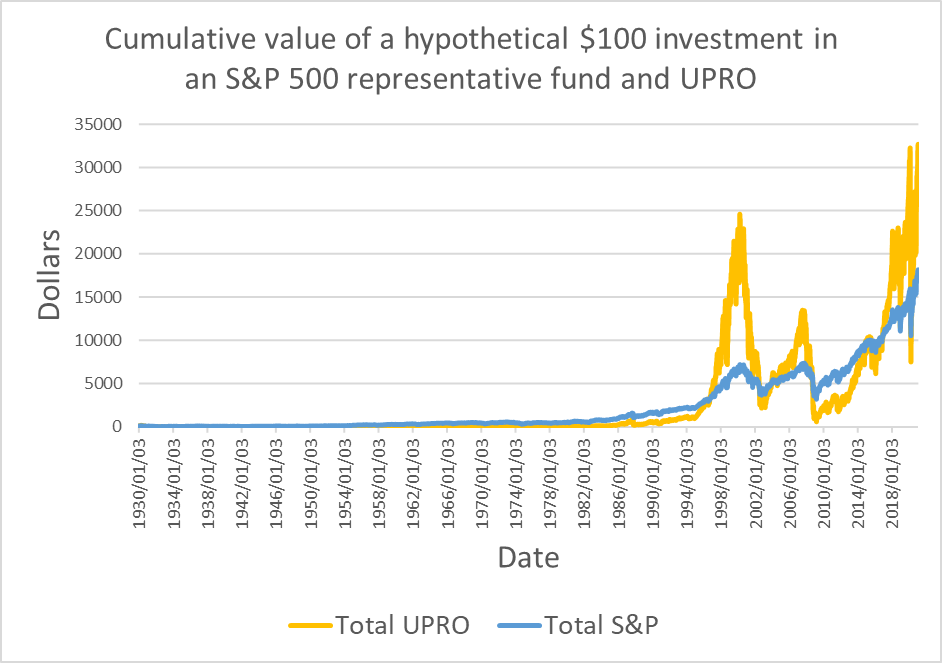
This mathematical drag occurs in sideways or choppy markets. When the market moves up and down without a clear trend, the constant rebalancing at different price points “eats” away at the fund’s Net Asset Value (NAV). This is why UPRO is often described as a trading vehicle rather than a “buy and hold” investment for the faint of heart.
Compounding in Trending Markets
Conversely, in a strong, low-volatility bull market, the daily compounding works in the investor’s favor. During a sustained upward trend, the 3x daily gains compound on top of one another. In these specific market conditions, UPRO can actually return more than three times the total return of the S&P 500 over a long period. For instance, during the prolonged bull market of the 2010s, UPRO significantly outperformed a simple 3x calculation of the S&P 500’s total return due to the power of positive compounding.
Strategic Implementation in a Financial Portfolio

Given its high-octane nature, UPRO is not a “set it and forget it” asset for the average retail investor. However, in the hands of a disciplined strategist, it can serve several distinct purposes within a diversified financial plan.
Tactical Swing Trading
Many active traders use UPRO to capitalize on short-term market momentum. If a trader anticipates a “relief rally” or a positive reaction to an economic report, UPRO allows them to deploy less capital to achieve the same dollar-for-dollar exposure as a larger position in a non-leveraged fund. This frees up capital for other trades or maintains a higher cash cushion.
The “Hedgefundie” Strategy and Risk Parity
In recent years, UPRO has gained a cult following in certain financial circles through a strategy known as “Hedgefundie’s Excellent Adventure” (HFEA). This strategy involves pairing UPRO with a 3x leveraged long-term Treasury ETF (such as TMF).
The logic is based on Modern Portfolio Theory: by combining two highly volatile, negatively correlated assets and rebalancing them quarterly, an investor can theoretically achieve market-beating returns with managed drawdowns. In this setup, UPRO provides the growth engine, while the leveraged treasuries act as a “crash insurance” policy, as bond prices often spike during equity sell-offs. While historically successful, this strategy carries immense risk, particularly in inflationary environments where both stocks and bonds may decline simultaneously.
Efficient Capital Allocation
For investors who are “capital constrained,” UPRO offers a way to achieve market exposure while keeping a significant portion of their portfolio in low-risk assets like money market funds or short-term bonds. For example, an investor could put 33% of their portfolio into UPRO and 67% into cash. This effectively gives them 100% exposure to the S&P 500 while maintaining a massive cash reserve for emergencies or other opportunities.
Navigating the Risks: Drawdowns and Liquidity
No discussion of UPRO is complete without a stark look at the risks involved. Leverage is a double-edged sword that cuts deeply during market corrections.
The Threat of a 90% Drawdown
The S&P 500 has, historically, experienced multiple corrections of 10% to 20% and several bear markets exceeding 30% to 50%. In a 3x leveraged environment, these moves are magnified. If the S&P 500 drops 10% in a single day (a rare but possible “black swan” event), UPRO would drop 30%. If the market continues to slide, UPRO can easily see drawdowns of 80% or 90%.
Recovering from a 90% loss requires a 900% gain just to get back to break-even. This is the primary reason why financial advisors warn against putting a large percentage of one’s net worth into UPRO. The psychological toll of watching a portfolio evaporate during a market panic often leads investors to sell at the bottom, locking in catastrophic losses.
Regulatory and Liquidity Considerations
UPRO is a highly liquid ETF, typically trading millions of shares per day with tight bid-ask spreads. This makes it easy to enter and exit positions. However, investors should be aware that leveraged ETFs are frequently under scrutiny by regulators like the SEC and FINRA. There are periodic discussions regarding restricting access to these products for retail investors who may not fully grasp the mathematical complexities. Furthermore, in extreme market crashes, the “circuit breakers” on the stock exchange and the internal mechanics of the swap agreements could theoretically lead to a decoupling of the fund from its index, though this remains an outlier risk.
Is UPRO Right for Your Portfolio?
Determining whether UPRO has a place in your financial strategy depends entirely on your risk tolerance, investment horizon, and market expertise. It is a specialized tool designed for a specific set of circumstances.
Suitability for Long-Term Investors
While most prospectuses state that UPRO is intended for daily use, some sophisticated investors argue that it can be held long-term if it represents a small, controlled “satellite” portion of a portfolio. However, this requires a stomach for extreme volatility and a disciplined rebalancing schedule. For the vast majority of long-term retirement savers, the standard, non-leveraged S&P 500 index funds remain the superior choice for steady wealth building.
Conclusion: A Tool for Precision
UPRO is a testament to the innovation of modern financial markets. It provides institutional-grade leverage to the average investor, democratizing a strategy that was once the exclusive domain of hedge funds and professional trading desks.
When used correctly—as a tactical tool for short-term gains, a capital-efficient way to gain market exposure, or a component of a diversified leveraged strategy—UPRO can be an invaluable asset. When used incorrectly, without an understanding of daily resets and volatility decay, it can be a recipe for financial ruin. As with any high-performance instrument, the key lies not in the tool itself, but in the skill and discipline of the person wielding it.
aViewFromTheCave is a participant in the Amazon Services LLC Associates Program, an affiliate advertising program designed to provide a means for sites to earn advertising fees by advertising and linking to Amazon.com. Amazon, the Amazon logo, AmazonSupply, and the AmazonSupply logo are trademarks of Amazon.com, Inc. or its affiliates. As an Amazon Associate we earn affiliate commissions from qualifying purchases.