
In the landscape of modern retail, few sectors have witnessed a metamorphosis as dramatic as the secondhand apparel market. Once relegated to dusty thrift stores and local consignment shops, the resale economy has transitioned into a global powerhouse, projected to reach $350 billion by 2027. At the center of this financial shift is thredUP, an online resale platform that has effectively industrialized the process of buying and selling used clothing. To understand what thredUP is from a financial and business perspective is to understand the “re-commerce” movement—a sector that blends logistics, technology, and consumer finance to redefine how we value the items in our closets.

ThredUP operates as a managed marketplace, a distinct business model that differentiates it from peer-to-peer platforms like eBay or Poshmark. Instead of requiring users to photograph, list, and ship individual items, thredUP centralizes the process through a massive network of automated distribution centers. This infrastructure-heavy approach is designed to solve the scalability problem that has historically plagued the resale industry, transforming “used goods” into a liquid asset class for consumers and a viable revenue stream for investors.
The Economics of Re-commerce: How thredUP Redefined the Secondary Market
The financial core of thredUP lies in its ability to process millions of unique SKUs (Stock Keeping Units) with high efficiency. In traditional retail, a warehouse might hold 10,000 units of the same black t-shirt. At thredUP, the warehouse holds 10,000 unique items, each with its own brand, size, condition, and price point. The company’s financial viability hinges on its proprietary “single-SKU” logistics systems, which use machine learning to price items based on real-time market demand, historical data, and seasonal trends.
The Market Valuation of Secondhand Apparel
For years, the financial value of used clothing was considered “sunk cost.” Once an item was purchased at retail, its resale value was often zero unless it was a high-end luxury piece. ThredUP changed this calculus by creating a transparent pricing ecosystem for mid-market and mass-market brands. By providing a platform where brands like Lululemon, J.Crew, and Madewell retain a significant percentage of their original MSRP (Manufacturer’s Suggested Retail Price), thredUP has helped consumers view their wardrobes as a rotating portfolio of assets rather than a collection of depreciating goods.
Solving the Scalability Problem in Resale
The primary barrier to profitability in resale is the cost of labor and logistics relative to the low average order value (AOV). ThredUP’s financial strategy has focused on extreme automation. By investing heavily in robotics and AI-driven sorting, they have lowered the cost-per-processed-unit. From a business finance perspective, this is a race toward a “break-even” point where the volume of goods processed offsets the high fixed costs of their distribution centers. For investors, the question is not whether there is a demand for secondhand goods—the demand is skyrocketing—but whether the margins can eventually mimic those of traditional e-commerce giants.
thredUP as a Financial Tool: Selling for Profit and Saving on Essentials
For the individual consumer, thredUP functions as a personal finance tool. In an era of high inflation and fluctuating discretionary income, the platform offers two distinct financial levers: a source of passive side income and a mechanism for significant cost savings.
The “Clean Out Kit” Model: Convenience vs. Commission
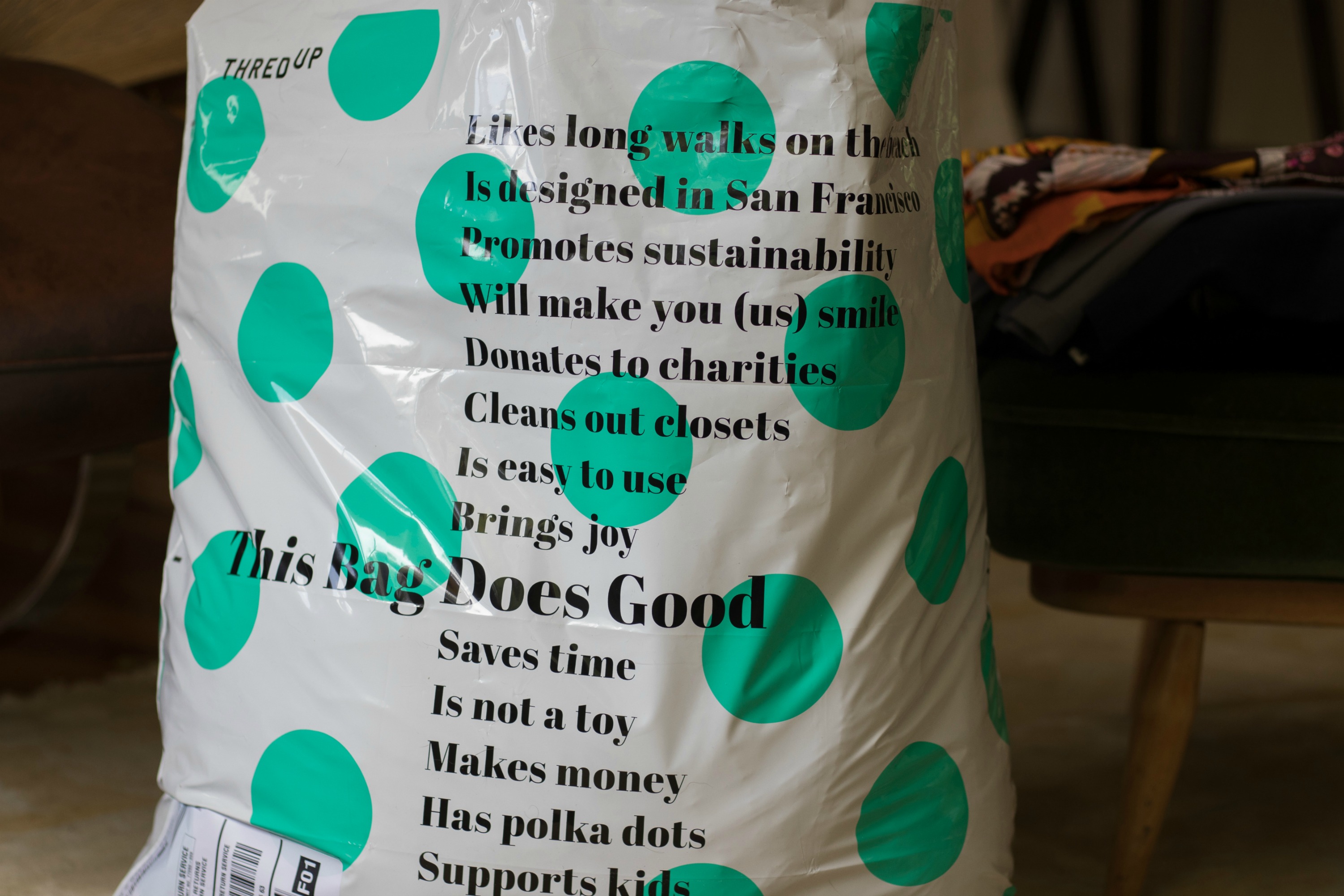
ThredUP’s “Clean Out Kit” is the engine of its supply chain. Users request a bag, fill it with clothes, and send it back. Unlike peer-to-peer platforms where the seller keeps 80% or more of the sale price, thredUP’s payout structure is tiered. Sellers earn a percentage of the selling price, which can range from as low as 3% to 5% for budget items to as high as 80% for premium luxury goods.
While the commission rates on lower-end items are modest, the “financial product” thredUP is selling to the user is time. For many busy professionals, the opportunity cost of listing 50 individual items on a marketplace is higher than the lost commission. This makes thredUP an attractive option for those looking to liquidate household assets with minimal effort, effectively turning “closet clutter” into store credit or cash.
Maximizing Returns: How to Hack the Payout Structure
From a wealth-management perspective, savvy users treat thredUP as a strategic outlet. By understanding the platform’s payout windows and brand preferences, sellers can maximize their returns. Items from “high-demand” brands often sell faster and at higher price points, triggering higher payout tiers. Furthermore, users who opt for “Store Credit” instead of cash often receive a bonus percentage, sometimes as high as 10-15%. For families looking to offset the cost of new seasonal wardrobes, this internal ecosystem creates a circular financial loop that preserves purchasing power.
The Business Case for Resale-as-a-Service (RaaS)
One of the most innovative aspects of thredUP’s business model is its pivot toward B2B services, known as Resale-as-a-Service (RaaS). This is where thredUP moves beyond being a simple marketplace and becomes a financial infrastructure provider for the entire fashion industry.
Diversifying Revenue Streams
Recognizing that many brands are wary of the “cannibalization” of their new products, thredUP offers its logistics and technology to retailers like Gap, Abercrombie & Fitch, and Target. These brands use thredUP’s platform to launch their own resale programs. This generates a diversified revenue stream for thredUP through service fees and logistics processing, moving the company closer to a software-plus-logistics model that is highly attractive to institutional investors.
Corporate Partnerships and Brand Loyalty
From a marketing and finance perspective, RaaS helps traditional retailers capture the “lifetime value” of a customer. When a customer returns used clothes to a brand in exchange for credit via thredUP, that credit is typically spent back at the original retailer. This creates a closed-loop financial system that boosts brand loyalty and ensures that the capital stays within the brand’s ecosystem, even as the product enters its second or third life cycle.
Investing in the Circular Economy: Financial Risks and Rewards
As a publicly traded company (NASDAQ: TDUP), thredUP represents a specific investment thesis: the belief that the circular economy is the future of retail. However, investing in this space requires an understanding of the unique financial risks involved.
Analyzing the TDUP Stock and Long-term Growth
Since its IPO, thredUP has faced the same scrutiny as many high-growth tech companies. Investors look at metrics like Active Buyers and Orders Processed, but the most critical figure is the “Contribution Margin.” As thredUP continues to automate its warehouses, its ability to increase the margin on every item sold is the key to long-term profitability. The company operates in a high-volume, low-margin environment, meaning that operational excellence is not just a goal—it is a financial necessity.
Environmental, Social, and Governance (ESG) as a Value Driver
For institutional investors, thredUP is a cornerstone of ESG portfolios. The fashion industry is one of the most resource-intensive sectors in the world. By extending the life of garments, thredUP provides a measurable reduction in carbon, water, and energy waste. In the modern financial world, ESG metrics are increasingly linked to capital allocation. Companies that can prove a positive environmental impact while scaling a profitable business model are positioned to receive more favorable lending terms and higher valuations from impact-focused investment funds.
Future Outlook: The Trillion-Dollar Resale Opportunity
The future of thredUP is inextricably linked to the broader shift in consumer behavior. Gen Z and Millennial shoppers, who are becoming the primary drivers of economic spending, prioritize value and sustainability over “fast fashion” consumption. This demographic shift suggests that the resale market is not a fad but a structural change in the global economy.
As thredUP refines its AI for even more precise pricing and explores international expansion, its role as a financial intermediary will likely grow. We are moving toward a world where every consumer product has a “digital twin” and a tracked resale value from the moment of its first purchase. In this future, thredUP acts as a clearinghouse—a financial exchange for the physical goods that make up our daily lives.
For the individual, thredUP represents a way to reclaim capital from underutilized assets. For the brand, it represents a new way to engage with a sustainable lifecycle. For the investor, it represents a stake in the infrastructure of a more efficient, circular, and technologically advanced retail economy. Understanding what thredUP is requires looking past the “used clothes” and seeing the sophisticated financial engine that is powering the next era of global commerce.
aViewFromTheCave is a participant in the Amazon Services LLC Associates Program, an affiliate advertising program designed to provide a means for sites to earn advertising fees by advertising and linking to Amazon.com. Amazon, the Amazon logo, AmazonSupply, and the AmazonSupply logo are trademarks of Amazon.com, Inc. or its affiliates. As an Amazon Associate we earn affiliate commissions from qualifying purchases.