
In the world of finance, few questions are as deceptively simple yet as profoundly impactful as “What is this number a percentage of?” While we are inundated with percentages daily—interest rates, market shifts, discount offers, and tax brackets—the actual value of these percentages is entirely dependent on the “base” or the denominator. Without a clear understanding of the starting point, a percentage is a floating abstraction that can lead to significant financial mismanagement or missed opportunities.
In professional finance and personal wealth management, identifying the base number is the first step toward clarity. Whether you are analyzing a corporate balance sheet or reviewing your quarterly investment report, the context of the percentage determines the reality of your wealth.

The Importance of the Base in Financial Literacy
At its core, a percentage is a ratio that expresses a fraction of 100. However, in the context of money, the complexity arises when the “whole” (the 100%) shifts. If a financial advisor tells you that your portfolio is up 10%, your immediate reaction might be one of success. But the critical follow-up must be: “10% of what?” Is it 10% of your initial capital investment, 10% of your account balance at the start of the year, or 10% of your net worth?
Defining the Denominator
The denominator is the mathematical anchor of any financial calculation. In budgeting, for instance, we often hear the rule of thumb that housing costs should not exceed 30% of your income. To make this figure useful, you must define the income base: is it 30% of your gross income (before taxes) or 30% of your net take-home pay? The difference between these two denominators can represent thousands of dollars in discretionary spending power annually. Misidentifying the base leads to “lifestyle creep” or, worse, insolvency, as consumers commit to fixed costs based on an inflated perception of their available resources.
Common Pitfalls in Mathematical Perception
Human psychology often struggles with “percentage change” versus “percentage point” differences. For example, if an interest rate moves from 3% to 4%, it has increased by one percentage point, but it has increased by 33.3% relative to its original base. In the world of high-yield savings accounts or mortgage lending, failing to recognize what the percentage is acting upon can result in a misunderstanding of the total cost of capital. Wealth is built in the margins, and the margins are defined by the denominator.
Investment Performance: ROI and the Base Value
When evaluating investment performance, the question “What is this a percentage of?” becomes a tool for auditing success. Return on Investment (ROI) is the most common metric used to measure efficiency, but it is also one of the most frequently manipulated or misunderstood figures in the financial industry.
The Compounding Effect and the Shift in Basis
Compounding interest is often called the eighth wonder of the world, but its power lies entirely in the shifting base. In year one, a 7% return is calculated on your initial principal. In year two, if you reinvest your gains, that 7% is now a percentage of a larger base (principal plus year-one interest).
However, the math of loss is much harsher than the math of gain because of the base shift. If your portfolio drops by 50%, you need a 100% gain to get back to your original starting point. This is because after a 50% loss, your new base is only half of what it was. A 50% gain on that new, smaller base only gets you to 75% of your original investment. Understanding that the percentage of gain required to recover is always higher than the percentage of loss sustained is fundamental to risk management.
Nominal vs. Real Returns: Factoring in Inflation
Another critical distinction involves “real” versus “nominal” returns. If your brokerage account shows a 5% annual gain, that is a percentage of your currency-denominated balance. But if inflation is running at 6%, your “real” return—the percentage of purchasing power you have gained—is actually -1%. In this scenario, the nominal percentage is a percentage of your dollar count, while the real return is a percentage of your actual wealth. Investors who focus only on the nominal base often find themselves “richer” in paper currency but poorer in what that currency can actually buy.
Business Profitability: Margin vs. Markup
For business owners and corporate finance professionals, the distinction between what a number is a percentage of can be the difference between a profitable venture and a failing one. The most frequent confusion occurs between “markup” and “margin.”
The Sales Price Perspective: Profit Margins
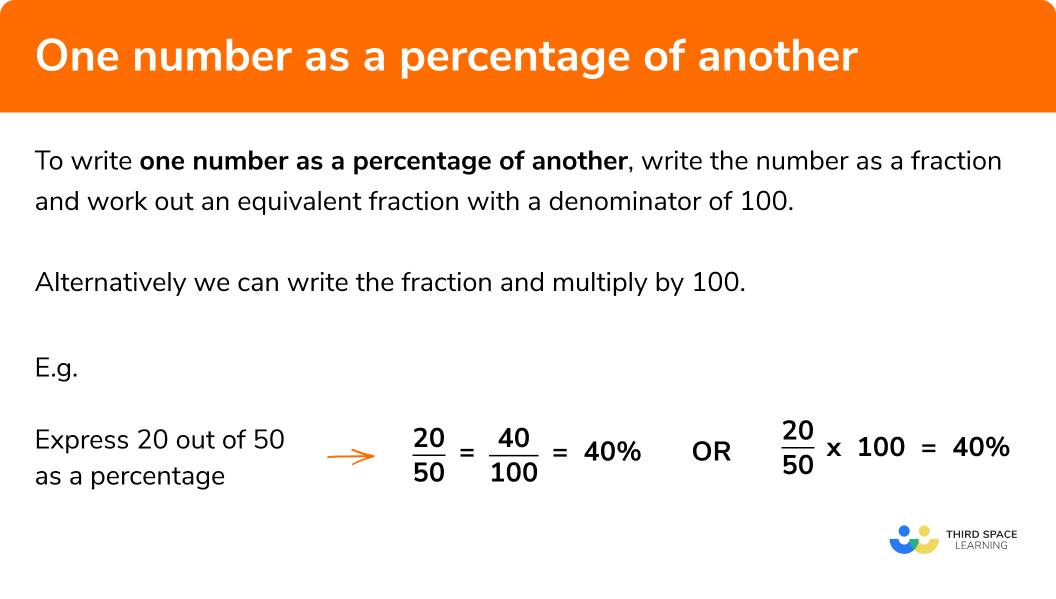
A profit margin is always calculated as a percentage of the final selling price. If you sell a product for $100 and it costs you $70 to produce, your profit is $30. To find the margin, you divide the profit ($30) by the selling price ($100), resulting in a 30% profit margin. This number is vital because it tells the business owner how much of every dollar of revenue is actual profit that can be used to pay for overhead, debt service, or dividends.
The Cost Basis Perspective: Markup Calculations
Markup, on the other hand, is a percentage of the cost. Using the same example, if the cost is $70 and the profit is $30, the markup is $30 divided by $70, which is approximately 42.8%.
If a manager mistakenly uses these terms interchangeably, the financial consequences are severe. If you want a 30% profit margin but mistakenly apply a 30% markup to your $70 cost, you would sell the product for $91. At a $91 sale price, your profit is only $21, which results in a 23% profit margin—falling significantly short of your 30% goal. Knowing whether your percentage is based on “Cost” (Markup) or “Revenue” (Margin) is the cornerstone of pricing strategy.
Consumer Finance and Debt Management
In the realm of personal debt, the “base” of a percentage determines the velocity at which you can achieve financial freedom. Lenders often use the complexity of percentage bases to their advantage, making debt seem less expensive than it truly is.
Understanding APR and Daily Accruals
The Annual Percentage Rate (APR) is a percentage of the total loan balance, but the way it is applied varies. Most credit cards calculate interest based on a “Daily Periodic Rate.” This is the APR divided by 365. Every single day, that percentage is applied to your average daily balance. If you make a purchase mid-month, the base for that day’s interest calculation increases immediately.
Furthermore, some loans are “amortized,” meaning the percentage of your monthly payment that goes toward interest is based on the remaining principal. In the early years of a 30-year mortgage, the interest percentage is acting upon a massive base (the full loan amount), meaning very little of your payment goes toward the actual principal. By the time you are in year 25, the base has shrunk, so the same interest rate results in a much smaller dollar amount, allowing your equity to grow faster.
Credit Utilization and the Total Available Limit
Credit scores are heavily influenced by the “credit utilization ratio.” This is a percentage of your used credit relative to your total credit limit. Here, the denominator—your total limit—is just as important as the numerator—your balance. If you have a $5,000 balance on a $10,000 limit, your utilization is 50%. If you increase your limit to $20,000 without spending more, your utilization drops to 25%. The percentage changed not because your debt decreased, but because the base increased. In the world of credit scoring, managing the denominator is often easier than reducing the numerator.
Tactical Financial Planning: The Denominator as a Tool
Strategic wealth building requires a constant recalibration of our financial denominators. By consciously choosing what we use as our base, we can make more informed decisions about taxes, asset allocation, and risk.
Tax Strategy and the Marginal Rate
One of the most common misunderstandings in personal finance is how tax brackets work. When a high-earner says they are in the “37% tax bracket,” that 37% is only a percentage of the income that falls within that specific range—it is not 37% of their total income.
The “effective tax rate” is a percentage of the total gross income. Understanding that the marginal rate only applies to the “top” of the stack allows investors to make better decisions regarding tax-advantaged accounts like 401(k)s or IRAs. They are saving a percentage based on their highest marginal bracket, which provides a much larger benefit than if the savings were based on their effective rate.

Asset Allocation and Risk Tolerance
Finally, risk should always be viewed as a percentage of your total liquid net worth. If an investor loses 20% on a speculative cryptocurrency trade, the impact depends entirely on the base. If that trade represented 1% of their total portfolio, the loss is a mere 0.2% of their total wealth—a manageable hit. If the trade represented 50% of their portfolio, a 20% drop is a catastrophic 10% loss of total net worth.
Success in money management is rarely about the “what” and almost always about the “compared to what.” Whenever you see a percentage—whether it is a marketing claim for a 50% discount, a stock market “rally” of 2%, or a 10% raise at work—stop and ask the fundamental question: “What is this number a percentage of?” Only when you identify the denominator can you truly understand the value of the numerator. In the language of finance, the base is everything.
aViewFromTheCave is a participant in the Amazon Services LLC Associates Program, an affiliate advertising program designed to provide a means for sites to earn advertising fees by advertising and linking to Amazon.com. Amazon, the Amazon logo, AmazonSupply, and the AmazonSupply logo are trademarks of Amazon.com, Inc. or its affiliates. As an Amazon Associate we earn affiliate commissions from qualifying purchases.