
The concept of “tidal force” is a foundational pillar in understanding the physics of our universe, yet it is often misunderstood as merely a phenomenon of ocean tides. While the term is inextricably linked to the movement of water on Earth, the underlying mechanics represent a universal gravitational effect that influences everything from the stability of planetary rings to the structural integrity of objects approaching a black hole. By examining the tidal force through the lens of physics and celestial mechanics, we can better appreciate how gravitational gradients shape the macroscopic and microscopic architecture of space.

The Gravitational Gradient: Why Distance Matters
To understand tidal forces, one must first dismantle the misconception that gravity acts as a uniform force upon a body. In reality, gravity follows an inverse-square law, meaning the strength of a gravitational field diminishes rapidly as distance from the source increases.
The Differential Nature of Gravity
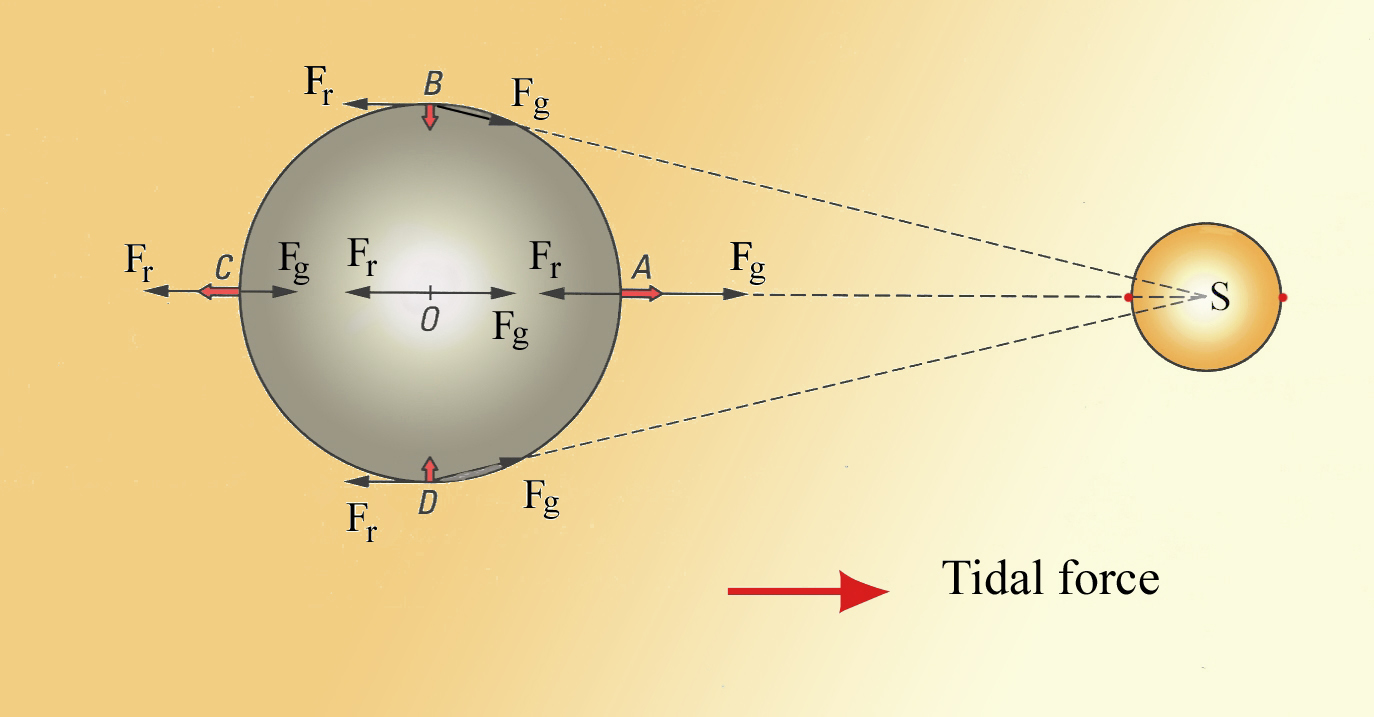
When an object—whether a moon, an asteroid, or a person—is exposed to a gravitational field, the side of the object closer to the source of gravity experiences a stronger pull than the side farther away. This differential pull is what we define as the tidal force. It is not the total gravity that is “tidal,” but rather the gradient or the variation in gravity across the extent of the object.
If an object were a perfect, rigid solid, this differential pull would simply manifest as a slight tug on its center of mass. However, because all physical bodies have a finite size, the near-side particles are accelerated toward the source more intensely than the far-side particles. This creates a stretching effect. If the object is fluid or elastic, this stress manifests as a physical deformation, elongating the body along the line connecting it to the gravitational source.
The Role of Inertia and Orbital Motion
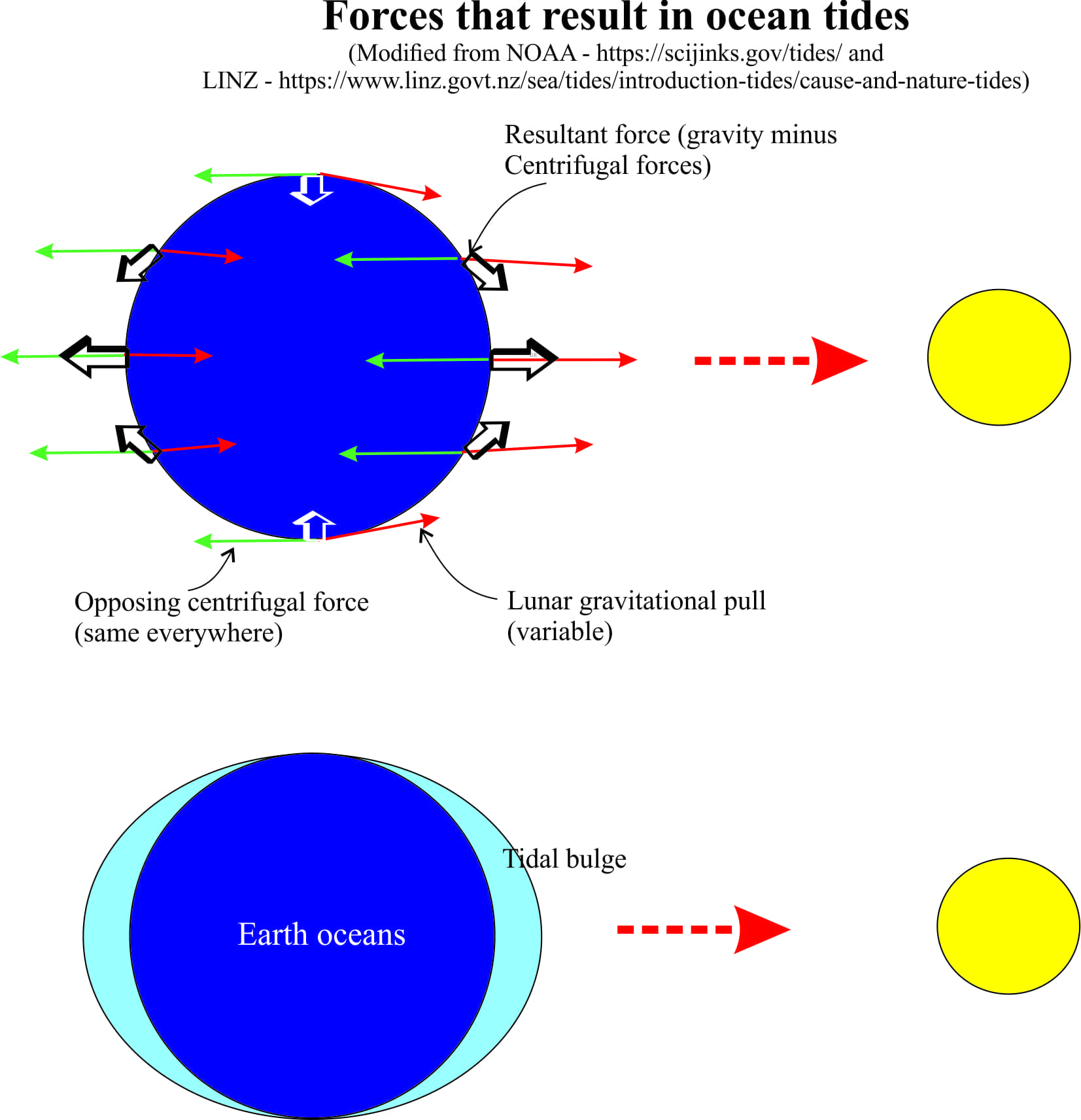
In an orbital system, the tidal force acts in concert with inertia. While the moon is pulled toward the Earth by gravity, its orbital velocity creates an outward “centrifugal” effect that keeps it in a stable trajectory. The tidal force, however, acts independently of this balance. It is a local stressor. If we look at the Earth-Moon system, the tidal force exerted by the Moon on Earth is effectively the difference between the Moon’s gravity at the Earth’s center and the Moon’s gravity at the Earth’s surface. This constant stretching is what leads to the periodic rise and fall of oceanic levels, as the fluid composition of Earth’s seas allows them to respond to this stress more visibly than the rigid crust.
Astrophysical Implications: From Tides to Spaghettification
The scale of tidal forces varies wildly depending on the mass and density of the gravitational source. While Earth’s tidal influence on the Moon is subtle, the tidal forces found near compact objects can be catastrophic.
The Roche Limit: The Breaking Point
Every celestial body has a threshold known as the Roche limit. This is the minimum distance to which a satellite can approach its primary body before the tidal forces overcome the satellite’s internal self-gravity (the force holding it together).
When a moon or asteroid crosses the Roche limit, the tidal stress becomes greater than the gravitational binding energy of the satellite. As a result, the body begins to disintegrate. This is the primary mechanism behind the formation of planetary rings. Saturn’s iconic rings are, in essence, the debris of moons and comets that ventured too close and were shredded by the planet’s intense tidal gradients.
Spaghettification Near Black Holes
At the extreme end of the spectrum lies the phenomenon of spaghettification, a term coined by Stephen Hawking. Near a stellar-mass black hole, the gravitational gradient is so steep that the difference in pull between one’s feet and one’s head would be insurmountable. As an object approaches the event horizon, the tidal force elongates it into a thin, long strand of matter. In this scenario, the tidal force acts as a destructive scalar, essentially pulling the object apart atom by atom. This illustrates that tidal force is not merely a nuance of planetary motion, but a fundamental constraint on the survival of matter in extreme environments.
Tidal Locking and Orbital Evolution
Tidal forces are also the primary architects of orbital evolution over long periods. They are not static; they are dissipative, meaning they convert kinetic energy into heat through friction.
The Mechanism of Tidal Locking
One of the most profound effects of tidal forces is tidal locking. This occurs when the tidal stress on a rotating body is so significant that it eventually syncs the body’s rotation period with its orbital period. The Moon is the most famous example of this; it is tidally locked to the Earth, which is why we always see the same face.
This happens because the tidal force creates a “bulge” on the orbiting body. As the body rotates, this bulge is dragged away from the direct line of gravity by the body’s rotation. Gravity then pulls back on this misplaced bulge, exerting a torque that slows the rotation down. Over millions of years, this process continues until the rotation matches the orbital revolution, effectively freezing the orientation of the body in relation to its host.
Energy Dissipation and Internal Heating
Tidal forces act as a constant source of internal energy for moons in our solar system. The best example is Io, the innermost moon of Jupiter. Io is subject to intense, fluctuating tidal forces due to its proximity to Jupiter and the gravitational perturbations of other moons. This causes the body of Io to physically flex and stretch—a process called “tidal heating.” This internal friction generates massive amounts of heat, making Io the most volcanically active body in the solar system. Here, the tidal force serves as a vital geological engine, proving that gravity’s influence extends far beyond the surface of a planet and deep into its core.
Measuring the Impact on Our Future
As we look toward the future of space exploration and technology, understanding the tidal force is not merely an academic exercise. It is a prerequisite for long-term survival and engineering in space.
Engineering in Tidal Fields
When designing space stations or habitats in orbit around planets or moons, engineers must account for tidal stress. While these stresses are negligible for small-scale structures, they become critical for “mega-structures,” such as space elevators or massive orbital rings. A structure spanning thousands of kilometers would experience significant tidal tension, requiring materials with immense tensile strength to prevent structural failure.
The Ongoing Dance of the Earth-Moon System
Even on Earth, the tidal force is doing work. Because the Earth rotates faster than the Moon orbits, the tidal bulge created by the Moon is pulled ahead of the Earth-Moon line. This causes the Earth’s rotation to slow down imperceptibly over time, lengthening our day. Simultaneously, the exchange of angular momentum pushes the Moon away from the Earth at a rate of roughly 3.8 centimeters per year.
The tidal force is, therefore, a dynamic agent of change. It is the invisible tether that dictates the rhythm of the tides, the life cycle of celestial rings, the volcanic activity of distant moons, and the eventual evolution of the solar system itself. By studying the tidal force, we are not just studying a “what”—we are studying the mechanism through which gravity sculpts the universe. It is a reminder that in the vastness of space, the most profound changes are often the result of the smallest differences in gravitational pull.
aViewFromTheCave is a participant in the Amazon Services LLC Associates Program, an affiliate advertising program designed to provide a means for sites to earn advertising fees by advertising and linking to Amazon.com. Amazon, the Amazon logo, AmazonSupply, and the AmazonSupply logo are trademarks of Amazon.com, Inc. or its affiliates. As an Amazon Associate we earn affiliate commissions from qualifying purchases.