
In an increasingly data-driven world, the ability to interpret and apply quantitative information is paramount, especially when it comes to managing finances. Among the myriad of mathematical concepts, understanding how to find the percentage of a total stands out as an indispensable skill, forming the bedrock of sound financial decision-making. From personal budgeting and investment analysis to business performance evaluation and economic forecasting, percentages provide a universal language for comparison, proportion, and change. They transform raw numbers into meaningful insights, allowing us to gauge impact, identify trends, and make informed choices that can significantly influence our financial well-being.

This article delves into the essential methods for calculating percentages of a total, exploring their profound relevance across various financial landscapes. We will not only demystify the core mathematical principles but also illustrate their practical applications, empowering you to leverage this fundamental concept for greater financial clarity and control. Whether you’re a meticulous budgeter, an aspiring investor, a business owner, or simply someone looking to sharpen their financial acumen, mastering percentages is an investment that consistently yields high returns.
The Foundational Math: Understanding Percentages and Their Calculation
At its core, a percentage is simply a way of expressing a number as a fraction of 100. It provides a standardized way to compare parts to a whole, regardless of the absolute size of the numbers involved. The term “percent” itself originates from the Latin “per centum,” meaning “by the hundred.”
Defining “Percentage” and “Total”
To calculate a percentage, two key components are always required:
- The Part: This is the specific quantity or amount you are interested in. It represents a portion of the larger whole.
- The Total: This is the entire quantity or sum, representing the whole from which the part is drawn.
The relationship between the part and the total is what percentages help us quantify, expressing that relationship in a universally understood format.
The Core Formula: Part / Total × 100
The calculation of a percentage is straightforward and relies on one fundamental formula:
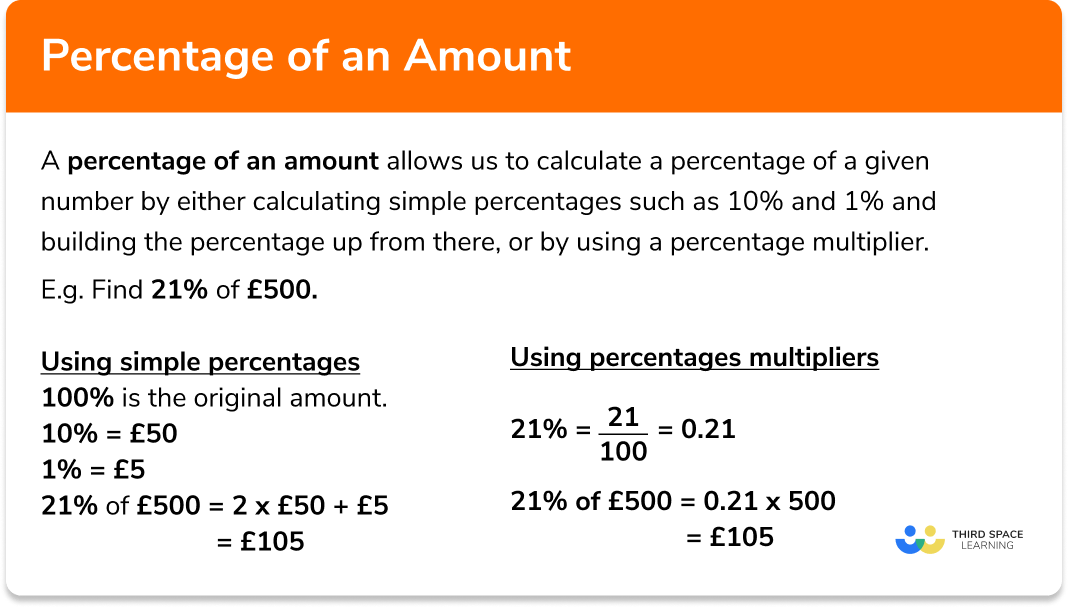
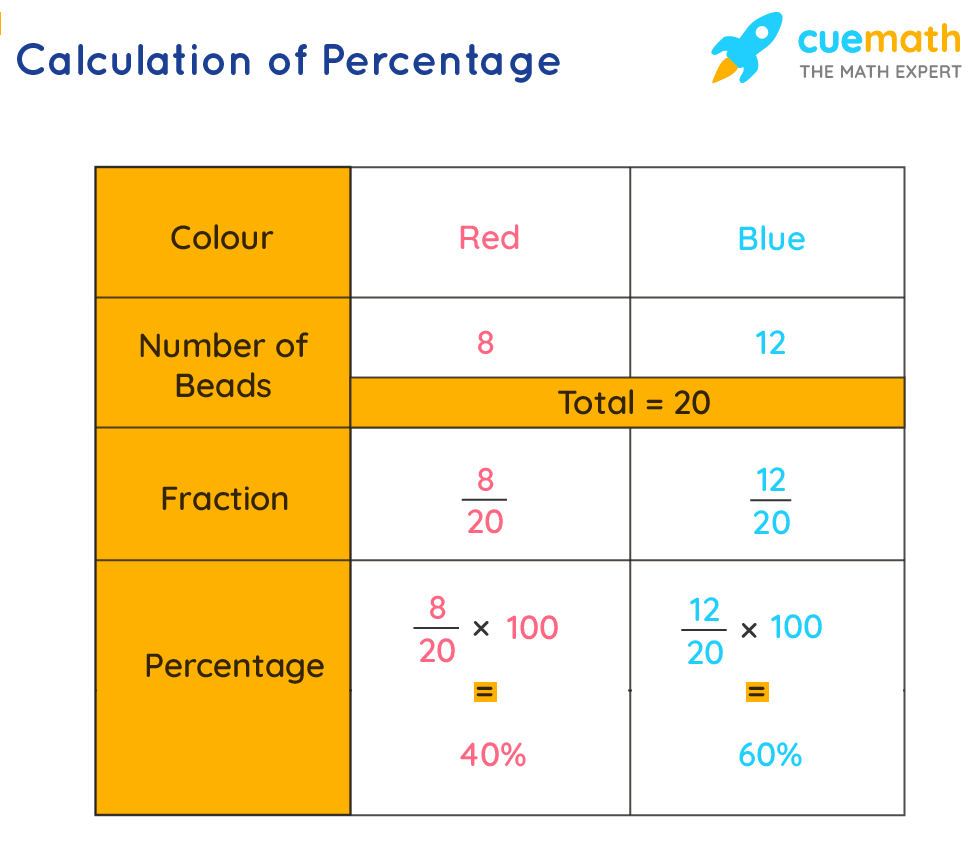
Percentage = (Part / Total) × 100
Let’s break down how this works:
- Divide the Part by the Total: This step converts the “part” into a decimal fraction of the “total.” For example, if you spend $200 out of a $1000 income, 200/1000 = 0.20.
- Multiply by 100: Multiplying the resulting decimal by 100 converts it into a percentage. Continuing the example, 0.20 × 100 = 20%. This means $200 is 20% of $1000.
This simple formula is the backbone of all percentage calculations, from determining discounts on a purchase to calculating the return on an investment.
Practical Examples for Clarity
Let’s consider a few basic financial scenarios to solidify this concept:
- Example 1: Discount Calculation: You find a product originally priced at $50, now on sale for $40. What is the percentage discount?
- Discount amount (Part) = $50 – $40 = $10
- Original price (Total) = $50
- Percentage Discount = ($10 / $50) × 100 = 0.20 × 100 = 20%
- Example 2: Budgeting for an Expense: Your monthly income is $4,000, and you spend $800 on rent. What percentage of your income goes to rent?
- Rent expense (Part) = $800
- Monthly income (Total) = $4,000
- Percentage for Rent = ($800 / $4,000) × 100 = 0.20 × 100 = 20%
These examples highlight how percentages provide immediate context, making it easier to compare different expenditures or evaluate the magnitude of a saving.
Percentages in Personal Finance: Mastering Your Money
For individuals, understanding percentages is not just an academic exercise; it’s a critical tool for effective personal financial management. It empowers you to analyze your financial situation, set realistic goals, and track progress with precision.
Budgeting and Expense Tracking
A well-structured budget is the cornerstone of personal finance, and percentages are its vital arteries.
- Income Allocation: By allocating percentages of your income to different categories (e.g., 50% for needs, 30% for wants, 20% for savings), you create a clear roadmap for your spending. This helps in understanding where your money goes and ensuring alignment with your financial priorities.
- Expense Analysis: Calculating the percentage each expense category represents out of your total spending helps identify areas where you might be overspending. For instance, if dining out consumes 25% of your discretionary income, you might decide to cut back to free up funds for other goals.
Savings and Investments
Percentages are indispensable when it comes to growing your wealth.
- Savings Rate: A common metric, your savings rate is the percentage of your income that you save. A higher savings rate accelerates your journey towards financial goals like a down payment or retirement.
- Portfolio Allocation: Investors use percentages to determine the allocation of their assets across different classes (e.g., 60% stocks, 30% bonds, 10% cash). This strategic allocation is crucial for managing risk and maximizing returns based on individual financial goals and risk tolerance.
- Compound Interest: While not a direct percentage of total calculation, understanding interest rates (which are expressed as percentages) is vital for grasping the power of compound interest, where your money earns returns on both the initial principal and accumulated interest.
Debt Management and Loan Interest
Percentages play a crucial role in navigating debt.
- Interest Rates: Loan interest rates (APR – Annual Percentage Rate) are expressed as percentages and directly impact the total cost of borrowing. Understanding how to calculate interest on a loan helps you choose the most favorable terms and develop effective repayment strategies.
- Debt-to-Income Ratio: Lenders often use your debt-to-income (DTI) ratio, expressed as a percentage, to assess your ability to manage monthly payments and repay new debts. This ratio helps individuals understand their borrowing capacity and avoid over-indebtedness.
Percentages in Business and Investing: Driving Strategic Decisions
Beyond personal finances, percentages are the lifeblood of business analysis and investment evaluation. They provide critical insights into performance, market positioning, and growth potential.
Profit Margins and Markups
For businesses, profit is paramount, and percentages are the standard for measuring profitability.
- Gross Profit Margin: This percentage indicates how much profit a company makes from each sale after deducting the cost of goods sold. Formula: (Revenue – Cost of Goods Sold) / Revenue × 100.
- Net Profit Margin: This is the ultimate measure of profitability, showing the percentage of revenue left after all expenses, including taxes and interest, have been deducted. Formula: Net Income / Revenue × 100.
- Markup Percentage: Businesses use markups to price products effectively, ensuring they cover costs and achieve desired profit levels. Formula: (Selling Price – Cost) / Cost × 100.
These margins are vital for pricing strategies, operational efficiency analysis, and comparing performance against industry benchmarks.
Market Share and Growth Rates
Understanding a company’s position within its industry and its trajectory is often communicated through percentages.
- Market Share: This metric represents a company’s sales as a percentage of the total sales within its industry. Formula: (Company Sales / Total Industry Sales) × 100. A growing market share indicates increasing competitive strength.
- Growth Rates: Companies track various growth rates—revenue growth, profit growth, customer growth—expressed as percentage increases over a period. These percentages are crucial for assessing business momentum and investor confidence.
Investment Returns and Valuations
Investors rely heavily on percentages to evaluate the performance and attractiveness of their holdings.
- Return on Investment (ROI): Perhaps the most fundamental investment metric, ROI calculates the percentage gain or loss on an investment relative to its initial cost. Formula: (Current Value – Original Cost) / Original Cost × 100.
- Dividend Yield: For income-focused investors, dividend yield (annual dividends per share as a percentage of the share price) indicates the income generated relative to the stock’s cost.
- Price-to-Earnings (P/E) Ratio: While not a direct percentage, ratios like P/E are often compared in percentage terms to industry averages, providing insight into a stock’s valuation.
Tools and Techniques for Efficient Percentage Calculation
While the basic formula is simple, leveraging modern tools can streamline percentage calculations, especially when dealing with large datasets or complex financial models.
Spreadsheet Software (Excel, Google Sheets)
Spreadsheets are perhaps the most powerful and versatile tools for financial calculations, including percentages.
- Built-in Formulas: Spreadsheets allow you to input the “part” and “total” into different cells and then use a simple formula (e.g.,
= (A2/B2)*100) to instantly calculate the percentage. - Formatting Options: You can easily format cells to display numbers as percentages, automatically handling the multiplication by 100 and adding the ‘%’ symbol. This is invaluable for creating clear, readable financial reports and dashboards.
- Dynamic Analysis: Spreadsheets enable dynamic analysis. If your “part” or “total” changes, the percentage automatically updates, facilitating scenario planning and “what-if” analyses for budgeting or investment projections.
Online Calculators and Financial Apps
For quick, on-the-go calculations or specific financial scenarios, a plethora of online calculators and mobile apps are available.
- General Percentage Calculators: Many websites offer basic calculators where you input the part and total to get the percentage.
- Specific Financial Calculators: Apps and websites provide specialized calculators for mortgage payments, loan interest, compound interest, ROI, and more, often incorporating percentage calculations seamlessly into their functions. These can be particularly helpful for understanding the impact of interest rates or evaluating loan offers.
Mental Math Shortcuts and Estimations
While precise calculations are often necessary, developing an intuition for percentages through mental math can be incredibly useful in everyday financial situations.
- Calculating 10%: To find 10% of any number, simply move the decimal point one place to the left (e.g., 10% of $250 is $25). This can then be used to estimate other percentages (e.g., 20% is double 10%, 5% is half of 10%).
- Using Fractions: Remember common percentage-fraction equivalences (e.g., 25% = 1/4, 50% = 1/2, 75% = 3/4) to quickly estimate or calculate in your head.
Common Pitfalls and Best Practices in Percentage Application
While percentages are powerful, their misuse or misinterpretation can lead to significant financial errors. Awareness of common pitfalls is crucial.
Misinterpreting the “Total”
A frequent mistake is incorrectly identifying the “total” (the denominator) when calculating a percentage.
- Example: If a business grew from $100,000 in sales to $120,000, the percentage increase is calculated on the original total ($100,000). A $20,000 increase / $100,000 = 20%. If you mistakenly used the new total, your percentage would be wrong. Always ensure your denominator accurately represents the base from which the percentage is being calculated.
Percentage Points vs. Percentage Change
This distinction is particularly important in finance and economics.
- Percentage Points: Refers to the absolute difference between two percentages. For example, if an interest rate increases from 5% to 7%, that’s an increase of 2 percentage points.
- Percentage Change: Refers to the relative change. An increase from 5% to 7% is a (7-5)/5 * 100 = 40% increase in the interest rate itself. Confusing these can lead to misrepresenting the magnitude of change.
The Importance of Context
A percentage figure, in isolation, can be misleading. Always consider the context.
- Small Bases: A 100% growth on a very small base number might still represent a negligible absolute increase. Conversely, a 1% increase on a multi-billion dollar base is a significant absolute gain.
- Timeframes: When discussing growth rates or returns, the timeframe over which the percentage is calculated is crucial (e.g., 5% monthly return vs. 5% annual return).
Conclusion
The ability to find the percentage of a total is far more than a simple arithmetic skill; it is a fundamental pillar of financial literacy. By mastering this concept, you gain the power to dissect complex financial data, make informed decisions, and navigate the intricate landscape of personal and business finance with confidence.
From meticulously crafting a personal budget to strategically allocating investment assets, evaluating business profitability, or deciphering the true cost of debt, percentages provide the clarity and context needed to translate raw numbers into actionable insights. In a world brimming with financial information, being able to accurately calculate, interpret, and critically assess percentages is an invaluable asset—a skill that truly empowers you to take control of your financial destiny and build a more secure and prosperous future. Embrace the power of percentages, and unlock a deeper understanding of your financial world.
aViewFromTheCave is a participant in the Amazon Services LLC Associates Program, an affiliate advertising program designed to provide a means for sites to earn advertising fees by advertising and linking to Amazon.com. Amazon, the Amazon logo, AmazonSupply, and the AmazonSupply logo are trademarks of Amazon.com, Inc. or its affiliates. As an Amazon Associate we earn affiliate commissions from qualifying purchases.