
In the intricate world of personal finance, investing, and business, numbers tell a story. Among the most crucial narrative elements is the concept of a percentage. Far from being a mere academic exercise, understanding “what is the percentage of a number” is a fundamental skill that underpins virtually every financial decision we make, every investment we evaluate, and every budget we construct. It’s the language of discounts, interest rates, investment returns, taxes, and economic growth. Without a firm grasp of percentages, navigating the financial landscape becomes akin to sailing without a compass.

This guide aims to demystify percentages, transforming them from abstract mathematical concepts into powerful tools for financial empowerment. We will delve into their definition, explore the mechanics of calculation, highlight their myriad applications in real-world financial scenarios, address common misconceptions, and ultimately, underscore why mastering this simple concept is indispensable for robust financial literacy.
1. Demystifying Percentages: The Foundation of Financial Understanding
At its core, a percentage is a way of expressing a number as a fraction of 100. The word “percent” itself originates from the Latin “per centum,” meaning “by the hundred.” It’s a standardized way to compare parts to a whole, making complex relationships easily understandable and comparable across different contexts. Whether you’re comparing the performance of two different investment portfolios or trying to understand the impact of a sales tax, percentages provide a universal metric.
1.1 Defining the “Part of 100”
When we say “10 percent,” we literally mean 10 out of 100, or 10/100. This simplicity is its greatest strength. Instead of dealing with unwieldy fractions like 1/8 or 3/7, percentages convert everything into a common base of 100, allowing for quick mental comparisons. For instance, knowing that you’ve saved 25% of your income is much more intuitive than saying you’ve saved 1/4 of it, especially when comparing it to a colleague who saved 2/5 (40%). This standardization is particularly vital in finance, where precise comparisons drive informed decision-making.
1.2 The Ubiquity of Percentages in Finance
From the moment you open a bank account to the day you plan for retirement, percentages are inescapable. They dictate the interest you earn on savings, the interest you pay on loans, the returns your investments generate, the discount you receive on a purchase, and the tax deducted from your paycheck. Financial news headlines frequently cite percentage changes in stock markets, inflation rates, and GDP growth. For anyone serious about managing their money effectively, understanding percentages isn’t optional; it’s foundational. It allows individuals to critically analyze financial products, understand the true cost of borrowing, evaluate investment opportunities, and interpret economic data with confidence.
2. The Mechanics of Percentage Calculation: Your Financial Toolkit
While the concept of a percentage is straightforward, the ability to calculate them accurately is what empowers financial acumen. Fortunately, the underlying formula is simple and universally applicable, serving as the bedrock for more complex financial analyses.
2.1 The Fundamental Formula: Part/Whole x 100
The core formula for calculating a percentage is:
Percentage = (Part / Whole) × 100
Let’s break this down:
- Part: This is the specific amount or quantity you are interested in.
- Whole: This is the total amount or quantity against which the part is being compared.
- 100: Multiplying by 100 converts the decimal fraction into a percentage format.
Example: If you spent $30 on dining out from your total monthly budget of $1500, the percentage of your budget spent on dining is:
($30 / $1500) × 100 = 0.02 × 100 = 2%
This basic formula is your versatile tool for calculating everything from expense ratios to profit margins.
2.2 Calculating Discounts and Markups
Percentages are indispensable for understanding pricing.
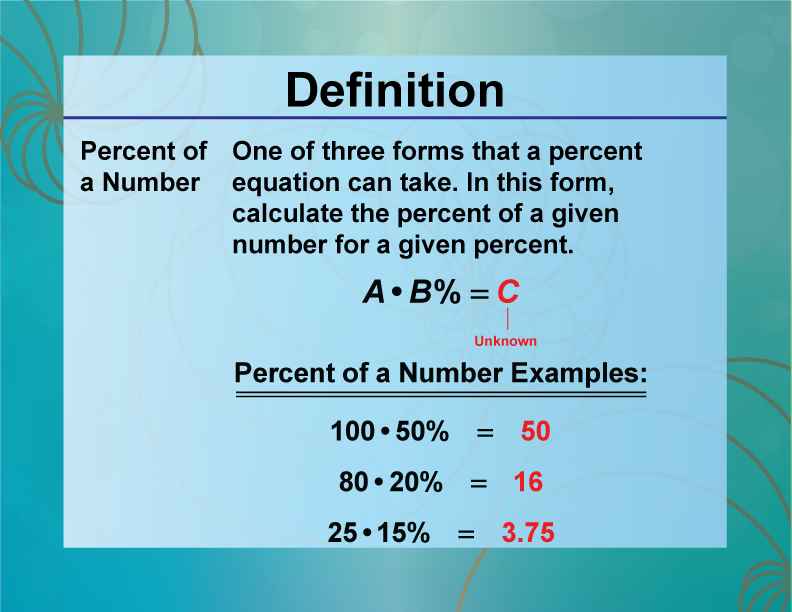
- Discounts: If an item originally costs $200 and is discounted by 15%, the discount amount is $200 × 0.15 = $30. The new price is $200 – $30 = $170.
- Markups: A business buying a product for $50 and marking it up by 30% would add $50 × 0.30 = $15. The selling price would be $50 + $15 = $65.
Accurately calculating these allows consumers to spot genuine deals and businesses to set profitable pricing strategies.
2.3 Understanding Interest Rates: Simple vs. Compound
Interest rates are perhaps the most common financial application of percentages.
- Simple Interest: If you invest $1,000 at a 5% simple annual interest rate, you earn $1,000 × 0.05 = $50 per year.
- Compound Interest: This is where percentages truly shine. If that $50 is added back to your principal, the next year you earn 5% on $1,050, then on $1,102.50, and so on. This “interest on interest” effect, often called the “eighth wonder of the world,” dramatically illustrates the power of percentages over time, particularly for long-term investments and retirement planning. Conversely, it highlights the escalating cost of debt if interest is compounded.
2.4 Assessing Growth and Decline: ROI and Inflation
- Return on Investment (ROI): A critical metric for investors. If you invest $10,000 and it grows to $12,000, your profit is $2,000. Your ROI is ($2,000 / $10,000) × 100 = 20%. This allows direct comparison between different investment vehicles.
- Inflation: The rate at which the general level of prices for goods and services is rising, and subsequently, purchasing power is falling. If the inflation rate is 3%, your money effectively buys 3% less than it did the previous year. Understanding this percentage helps in planning for future expenses and ensuring your investments outpace inflation.
3. Percentages in Action: Real-World Financial Applications
Beyond theoretical calculations, percentages play an active, practical role in nearly every facet of our financial lives. They are the analytical backbone for decision-making.
3.1 Personal Budgeting and Expense Analysis
A well-structured budget often relies heavily on percentages. Financial advisors frequently recommend allocating specific percentages of income to different categories: 50% for needs, 30% for wants, and 20% for savings and debt repayment (the 50/30/20 rule). By calculating the percentage of your income going towards housing, food, entertainment, or savings, you can quickly identify areas of overspending or opportunities for optimization. This holistic view, made possible by percentages, fosters financial discipline and goal achievement.
3.2 Investment Performance and Portfolio Allocation
In the investment world, percentages are the universal language. Portfolio managers talk about allocating 60% to stocks and 40% to bonds, or having 15% of a portfolio in emerging markets. When reviewing performance, investors look at the percentage gain or loss over a period. Comparing an 8% annual return on one fund to a 6% return on another instantly shows which performed better, even if the initial investment amounts were different. Understanding these percentages is critical for constructing a diversified portfolio that aligns with personal risk tolerance and financial goals.
3.3 Business Finance: Profit Margins, Sales Tax, and Commissions
For businesses, percentages are vital for profitability and compliance.
- Profit Margins: Gross profit margin, operating profit margin, and net profit margin are all expressed as percentages, indicating how much profit a company makes for every dollar of revenue. A 10% net profit margin means 10 cents of every dollar earned is pure profit.
- Sales Tax: A percentage added to the price of goods and services. Businesses must accurately calculate and remit these percentages to tax authorities.
- Commissions: Salespeople often earn a percentage of their sales. A 5% commission on a $1,000 sale means a $50 earning.
These percentages drive operational decisions, pricing strategies, and compensation structures.
3.4 Understanding Financial News and Economic Indicators
Daily financial news is saturated with percentages. Unemployment rates, GDP growth, inflation figures, interest rate hikes or cuts by central banks—all are communicated as percentages. A 0.25% interest rate hike might seem small, but understanding its percentage impact on borrowing costs for mortgages or business loans is crucial. Interpreting these indicators allows individuals and businesses to make informed decisions about spending, saving, and investing in response to broader economic trends.
4. Navigating Common Pitfalls and Nuances
While percentages are powerful, they can also be misleading if not understood completely. Certain nuances and common pitfalls require careful attention to avoid misinterpretations that can lead to poor financial decisions.
4.1 Percentage Points vs. Percentage Change: A Crucial Distinction
This is one of the most common sources of confusion.
- Percentage Change: Refers to the proportional change relative to the initial amount. E.g., if an interest rate goes from 4% to 5%, that’s a (5-4)/4 * 100 = 25% increase.
- Percentage Points: Refers to the absolute difference between two percentages. If an interest rate goes from 4% to 5%, that’s an increase of 1 percentage point (5% – 4% = 1%).
These are very different statements. A 1 percentage point increase in interest rates from 4% to 5% sounds modest, but it represents a 25% relative increase in the cost of borrowing, which can have significant financial implications. Understanding this distinction is vital when evaluating policy changes, investment returns, or financial product offerings.
4.2 The Impact of Compounding Over Time
The “snowball effect” of compounding (both positive for investments and negative for debt) is a testament to the power of percentages over extended periods. A small annual percentage yield (APY) on savings, consistently applied, can lead to substantial growth. Conversely, a high annual percentage rate (APR) on credit card debt, if not managed, can lead to overwhelming financial burdens. Recognizing this time-value of money, driven by percentage rates, is critical for long-term financial planning.
4.3 Avoiding Misinterpretations of Data
Percentages can be manipulated or presented in ways that create a biased perception. For instance, an investment showing a “50% gain” might sound impressive, but if it started at $100 and only reached $150, the absolute gain is small. Conversely, if an investment dropped from $1,000,000 to $900,000, it’s only a 10% loss, but the absolute loss is substantial. Always consider the base (“the whole”) when interpreting percentage figures to understand the true magnitude of change.
5. Leveraging Technology for Percentage Mastery
While mental arithmetic for simple percentages is beneficial, for complex financial calculations, technology is an invaluable ally. Modern tools simplify the process, allowing for greater accuracy and efficiency.
5.1 The Role of Calculators and Spreadsheets
Even basic calculators have a percentage function, simplifying quick calculations. For more intricate financial modeling, spreadsheet software like Microsoft Excel or Google Sheets are indispensable. They allow users to set up complex formulas, calculate compound interest over decades, analyze multiple investment scenarios, and track budgets with automatic percentage calculations, eliminating manual errors and saving significant time.
5.2 Financial Apps and Online Tools
Numerous financial apps and online tools are designed to automate percentage-based calculations. Budgeting apps track spending and display it as a percentage of income. Investment platforms automatically calculate returns, expense ratios, and portfolio allocations. Loan calculators instantly show the percentage of interest paid over the life of a loan. These tools empower individuals to gain real-time insights into their financial health without needing to be a math expert.

5.3 Building Your Quantitative Financial Literacy
Ultimately, understanding “what is the percentage of a number” is more than just learning a formula; it’s about building a core component of quantitative financial literacy. It’s the ability to translate raw numbers into meaningful insights that drive better financial decisions. By embracing this fundamental concept, leveraging available tools, and being mindful of potential pitfalls, anyone can enhance their financial intelligence, secure their economic well-being, and navigate the complex world of money with greater confidence and control. The power to understand your finances truly begins with understanding percentages.
aViewFromTheCave is a participant in the Amazon Services LLC Associates Program, an affiliate advertising program designed to provide a means for sites to earn advertising fees by advertising and linking to Amazon.com. Amazon, the Amazon logo, AmazonSupply, and the AmazonSupply logo are trademarks of Amazon.com, Inc. or its affiliates. As an Amazon Associate we earn affiliate commissions from qualifying purchases.