
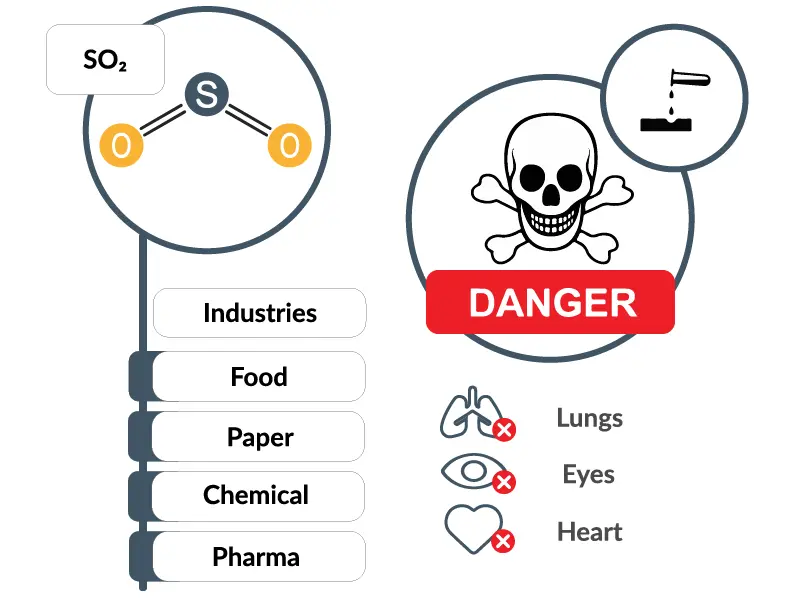
For decades, sulfur dioxide ($SO2$) was viewed primarily through the lens of chemistry and environmental science. As a pungent, colorless gas produced by volcanic eruptions and industrial processes—specifically the burning of fossil fuels—it has long been a marker of human impact on the planet. However, in the modern era, “what is sulfur dioxide” has become a question for the technology sector. Today, $SO2$ is less a chemical curiosity and more a data point, a catalyst for hardware innovation, and a primary focus for AI-driven predictive modeling.
The intersection of environmental health and digital technology has given rise to a sophisticated ecosystem of sensors, satellites, and software designed to track, analyze, and mitigate this gas. As smart cities evolve and industrial facilities face stricter regulatory frameworks, the technology used to manage sulfur dioxide has become a multi-billion-dollar frontier in the “Green Tech” space.

Sensing the Invisible: IoT and Hardware Innovation in $SO_2$ Detection
The first step in managing any environmental factor is measurement. Historically, measuring sulfur dioxide required bulky, expensive stationary monitoring stations that were few and far between. Modern technology has disrupted this model through the miniaturization of sensors and the proliferation of the Internet of Things (IoT).
High-Precision Gas Sensors and MEMS Technology
At the heart of modern $SO2$ detection are Micro-Electro-Mechanical Systems (MEMS). These tiny devices have allowed engineers to shrink gas chromatography and electrochemical sensing capabilities onto a chip. Modern electrochemical $SO2$ sensors work by reacting with the gas and producing an electrical signal proportional to the concentration.
The tech industry has focused heavily on improving the “selectivity” and “sensitivity” of these sensors. In complex urban environments, sensors must distinguish between $SO2$, nitrogen dioxide ($NO2$), and ozone ($O_3$). Advanced coating materials, such as metal-oxide semiconductors and carbon nanotubes, are now being used to ensure that digital readings are accurate even at parts-per-billion (ppb) levels.
Wireless Sensor Networks (WSN) and Urban Integration
IoT connectivity has transformed these individual sensors into a cohesive network. By deploying Wireless Sensor Networks across a city—often mounted on streetlights, buses, or delivery vehicles—municipalities can create a “digital twin” of their air quality.
Using low-power wide-area network (LPWAN) protocols like LoRaWAN or NB-IoT, these sensors transmit real-time $SO_2$ data to centralized dashboards. This allows for hyper-local monitoring. Instead of knowing the air quality of a city, tech-enabled citizens can now know the air quality of a specific street corner. This granular data is essential for “Smart City” initiatives that aim to redirect traffic or alert vulnerable populations during localized sulfur spikes.
Big Data and AI: Modeling Sulfur Dioxide Dispersion
Collecting data is only half the battle; the real value lies in the interpretation. Sulfur dioxide behaves in complex ways, influenced by wind patterns, humidity, and temperature. This is where software and artificial intelligence come into play.
Predictive Analytics for Urban Air Quality
Machine learning (ML) algorithms are now being trained on decades of atmospheric data to predict $SO_2$ behavior. By combining historical emission data with real-time meteorological feeds, AI models can forecast “pollution events” before they occur.
For example, if a heavy industrial zone is upwind of a residential area, a predictive model can analyze upcoming weather shifts and suggest a temporary reduction in industrial output or a change in fuel types to prevent an $SO_2$ surge. These neural networks use “Random Forest” or “Long Short-Term Memory” (LSTM) architectures to process time-series data, providing a level of foresight that was impossible with traditional statistical methods.
Machine Learning in Emission Control Systems
Inside the factory walls, AI is being integrated into Flue-Gas Desulfurization (FGD) systems. These are the massive “scrubbers” that remove $SO_2$ from industrial exhaust. Traditionally, these systems operated on static parameters.

Modern tech-driven plants now use “Deep Learning” to optimize the scrubbing process. By analyzing the chemical composition of the fuel in real-time, the software can adjust the amount of reagent (usually lime or limestone) needed to neutralize the $SO_2$. This not only ensures compliance with environmental laws but also significantly reduces the operational costs and energy consumption of the plant, proving that tech efficiency and environmental protection go hand-in-hand.
Satellite Remote Sensing: Monitoring $SO_2$ from the Stratosphere
While ground sensors provide local detail, the global tech community relies on orbital assets to understand the macro-movement of sulfur dioxide. Satellite technology has moved beyond simple photography into the realm of hyperspectral imaging.
Hyperspectral Imaging and Global Surveillance
Satellites such as the European Space Agency’s Sentinel-5P, equipped with the TROPOMI (TROPOspheric Monitoring Instrument), have revolutionized how we see $SO_2$. TROPOMI works by measuring the “fingerprint” of sulfur dioxide in the ultraviolet and visible light spectrums reflected from Earth’s atmosphere.
The tech involves sophisticated spectrometers that can detect the specific absorption lines of $SO_2$. This allows scientists to track massive plumes of sulfur dioxide from volcanic eruptions or detect “hidden” emitters—factories or shipping vessels that may be under-reporting their emissions. The data is processed using heavy-duty cloud computing clusters that turn raw spectral data into visual heat maps accessible to researchers worldwide.
Ground-Truth Integration with Satellite Data
The most advanced tech platforms now use “data fusion” to combine satellite observations with ground-level IoT data. Satellite data is excellent for coverage but can be obscured by clouds or limited by vertical resolution. By using software to calibrate satellite readings against a network of ground sensors, tech firms can create a seamless 3D model of $SO_2$ concentrations from the soil to the stratosphere. This “source-to-sink” tracking is vital for international climate policy and the enforcement of global environmental standards.
The Green Tech Revolution: Scrubbing and Carbon Capture Technologies
As the digital world demands more energy, the tech used to clean that energy has become a priority. The evolution of sulfur dioxide management is a core component of the broader Green Tech movement, focusing on both hardware engineering and software-defined management.
Flue-Gas Desulfurization (FGD) Advancements
The “hardware” of $SO2$ mitigation—scrubbers—has undergone a digital makeover. Modern FGD units are equipped with thousands of digital pressure, temperature, and pH sensors. This allows for a “Digital Twin” approach, where a virtual model of the scrubber runs in parallel with the physical machine. Engineers can use the digital twin to simulate different scenarios, such as a change in coal quality, to ensure the $SO2$ removal rate remains above 99% without physical trial and error.
Furthermore, emerging “dry scrubbing” technologies utilize advanced ceramic filters and electrostatic precipitators that are controlled by high-speed microprocessors. These systems are more compact and require less water, making them ideal for data centers or micro-grids that rely on backup diesel generators which might otherwise emit high levels of $SO_2$.
Software-Defined Emission Management (SDEM)
The final frontier in the tech-based management of $SO_2$ is Software-Defined Emission Management (SDEM). This involves enterprise-level software suites that integrate an organization’s entire environmental footprint into a single dashboard.
For a global corporation, SDEM platforms track $SO2$ emissions across various manufacturing sites in real-time. These platforms use blockchain technology to create immutable records of emissions, which are increasingly required for ESG (Environmental, Social, and Governance) reporting and the digital carbon credit markets. By treating $SO2$ as a digital asset (or liability), companies can use software to trade emission permits, optimize their supply chains for the lowest environmental impact, and provide transparent data to stakeholders.
Conclusion: The Tech-Driven Future of Air Quality
Sulfur dioxide is no longer just a byproduct of the industrial age; it is a catalyst for the digital age. From the MEMS sensors in our pockets to the hyperspectral cameras in orbit, the technology surrounding $SO_2$ is a testament to human ingenuity. We have moved from a period of passive observation to an era of active, data-driven management.
As we look forward, the convergence of AI, IoT, and satellite technology promises a world where sulfur dioxide emissions are not only monitored but predicted and mitigated with surgical precision. For the tech industry, $SO_2$ represents both a challenge to overcome and a marketplace for innovation, ensuring that as our digital world grows, the air we breathe remains clear. In the end, the answer to “what is sulfur dioxide” is being rewritten: it is the data stream that is helping us build a more sustainable, tech-integrated future.
aViewFromTheCave is a participant in the Amazon Services LLC Associates Program, an affiliate advertising program designed to provide a means for sites to earn advertising fees by advertising and linking to Amazon.com. Amazon, the Amazon logo, AmazonSupply, and the AmazonSupply logo are trademarks of Amazon.com, Inc. or its affiliates. As an Amazon Associate we earn affiliate commissions from qualifying purchases.