
Imagine a world where every car struggles to turn a corner smoothly, with tires scrubbing violently and the drivetrain groaning under immense stress. This would be the reality if it weren’t for one of the most ingenious yet often overlooked components in automotive engineering: the differential. While hidden away, usually in the rear axle housing of your vehicle, the rear differential plays a pivotal role in ensuring your car can navigate turns safely, efficiently, and comfortably. It’s a marvel of mechanical engineering that addresses a fundamental challenge of vehicle dynamics, allowing your wheels to spin at different speeds when necessary. This article delves into the essential function of the rear differential, exploring its mechanical principles, various types, and its critical impact on vehicle performance and handling.

The Fundamental Challenge: Turning Corners
At its core, the rear differential solves a problem that arises every time a vehicle attempts to turn: the differing distances traveled by its wheels. Without a mechanism to accommodate this discrepancy, a vehicle’s ability to steer would be severely compromised, leading to inefficiencies and potential damage.
The Problem with a Solid Axle
To understand the genius of the differential, it’s helpful to consider what would happen without it. Early vehicles, and even modern-day go-karts, often feature a “live” or solid axle connecting the two driving wheels. This means both wheels are forced to rotate at precisely the same speed. While this works adequately for straight-line travel, the moment the vehicle attempts to turn, a significant problem arises.
When a car makes a turn, the wheel on the inside of the curve travels a shorter distance than the wheel on the outside of the curve. If both wheels are rigidly connected by a solid axle and forced to spin at the same rate, one of two undesirable outcomes will occur: either the inner wheel will be dragged forward, or the outer wheel will be forced to spin slower than it needs to. In practice, this results in “tire scrub” – one or both tires are forced to slip or drag across the pavement to compensate for the speed difference. This scrubbing action leads to excessive and uneven tire wear, puts immense strain on the drivetrain components (axle shafts, bearings, and gears), makes steering difficult and imprecise, and significantly reduces traction and stability during cornering. It’s a fundamental physical incompatibility that demands a sophisticated solution.
The Need for Speed Differentiation
The inescapable truth of vehicle dynamics is that for a vehicle to execute a smooth, stable, and efficient turn, its drive wheels must be capable of rotating at different speeds. The inner wheel must spin slower, covering less ground, while the outer wheel must spin faster, covering more ground, all while maintaining propulsion from the engine. This fundamental requirement for speed differentiation is precisely the problem the differential was designed to solve. It acts as a clever gear train that allows the driven wheels to vary their rotational speeds while still transmitting power from the engine to both. Without this crucial capability, modern vehicles, especially those designed for comfort and performance, would simply not be viable.
How the Differential Works: A Mechanical Marvel
The differential is a masterpiece of mechanical engineering, a compact assembly of gears that achieves its seemingly magical feat of power distribution and speed differentiation. While there are various types, the “open differential” is the most common and forms the basis for understanding more advanced designs.
Key Components of a Standard Open Differential
An open differential typically consists of several key components working in concert:
- Pinion Gear: This small gear is located at the end of the driveshaft (in a rear-wheel-drive vehicle) and transmits engine power to the differential.
- Ring Gear: The pinion gear meshes with the larger ring gear, which is bolted to the differential case. The ring gear converts the rotational energy from the driveshaft into a rotational force for the entire differential assembly.
- Differential Case (or Housing): This is the main body of the differential, which rotates with the ring gear. It houses the internal gears.
- Spider Gears (or Pinion Gears): These are usually two (sometimes four) small bevel gears mounted on a cross-pin (or spider shaft) within the differential case. They are free to rotate on this pin.
- Side Gears (or Axle Gears): These are two larger bevel gears located on opposite sides of the spider gears. Each side gear is splined to an axle shaft, which in turn connects to a drive wheel.
The entire assembly is filled with a specialized gear oil that lubricates the moving parts, dissipates heat, and prevents wear.
The Magic of Differential Action (Straight Line vs. Turning)
The genius of the differential lies in how these gears interact, particularly the spider and side gears:
- Driving in a Straight Line: When the vehicle travels in a straight line, both drive wheels require the same rotational speed. As the ring gear spins the differential case, the spider gears, being free to rotate on their cross-pin, simply push against the side gears. Because there’s no difference in resistance between the two axle shafts, the spider gears remain stationary relative to their cross-pin and the differential case. They essentially act as a solid link, transmitting power equally to both side gears, causing both wheels to turn at the same speed.
- Driving Through a Turn: This is where the differential truly shines. When the vehicle turns, the inner wheel slows down, and the outer wheel speeds up. As the inner axle shaft (and its corresponding side gear) slows, it creates resistance. The spider gears, still being spun by the differential case, are now forced to rotate on their cross-pin. They “walk” around the slower inner side gear, effectively transferring the excess rotational energy to the faster outer side gear. This allows the outer wheel to speed up while the inner wheel slows down, maintaining equal torque delivery to both wheels but at different speeds. The net effect is that engine power is continuously transmitted to both wheels, but their rotational speeds are allowed to vary independently, enabling smooth and efficient cornering without tire scrub or drivetrain strain.
Torque Distribution and Limitations of Open Differentials
An important characteristic of an open differential is that it always distributes equal torque to both drive wheels. While this is crucial for smooth cornering, it presents a significant limitation: if one wheel loses traction (e.g., on ice, mud, or if it’s lifted off the ground), it will spin freely, as it requires very little torque to do so. Since the open differential delivers equal torque to both wheels, the wheel with traction will receive the same minimal torque as the spinning wheel, effectively leaving the vehicle stranded with no power delivered to the ground. This “one-wheel peel” scenario highlights the open differential’s main drawback in low-traction situations.
Beyond the Open Differential: Enhanced Traction Technologies
While the open differential is perfect for everyday road driving, its limitations in low-traction scenarios led to the development of more advanced differential types designed to improve vehicle performance and capability.
Limited-Slip Differentials (LSDs)
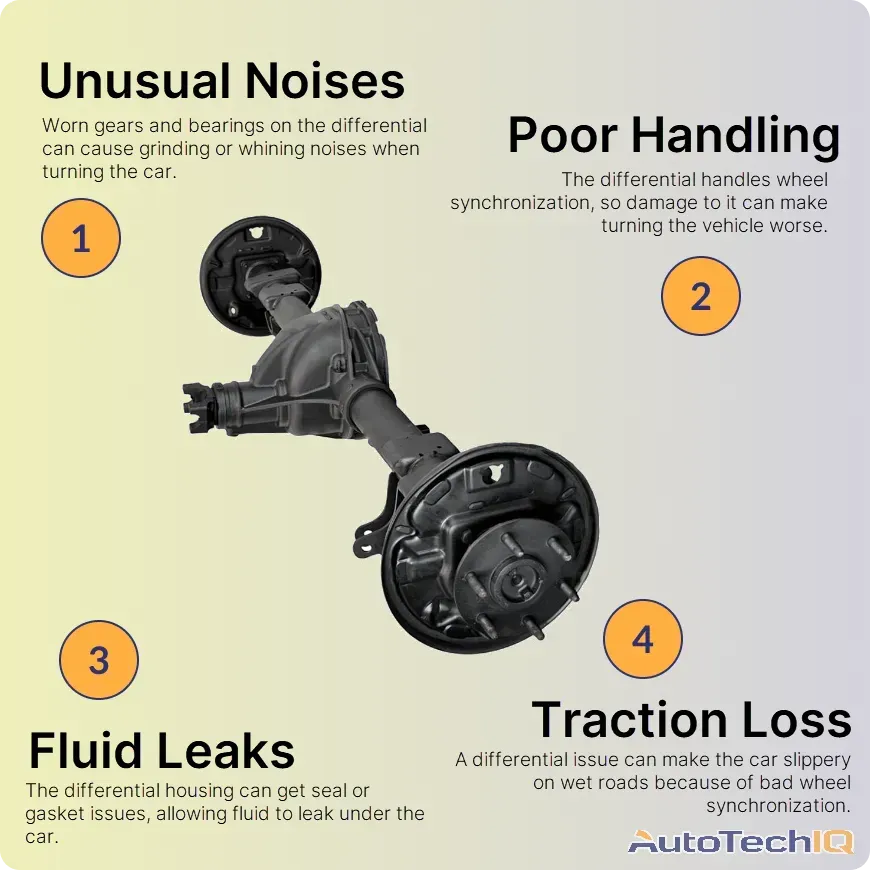
Limited-slip differentials (LSDs) were engineered to overcome the inherent weakness of the open differential when one wheel loses traction. An LSD aims to transfer a portion of the available torque to the wheel with more grip, preventing the “one-wheel peel” syndrome.
There are several common mechanisms for LSDs:
- Clutch-Type LSDs: These use a series of clutch packs (similar to those in a manual transmission) placed between the side gears and the differential case. When a speed difference between the wheels is detected (indicating slip), pressure from internal springs or ramped cams engages the clutch packs. This resistance forces more torque to be sent to the wheel with better traction. They offer a direct and aggressive locking action, often found in performance vehicles.
- Viscous-Type LSDs: These employ a sealed unit filled with a special silicone fluid and a stack of perforated plates, some connected to the differential case and others to the axle shafts. When a speed difference occurs, the fluid heats up and thickens rapidly due to shear forces, creating resistance that “locks” the plates together, transferring torque to the wheel with grip. They are smoother in operation but can be less aggressive than clutch types.
- Torsen (Torque-Sensing) LSDs: These are entirely gear-based differentials (worm gears and spur gears) that mechanically sense torque differences. They are highly effective because they bias torque to the wheel with traction before significant slip occurs, responding linearly to load. Torsen differentials are popular in high-performance cars and some SUVs for their durability and progressive action.
LSDs significantly improve acceleration, handling, and stability, especially when cornering under power or driving on slippery surfaces, making them a popular upgrade for enthusiasts and a standard feature in many sports cars and performance-oriented vehicles.
Locking Differentials
Locking differentials provide the ultimate solution for maximum traction, typically used in extreme off-road or low-speed, high-load conditions. When engaged, a locking differential mechanically connects both axle shafts directly, forcing them to rotate at exactly the same speed regardless of traction.
- How they work: When activated (either manually by the driver or automatically based on internal mechanisms), a locking differential bypasses the differential action entirely. It essentially transforms the axle into a solid unit, similar to a solid axle, ensuring that both wheels receive 100% of the available torque.
- When used: They are invaluable in situations where one or more wheels might be completely off the ground or buried in deep mud, where an open or even an LSD might struggle to provide power.
- Drawbacks: Locking differentials are not suitable for driving on paved surfaces or during turns. With both wheels forced to spin at the same speed, a locked differential will cause severe tire scrub, drivetrain binding, and unpredictable handling when turning. Therefore, they are typically designed to be engaged only when needed and disengaged for regular road use.
Electronically Controlled Differentials (e-Diffs)
Modern automotive technology has introduced electronically controlled differentials, which represent the pinnacle of differential development in terms of precision and adaptability. These systems utilize computer-controlled actuators or clutches to dynamically adjust the amount of torque sent to each wheel.
- How they work: An e-diff integrates with the vehicle’s electronic stability control (ESC) and traction control systems. Sensors continuously monitor wheel speed, steering angle, throttle position, and yaw rate. The vehicle’s computer then precisely controls the engagement of clutches or internal mechanisms within the differential to optimally distribute torque between the drive wheels.
- Benefits: E-diffs offer superior performance because they can instantaneously and continuously vary the locking effect based on real-time driving conditions. This provides optimal traction, enhanced stability, improved handling, and a more predictable driving experience across a wide range of scenarios, from spirited driving on dry pavement to navigating challenging snowy or muddy roads. They are often found in high-performance sports cars, luxury SUVs, and advanced all-wheel-drive systems.
Placement, Maintenance, and Impact on Vehicle Dynamics
The differential’s design and location are crucial for its function, and like any complex mechanical system, it requires proper maintenance to ensure longevity and optimal performance.
Front, Rear, and Center Differentials
While the “rear differential” is specifically discussed, it’s important to note that differentials are found in various locations depending on the vehicle’s drivetrain layout:
- Rear-Wheel Drive (RWD): As the name suggests, the differential is typically located at the rear axle, often integrated into the rear axle housing.
- Front-Wheel Drive (FWD): In FWD vehicles, the differential is integrated into the transaxle assembly, which combines the transmission and differential into a single unit, sending power to the front wheels.
- All-Wheel Drive (AWD) / Four-Wheel Drive (4WD): These systems often feature a differential at both the front and rear axles. Additionally, an AWD/4WD vehicle requires a center differential (or a transfer case with differential capabilities) to manage speed differences between the front and rear axles, which also travel different distances during a turn. Without a center differential, an AWD/4WD vehicle would experience the same binding and scrubbing issues between its front and rear axles as a 2WD car would between its left and right wheels.
Differential Fluid: The Lifeblood
The differential’s internal gears operate under immense pressure and generate significant heat due to friction. To protect these components and ensure smooth operation, they rely on specialized differential fluid, a type of gear oil.
- Importance of Lubrication: This fluid performs several critical functions: it lubricates the meshing gears, dissipates heat, and prevents corrosion and wear. The specific weight and additives in differential fluid are crucial for different vehicle types and differential designs (e.g., some LSDs require specific friction modifiers).
- Maintenance: Differential fluid is not a “lifetime” fluid and requires periodic replacement. The service interval varies depending on the vehicle manufacturer, driving conditions (e.g., heavy towing, off-roading, or performance driving can necessitate more frequent changes), and the type of fluid used. Neglecting differential fluid changes can lead to premature wear of gears and bearings, increased operating temperatures, noise, and ultimately, catastrophic differential failure, resulting in costly repairs.
Impact on Driving Experience
The differential’s silent work has a profound impact on the overall driving experience:
- Smooth Cornering: The most immediate benefit is the ability to turn corners without shuddering, tire noise, or excessive tire wear.
- Traction Management: With advanced differentials, drivers experience superior traction and stability, especially when accelerating, driving in adverse weather, or navigating challenging terrain.
- Vehicle Handling: The type of differential significantly influences a vehicle’s handling characteristics. For example, a vehicle with a performance-oriented LSD might feel more stable and responsive when powering through turns, allowing for more precise control and higher cornering limits. Conversely, a locked differential, while excellent for off-road traction, would make a road vehicle dangerously unpredictable during turns.
In essence, the differential is not just a component that allows wheels to turn at different speeds; it is a critical technological enabler that underpins modern vehicle dynamics, safety, and performance.

Conclusion
The rear differential, often unseen and uncelebrated, stands as a testament to the ingenuity of automotive engineering. From its humble origins solving the basic problem of turning a corner, it has evolved into a sophisticated piece of technology, with various iterations designed to optimize traction, enhance performance, and improve safety across the full spectrum of driving conditions. Whether it’s the basic open differential ensuring smooth commutes or an advanced electronically controlled unit enabling exhilarating track performance or conquering extreme off-road terrain, its fundamental purpose remains the same: to efficiently transmit power while allowing for critical speed differentiation between wheels. Understanding “what the rear differential does” is to appreciate a core technology that makes modern driving possible, safe, and enjoyable.
aViewFromTheCave is a participant in the Amazon Services LLC Associates Program, an affiliate advertising program designed to provide a means for sites to earn advertising fees by advertising and linking to Amazon.com. Amazon, the Amazon logo, AmazonSupply, and the AmazonSupply logo are trademarks of Amazon.com, Inc. or its affiliates. As an Amazon Associate we earn affiliate commissions from qualifying purchases.