
In the world of finance, few metrics carry as much weight as the S&P 500. When news anchors report that “the market is up,” or when financial advisors discuss the long-term health of a retirement portfolio, they are almost inevitably referencing the Standard & Poor’s 500 Index. But to understand what the S&P 500 is today requires more than just checking a ticker symbol on a smartphone. It requires an exploration of how 500 of the largest publicly traded companies in the United States have become the definitive barometer for global economic health and a cornerstone of modern wealth building.

Today, the S&P 500 represents roughly 80% of the total value of the U.S. stock market. It is not merely a list of companies; it is a living, breathing cross-section of American industry, innovation, and consumer behavior. From the technology giants of Silicon Valley to the industrial powerhouses of the Midwest, the index tracks the collective fortune of the corporate world, serving as a benchmark for professional fund managers and individual investors alike.
The Anatomy of the Standard & Poor’s 500 Index
At its core, the S&P 500 is a float-adjusted market-capitalization-weighted index. This technical definition is the foundation of how it functions today. Unlike the Dow Jones Industrial Average, which is price-weighted (meaning a company with a higher stock price has more influence regardless of its total value), the S&P 500 gives more weight to the companies with the largest total market value.
How the Index is Constructed
The S&P 500 is maintained by S&P Dow Jones Indices, a joint venture that monitors the eligibility of companies. To be included in the index today, a company must meet strict criteria. It must be a U.S. company, have a market capitalization of several billion dollars (a threshold that is periodically adjusted upward), and maintain high liquidity. Furthermore, the company must be profitable over recent quarters. This “quality” filter ensures that the index represents the strongest players in the economy, rather than just the largest.
The index is rebalanced quarterly. During these periods, companies that have shrunk in value or failed to meet financial standards may be removed, while rising stars from the mid-cap universe are added. This constant evolution is why the S&P 500 is often described as a “self-cleansing” mechanism for an investor’s portfolio; it automatically replaces losers with winners over long horizons.
Market Cap Weighting vs. Equal Weighting
In a market-cap-weighted system, the largest companies—such as Apple, Microsoft, and Amazon—exert a significant influence on the index’s daily movement. If these “mega-cap” stocks perform well, the entire index can rise even if hundreds of smaller companies within the index are stagnant.
Today, there is also an “Equal Weight” version of the S&P 500, where every company, regardless of size, accounts for 0.2% of the index. Comparing the standard S&P 500 to the Equal Weight version allows analysts to see whether a market rally is being driven by a handful of tech giants or if there is “breadth”—meaning the majority of American businesses are thriving. Understanding this distinction is crucial for investors who want to gauge the true health of the broader economy versus the performance of a few dominant leaders.
Why the S&P 500 Serves as the Ultimate Economic Barometer
The S&P 500 is widely considered the best single gauge of large-cap U.S. equities. Because it covers such a massive portion of the equity market, its movements are highly correlated with the overall health of the United States economy. When the index hits new highs, it often signals high consumer confidence, corporate profitability, and a robust labor market.
Representation Across Sectors
One of the reasons the S&P 500 remains relevant today is its diverse sector exposure. The index is divided into 11 Global Industry Classification Standard (GICS) sectors, including Information Technology, Healthcare, Financials, Consumer Discretionary, and Energy.
In the current economic climate, the Information Technology sector holds the largest weight, reflecting the digital transformation of the global economy. However, the presence of Healthcare and Consumer Staples provides a “defensive” cushion during downturns. Because these sectors represent the fundamental needs of society—medicine, food, banking, and energy—the S&P 500 captures the cyclical nature of the economy. When tech cools off, value-oriented sectors like Energy or Utilities may lead, providing a balanced perspective that a tech-heavy index like the Nasdaq 100 cannot offer.
The Correlation with GDP Growth
While the stock market is not the economy, the two are inextricably linked over the long term. The companies within the S&P 500 are the primary drivers of U.S. Gross Domestic Product (GDP). They are the employers of millions and the innovators behind new technologies. Consequently, the earnings growth of S&P 500 companies often precedes or mirrors the growth of the national economy. Today, investors watch “earnings season”—the period when these 500 companies report their profits—with eagle eyes, as these reports offer the most granular data available on consumer spending and corporate investment.
Historical Performance and the “Rule of 7”
To understand the S&P 500 today, one must look at where it has been. Historically, the index has provided an average annual return of approximately 10% before inflation (around 7% after inflation) over the last several decades. This has led to the popularization of the “Rule of 7,” which suggests that an investment in the S&P 500 tends to double every seven to ten years.
Decades of Compounded Growth
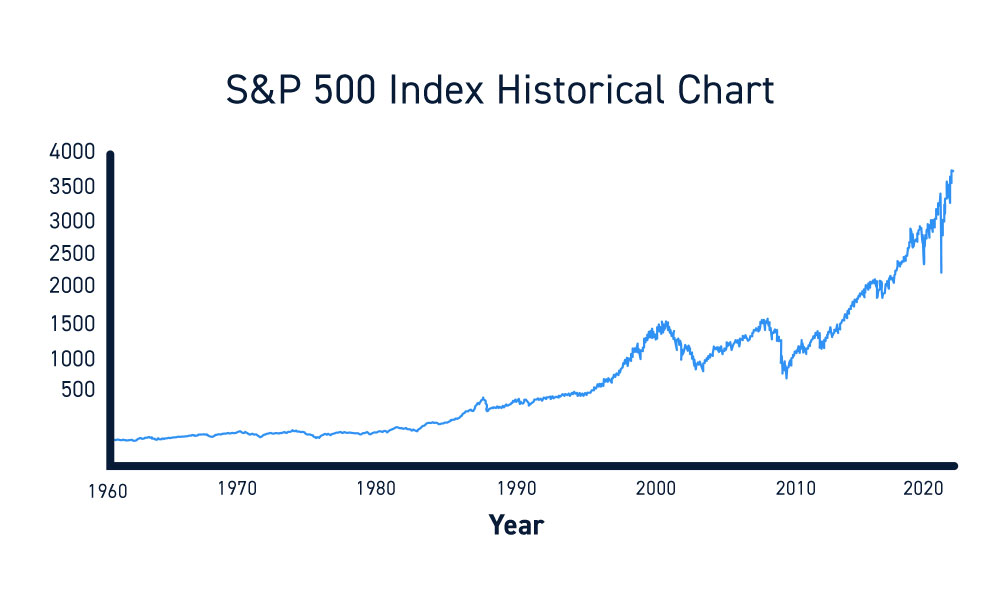
The power of the S&P 500 lies in the mathematical miracle of compounding. Because the index consists of dividend-paying companies that reinvest their profits into growth, the total return (price appreciation plus dividends) has historically outperformed most other asset classes, including gold and bonds, over 20-year periods.
Today, the total return version of the index is the gold standard for measuring wealth creation. For an individual who started investing 30 years ago, even through multiple market crashes, the S&P 500 has likely turned modest savings into significant wealth. This historical reliability is why the index is the primary vehicle for 401(k) plans and pension funds across the country.
Navigating Bear Markets and Recessions
It is a mistake to view the S&P 500 as a guaranteed upward line. Its history is punctuated by “bear markets”—periods where the index drops 20% or more from its highs. We saw this during the 2008 financial crisis, the 2020 COVID-19 crash, and the inflationary pressures of 2022.
However, the S&P 500 is defined today by its resilience. Every single bear market in the history of the index has eventually ended in a new all-time high. This recovery capability is driven by the index’s methodology: as failing companies drop out, they are replaced by the next generation of growth drivers. For the patient investor, “today’s” volatility is often seen as a temporary hurdle on a long-term trajectory of growth.
Modern Challenges: Concentration Risk and Big Tech
While the S&P 500 is a pillar of stability, it faces modern challenges that investors must recognize today. The most prominent of these is “concentration risk.” Because the index is market-cap weighted, the top 10 companies now account for a historically high percentage of the total index value—at times exceeding 30%.
The “Magnificent Seven” Influence
In the current market, a small group of companies known as the “Magnificent Seven”—including NVIDIA, Microsoft, Alphabet, and Meta—have a disproportionate impact on the index’s performance. This means that when you buy the S&P 500 today, you are heavily betting on the continued dominance of Artificial Intelligence and Big Tech.
If these few companies face regulatory headwinds or a slowdown in growth, the entire S&P 500 can suffer, even if the other 490 companies are performing well. This has led some financial experts to question whether the index is as “diversified” as it once was. Understanding this concentration is vital for anyone using the S&P 500 as their sole investment vehicle.
Diversification in the Age of Tech Dominance
To counter this concentration, many modern investors look at the S&P 500 alongside other indices. However, the S&P 500 remains the benchmark because these tech giants are not just “software companies”—they are integrated into every facet of the global economy. Microsoft provides the infrastructure for finance; Amazon dominates logistics; Alphabet controls the flow of information. Thus, their heavy weight in the index today reflects their heavy weight in our actual lives.
How to Invest in the S&P 500 Today
One of the greatest financial innovations of the last 50 years is the ability for the average person to “own” the S&P 500. Before the 1970s, it was nearly impossible for an individual to buy shares in 500 different companies. Today, it can be done with a single click and for a cost that is nearly zero.
Index Funds and ETFs
The rise of the Exchange-Traded Fund (ETF) has revolutionized how the S&P 500 is accessed. Modern funds like the SPDR S&P 500 ETF Trust (SPY), the iShares Core S&P 500 ETF (IVV), and the Vanguard S&P 500 ETF (VOO) allow investors to purchase a basket of all 500 stocks in a single share.
These funds are characterized by incredibly low “expense ratios.” In many cases, the cost to have a professional firm manage your S&P 500 holdings is less than 0.05% per year. This low-cost access is why legendary investor Warren Buffett has famously recommended that most people should simply put their money in an S&P 500 index fund rather than trying to pick individual stocks.

The Philosophy of Passive vs. Active Management
The S&P 500 is the centerpiece of the “passive investing” revolution. Data consistently shows that over long periods, the majority of active fund managers—those who try to pick specific stocks to beat the market—actually underperform the S&P 500.
Today, the S&P 500 represents the “efficient market hypothesis” in action. Because so many people are watching these 500 companies, their stock prices usually reflect all available information. By investing in the index, you are not trying to outsmart the market; you are choosing to grow with the market. For the modern investor, the S&P 500 is more than an index; it is a philosophy of participating in the long-term ingenuity and productivity of the American corporate machine.
Whether the index is up or down on any given day, its role remains the same: it is the definitive record of our economic journey and one of the most powerful tools ever created for the democratization of wealth. Understanding what the S&P 500 is today is the first step toward mastering the fundamentals of personal finance and long-term investing.
aViewFromTheCave is a participant in the Amazon Services LLC Associates Program, an affiliate advertising program designed to provide a means for sites to earn advertising fees by advertising and linking to Amazon.com. Amazon, the Amazon logo, AmazonSupply, and the AmazonSupply logo are trademarks of Amazon.com, Inc. or its affiliates. As an Amazon Associate we earn affiliate commissions from qualifying purchases.