
In the realm of computer graphics, software development, and UI design, spatial manipulation is a fundamental concept. Whether you are building a mobile application that needs to support screen rotation, developing a 2D game engine, or training a machine learning model for image recognition, understanding the “rule” for a 90-degree clockwise rotation is essential.
In mathematics, this transformation is often taught through the lens of coordinate geometry. However, in the technology sector, this rule extends far beyond a simple classroom formula. It involves understanding how digital coordinate systems differ from Cartesian planes, how matrices facilitate complex transformations in real-time rendering, and how these operations are optimized at the hardware level.
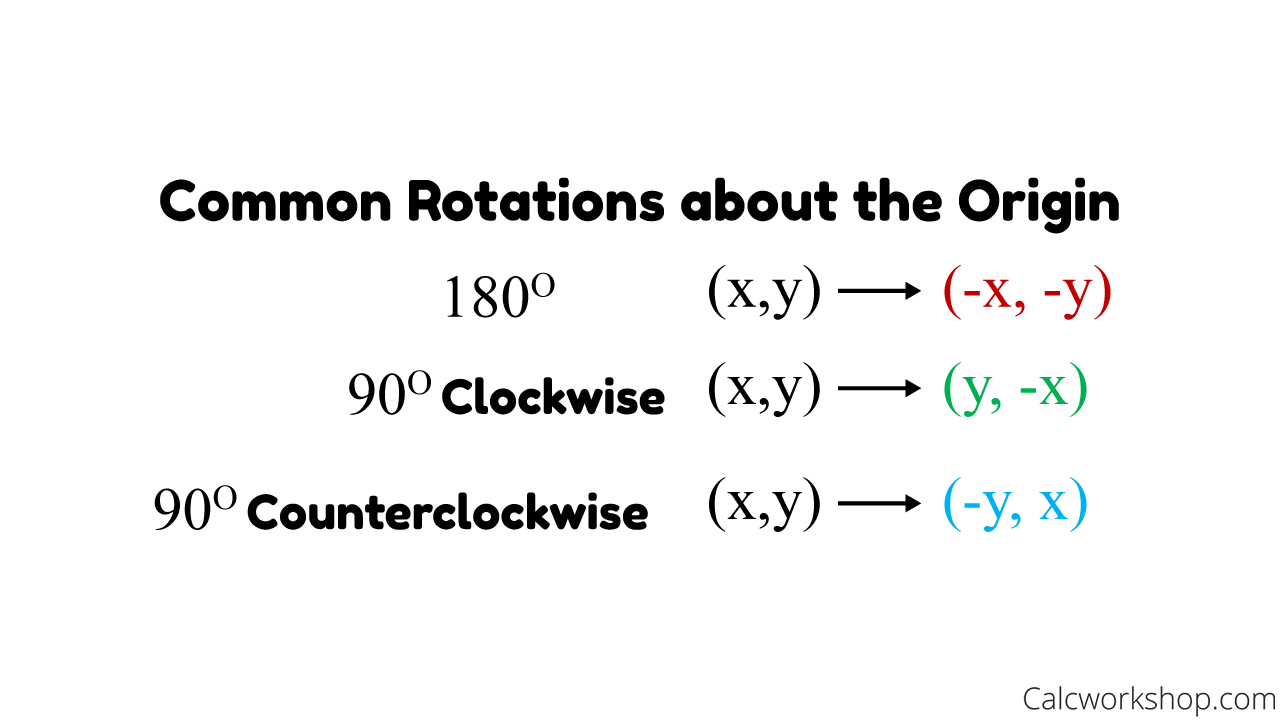
The Mathematical Foundation: The (x, y) to (y, -x) Transformation
At its most basic level, the rule for a 90-degree clockwise rotation about the origin in a standard Cartesian coordinate system is defined by a simple swap and sign change: (x, y) → (y, -x).
To visualize this, imagine a point located at (2, 3) on a graph. If we rotate this point 90 degrees clockwise around the origin (0, 0), the new coordinates become (3, -2). The original x-value becomes the negative version of the new y-value, and the original y-value becomes the new x-value.
Why the Signs Flip
In a clockwise rotation, you are moving a point from one quadrant to the next in a specific direction. If a point starts in Quadrant I (positive x, positive y), a 90-degree clockwise turn moves it into Quadrant IV (positive x, negative y). This explains why the y-coordinate in our transformation becomes negative.
The Unit Circle Perspective
For tech professionals working with trigonometry-heavy applications, such as VR/AR development or robotics, the rotation is often expressed through sine and cosine functions. A 90-degree clockwise rotation corresponds to an angle of -90 degrees (or 270 degrees) in standard mathematical notation.
The general rotation matrix for any angle θ is:
[ cos(θ) sin(θ) ]
[ -sin(θ) cos(θ) ]
Plugging in 90 degrees for a clockwise direction (which mathematically is -90°), we find that the cosine of -90° is 0 and the sine of -90° is -1. This simplifies the matrix and confirms the (y, -x) transformation rule that forms the backbone of digital rotation scripts.
Rotation in Computer Graphics vs. Standard Mathematics
While the (x, y) → (y, -x) rule is the standard in mathematics, software engineers must account for the “Computer Graphics Coordinate System.” In standard math, the y-axis increases as you move upward. In most digital environments—including HTML5 Canvas, CSS, and many windowing systems like Windows or macOS—the origin (0, 0) is at the top-left corner. In this system, the y-axis increases as you move downward.
Adjusting for the Inverted Y-Axis
Because the y-axis is inverted in digital screens, the implementation of the 90-degree clockwise rule can feel counter-intuitive. When a developer applies a transformation in a “Y-down” environment, the mathematical rotation logic must be meticulously mapped to ensure the object doesn’t disappear off-canvas.
For instance, if you are rotating an image inside a rectangular container, the “origin” of the rotation is rarely (0, 0). Most modern UI frameworks, like React Native or Flutter, default to the center of the object as the pivot point. Understanding the shift from a global origin to a local pivot point is what separates a novice developer from a senior graphics engineer.
Matrix Transformations in CSS and WebGL
In web development, the rule for 90 degrees clockwise is most commonly seen in CSS via the transform: rotate(90deg); property. Behind the scenes, the browser engine is not just moving points; it is calculating a transformation matrix.
A 2D rotation in CSS is actually a 3×3 matrix applied to the element’s rendering layer. When you trigger a 90-degree rotation, the browser uses the GPU to recompute the pixel positions. For high-performance applications, developers often use transform: translateZ(0); or will-change: transform; to ensure these rotations are handled by the graphics processor rather than the main CPU thread, ensuring a smooth 60 or 120 FPS (frames per second) experience.
Implementation in Software Engineering and AI
The 90-degree clockwise rule is a staple in data processing and image manipulation libraries. From a technical perspective, rotating an image isn’t just about moving a single point; it’s about re-indexing a massive array of pixel data.
Array Transposition in Image Processing
In libraries like Python’s NumPy or OpenCV—the industry standards for AI and computer vision—an image is treated as a multi-dimensional array (or matrix). A 90-degree clockwise rotation is achieved through two primary operations:
- Transposing the Matrix: Flipping the rows and columns.
- Reversing the Rows: Ensuring the pixels are in the correct order for a clockwise orientation.
If you have a matrix where the top-left pixel is at index [0,0], after a 90-degree clockwise rotation, that pixel will move to the top-right position. In a 3×3 matrix, the logic follows:
- Original:
[1, 2, 3], [4, 5, 6], [7, 8, 9] - Transposed:
[1, 4, 7], [2, 5, 8], [3, 6, 9] - Rotated (Reversed Rows):
[7, 4, 1], [8, 5, 2], [9, 6, 3]
This sequence is highly efficient and is used by AI developers for “Data Augmentation.” By rotating images 90, 180, and 270 degrees, engineers can quadruple the size of their training datasets, helping neural networks become invariant to the orientation of the objects they are trying to identify.
Game Engines and Vector Math
In game development (using engines like Unity or Unreal), the 90-degree rule is often applied using Quaternions or Euler angles. While the underlying math is complex, the goal is often to rotate a player’s view or a game object.
When a developer scripts a 90-degree turn in a 2D top-down game, they are essentially applying the (x, y) → (y, -x) rule to the velocity vector of the character. If a character is moving at a velocity of (5, 0)—purely on the x-axis—a 90-degree clockwise turn changes their velocity to (0, -5), directing them downward on the screen.
Practical Applications in Modern Tech Environments
Understanding the technical execution of this rule is vital across several high-growth tech niches.
1. Responsive UI and UX Design
Mobile devices are perhaps the most common place where 90-degree rotations occur. When a user tilts their phone from portrait to landscape, the OS must apply a 90-degree rotation rule to the entire viewport. This involves recalculating the “Aspect Ratio” and re-rendering the layout. Designers and developers must ensure that their “flex” or “grid” systems can handle the swap between the x and y dimensions without losing the user’s scroll position.
2. Digital Security and Steganography
In the niche of digital security, rotation rules are sometimes used in basic visual cryptography or image-based watermarking. By rotating certain pixel blocks 90 degrees clockwise according to a specific key, data can be “scrambled” to the naked eye. While not a replacement for modern AES encryption, it is a fascinating application of geometric rules in data obfuscation.
3. Satellite Imagery and GIS
Geographic Information Systems (GIS) rely heavily on coordinate transformations. When satellite data is captured, it is rarely perfectly aligned with the Earth’s grid. Engineers use rotation rules to “rectify” the images. A 90-degree clockwise rotation might be part of a larger transformation pipeline used to align a satellite’s “raw” sensor output with a standard map projection like Mercator or WGS84.
4. Robotics and Pathfinding
In autonomous drone flight or vacuum cleaning robots, the “rule” is used for localization. As a robot turns 90 degrees clockwise to avoid an obstacle, its internal map must update its orientation vector. If the robot’s logic fails to correctly apply the (x, y) → (y, -x) transformation, its internal coordinate system will become desynchronized from the physical world, leading to navigation failure.
Conclusion: The Ubiquity of the Rotation Rule
The 90-degree clockwise rule is far more than a geometry theorem; it is a foundational pillar of modern digital infrastructure. From the way your smartphone screen responds to your movements to the way AI models learn to recognize a cat regardless of its orientation, the (x, y) → (y, -x) transformation is constantly at work.
For tech professionals, mastering these transformations is about more than memorizing a formula—it’s about understanding the nuances of coordinate systems, the efficiency of matrix operations, and the practical application of vector math in software. Whether you are coding in Python, styling with CSS, or building the next great 3D engine, the 90-degree clockwise rule is a tool that ensures precision and fluidity in a digital-first world.
aViewFromTheCave is a participant in the Amazon Services LLC Associates Program, an affiliate advertising program designed to provide a means for sites to earn advertising fees by advertising and linking to Amazon.com. Amazon, the Amazon logo, AmazonSupply, and the AmazonSupply logo are trademarks of Amazon.com, Inc. or its affiliates. As an Amazon Associate we earn affiliate commissions from qualifying purchases.