
Tax evasion, often misunderstood and frequently underestimated in its severity, stands as a serious financial crime with far-reaching consequences. It’s a deliberate act of skirting tax obligations by illegally misrepresenting financial information to the tax authorities. Unlike tax avoidance, which involves legally minimizing one’s tax burden through legitimate deductions, credits, and planning, tax evasion crosses a critical line into illegality, inviting a spectrum of punitive measures that can dramatically alter an individual’s or business’s financial health, freedom, and reputation. Understanding these penalties is not merely an academic exercise; it’s a critical component of responsible financial management and legal compliance.
Understanding Tax Evasion: A Legal and Financial Perspective
At its core, tax evasion is about deception – a conscious effort to defraud the government of taxes rightfully owed. The motivations behind it can vary, from a misguided attempt to save money to a more complex scheme involving organized crime. Regardless of the motive, the act itself is a direct assault on the integrity of the tax system and the funding of public services.
Defining Tax Evasion vs. Tax Avoidance
The distinction between tax evasion and tax avoidance is paramount and often blurred in public discourse. Tax avoidance involves using legal methods to reduce one’s tax liability. This could include claiming legitimate deductions, investing in tax-advantaged accounts like IRAs or 401(k)s, or structuring a business in a way that legally minimizes taxes. It adheres to the letter and spirit of the law.
Tax evasion, on the other hand, involves illegal methods to escape tax obligations. This means deliberately misrepresenting income, expenses, or assets to pay less tax than legally required. It’s a criminal act that can lead to severe civil and criminal penalties. The key differentiator is the intent to defraud and the use of unlawful means.
Common Forms of Tax Evasion
Tax evasion can manifest in numerous ways, often becoming more sophisticated as individuals and businesses attempt to hide their tracks. Some of the most common forms include:
- Underreporting Income: Failing to declare all taxable income, such as wages, business profits, investment gains, or rental income. This can involve omitting entire sources of income or significantly reducing the reported amounts.
- Overstating Deductions or Expenses: Falsely claiming deductions for non-existent expenses, inflating the cost of legitimate business expenses, or claiming personal expenses as business ones.
- Hiding Assets or Income Offshore: Stashing money or assets in foreign bank accounts or entities without reporting them to the domestic tax authorities, often in jurisdictions known for banking secrecy.
- Falsifying Documents: Creating fake invoices, receipts, or financial statements to support fraudulent claims of income or expenses.
- Creating Sham Entities: Setting up shell corporations or trusts designed solely to obscure ownership of assets or income and avoid tax liability.
- Working “Off the Books”: Receiving cash payments for services rendered without reporting the income to avoid payroll or income taxes.
Each of these actions, when proven to be deliberate, constitutes a serious breach of tax law and triggers the severe penalties designed to deter such behavior.
The Multi-Layered Penalties for Individuals
For individuals, the penalties for tax evasion are multifaceted, encompassing financial repercussions, loss of liberty, and long-term damage to one’s reputation and opportunities. The severity often depends on the amount of tax evaded, the duration of the evasion, and the individual’s cooperation with authorities.
Financial Penalties: Fines and Interest
The most immediate and common consequence of tax evasion is substantial financial penalties. These are civil penalties imposed by tax authorities and are separate from any criminal charges.
- Accuracy-Related Penalties: If underpayment of tax is due to negligence or disregard of rules, a penalty of 20% of the underpayment may be assessed.
- Civil Fraud Penalty: For intentional underpayment of tax due to fraud, a penalty of 75% of the underpayment attributed to fraud can be levied. This is one of the harshest civil penalties.
- Failure to File/Pay Penalties: Even without intentional evasion, failing to file a return or pay taxes on time incurs penalties. The failure-to-file penalty is typically 5% of the unpaid taxes for each month or part of a month that a tax return is late, capped at 25%. The failure-to-pay penalty is 0.5% of the unpaid taxes for each month or part of a month, also capped at 25%.
- Interest Charges: In addition to penalties, interest is charged on underpayments from the date the tax was due until it is paid. This interest rate fluctuates but adds significantly to the total amount owed.
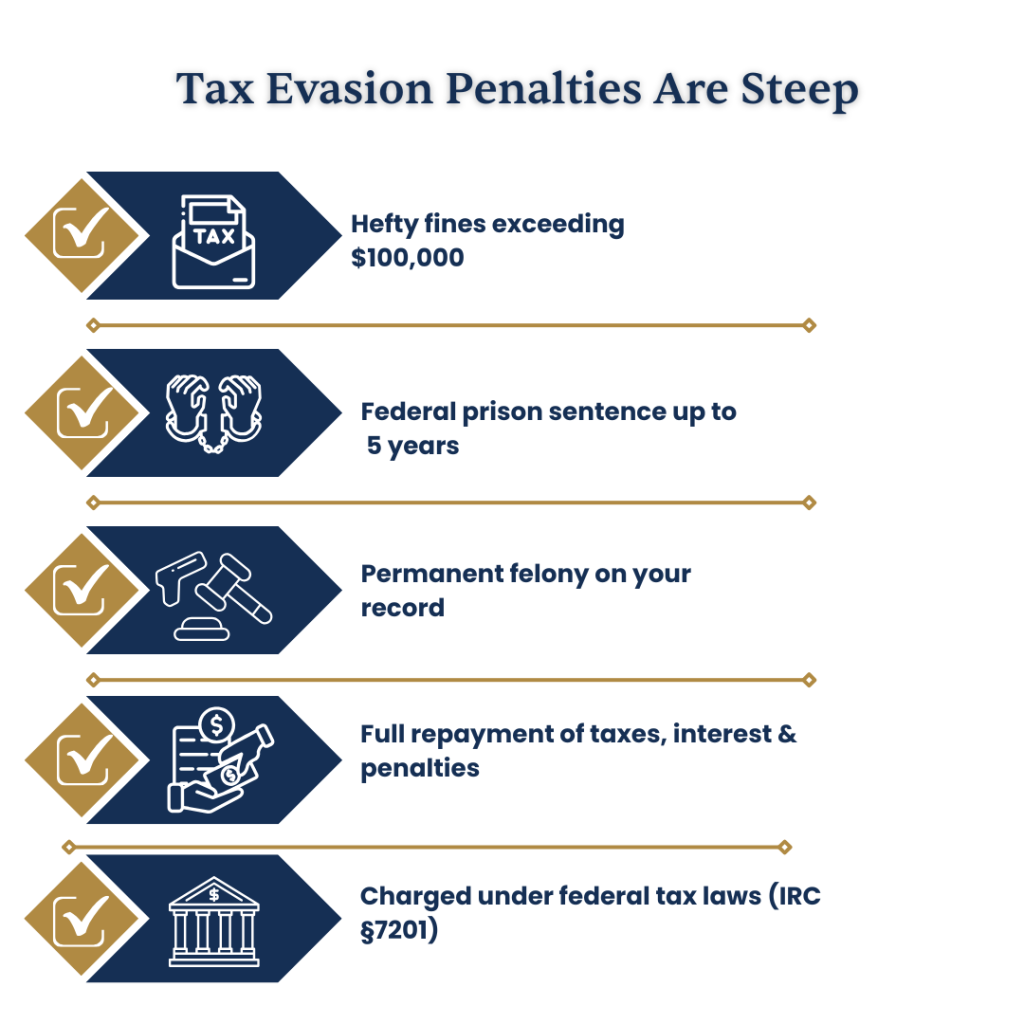
- Restitution: Beyond penalties and interest, individuals will be required to pay back all taxes owed to the government.
These financial burdens can quickly escalate, turning a seemingly small amount of evaded tax into a crippling debt.
Criminal Penalties: Imprisonment and Reputation Damage
When tax evasion is deemed intentional and egregious, it can lead to criminal charges, which carry far more severe consequences than civil penalties.
- Imprisonment: Individuals convicted of criminal tax evasion can face significant jail time. Depending on the jurisdiction and the specific statutes violated (e.g., tax evasion, filing false returns, conspiracy to defraud the government), sentences can range from a few months to several years. For example, in the United States, tax evasion can carry a sentence of up to five years in prison for each offense.
- Probation: Even if prison time is not imposed, individuals may be placed on probation, subject to strict conditions and monitoring.
- Criminal Fines: In addition to civil penalties, criminal fines can be imposed, often reaching hundreds of thousands of dollars, further compounding the financial distress.
- Reputation Damage: A criminal conviction for tax evasion carries an indelible stain on one’s reputation. It can destroy careers, sever business relationships, and lead to social ostracization. For professionals like lawyers, accountants, or financial advisors, it almost certainly means the loss of their license and livelihood.
Loss of Rights and Opportunities
Beyond financial and criminal repercussions, tax evasion can lead to the loss of certain rights and significantly diminish future opportunities.
- Passport Revocation: Many countries, including the U.S., have laws allowing for the revocation or denial of passports for individuals with serious delinquent tax debts.
- Difficulty Obtaining Loans or Credit: A criminal record, especially for financial crimes, can make it nearly impossible to secure loans, mortgages, or lines of credit, impacting future financial stability.
- Professional License Suspension/Revocation: Individuals in regulated professions (e.g., doctors, lawyers, real estate agents) can have their professional licenses suspended or revoked, ending their careers.
- Ineligibility for Public Office or Certain Government Jobs: A conviction for tax evasion can disqualify individuals from holding public office or certain government positions that require a high degree of trust and financial probity.
Penalties for Businesses and Corporations
Tax evasion by businesses and corporations not only incurs similar penalties to individuals but also poses unique challenges due to their legal structure and broader societal impact. The scale of evasion can often be much larger, leading to more substantial fines and regulatory interventions.
Corporate Fines and Regulatory Scrutiny
Businesses face hefty financial penalties, which are often scaled according to the size of the company and the magnitude of the evaded taxes.
- Exorbitant Corporate Fines: Corporations can be fined millions or even tens of millions of dollars for tax evasion, with the amounts often surpassing those levied on individuals. These fines can severely impact a company’s financial health and shareholder value.
- Increased Audits and Oversight: A history of tax evasion, or even suspicion, can lead to prolonged and intrusive audits by tax authorities. This increased scrutiny can divert significant company resources and expose other areas of non-compliance.
- Disgorgement of Profits: In some cases, companies may be forced to disgorge profits derived from their illegal activities, further impacting their financial standing.

Impact on Business Operations and Shareholder Value
The repercussions of corporate tax evasion extend far beyond monetary fines, affecting the very fabric of the business.
- Reputational Damage and Loss of Trust: A public finding of tax evasion can severely tarnish a company’s brand image, leading to a loss of customer loyalty, investor confidence, and public trust. This can be particularly devastating for consumer-facing businesses.
- Difficulty Securing Contracts: Government agencies and other businesses may be unwilling to work with companies that have a record of tax fraud, leading to a loss of valuable contracts and opportunities.
- Shareholder Backlash: Investors, particularly institutional ones, can react negatively to tax evasion scandals, leading to a sharp decline in stock price and potential shareholder lawsuits.
- Employee Morale and Turnover: Employees may experience a loss of faith in their employer, leading to decreased morale, increased turnover, and difficulty attracting new talent.
Personal Liability for Business Owners/Executives
While corporations are distinct legal entities, individuals at the helm are not immune from personal accountability.
- “Responsible Person” Liability: Owners, directors, officers, or even certain employees deemed “responsible persons” can be held personally liable for a company’s unpaid trust fund taxes (e.g., withheld income tax, Social Security, Medicare taxes). This penalty, often referred to as the Trust Fund Recovery Penalty (TFRP), can be 100% of the unpaid trust fund tax.
- Criminal Charges Against Executives: Executives who actively participate in or knowingly allow tax evasion schemes can face individual criminal charges, including imprisonment and personal fines, separate from the corporate penalties. This serves as a powerful deterrent against executive misconduct.
- Disqualification from Directorships: Individuals convicted of financial crimes may be disqualified from serving as directors of public companies.
The Investigation and Prosecution Process
The path from suspicion to conviction for tax evasion is a complex and often lengthy journey, involving multiple stages of investigation and legal proceedings. Understanding this process is crucial for anyone involved.
How Tax Evasion is Discovered
Tax authorities employ a variety of methods to uncover tax evasion, becoming increasingly sophisticated with technological advancements.
- Whistleblowers: Informants who provide credible information about tax fraud can be a significant source of leads, often incentivized by a percentage of the recovered taxes.
- Data Analytics and AI: Tax agencies increasingly use advanced data analytics and artificial intelligence to identify anomalies, patterns, and inconsistencies in reported income and expenses across vast datasets.
- Random Audits and Targeted Audits: While some audits are random, many are triggered by specific red flags in a tax return (e.g., unusually high deductions, significant income fluctuations).
- Information Sharing: International agreements and domestic inter-agency cooperation allow tax authorities to share information about financial transactions, assets, and income.
- Media Reports and Public Information: News reports or even social media activity can sometimes draw the attention of tax investigators.
Stages of an IRS Investigation (U.S. Example)
In the United States, the Internal Revenue Service (IRS) conducts investigations through distinct stages:
- Civil Audit: This is the initial stage, where an IRS auditor examines a taxpayer’s records to verify the accuracy of their return. Most audits remain civil, seeking to adjust tax liability and impose civil penalties.
- Referral to Criminal Investigation (CI): If the civil auditor uncovers indicators of fraud or willful intent to evade taxes, the case may be referred to the IRS’s Criminal Investigation Division. At this point, the investigation shifts from civil to criminal, with different rules regarding taxpayer rights.
- Grand Jury Investigation: In some cases, especially complex ones, a grand jury may be empaneled to hear evidence and determine if there is sufficient probable cause to issue an indictment.
- Trial: If indicted, the case proceeds to trial, where prosecutors present evidence to a judge or jury to prove beyond a reasonable doubt that the defendant committed tax evasion.
- Sentencing: If convicted, the court will determine the appropriate penalties, including fines, restitution, and imprisonment.
The Role of Legal Counsel
Throughout any investigation or legal proceeding related to tax evasion, the role of experienced legal counsel is indispensable. A tax attorney specializing in criminal tax defense can:
- Protect Taxpayer Rights: Ensure that the taxpayer’s constitutional rights are upheld, particularly during criminal investigations.
- Navigate Complex Laws: Provide expertise on intricate tax codes and legal procedures.
- Negotiate with Authorities: Communicate and negotiate with the IRS or other tax authorities on behalf of the client.
- Develop Defense Strategies: Craft a robust defense, which might include demonstrating lack of intent, errors in calculations, or challenging evidence.
- Advise on Voluntary Disclosure: Guide clients through programs that allow for reduced penalties for coming forward voluntarily.
Attempting to navigate a tax evasion investigation without expert legal representation is highly ill-advised, given the severe potential consequences.
Mitigating Risks and Seeking Resolution
While the penalties for tax evasion are severe, there are pathways for individuals and businesses to mitigate risks, correct past errors, and resolve tax debts, often with reduced penalties, particularly if proactive steps are taken.
Voluntary Disclosure Programs
For those who have engaged in tax evasion and wish to correct their past transgressions, voluntary disclosure programs offer a lifeline. These programs typically allow taxpayers to come forward, admit their non-compliance, and pay back taxes, interest, and reduced penalties, often avoiding criminal prosecution. The key is “voluntary” – the disclosure must be made before the tax authorities discover the evasion. This demonstrates a willingness to comply and is viewed favorably by prosecutors.
Offers in Compromise (OIC) and Payment Plans
For taxpayers who genuinely cannot afford to pay their tax debt, whether due to evasion or other financial difficulties, options exist to resolve the liability.
- Offers in Compromise (OIC): An OIC allows certain taxpayers to resolve their tax liability with the IRS for a lower amount than what they originally owe. The IRS considers the taxpayer’s ability to pay, their income, expenses, and asset equity when evaluating an OIC. It’s an option for those facing significant financial hardship.
- Installment Agreements/Payment Plans: Taxpayers who owe taxes but cannot pay them in full can apply for an installment agreement, allowing them to make monthly payments over a period of up to 72 months. This avoids the escalation of collection actions, though interest and penalties still accrue until the debt is paid.

The Importance of Accurate Record-Keeping and Professional Advice
The best defense against tax evasion penalties is prevention. Maintaining meticulous financial records and seeking professional tax advice are foundational elements of compliance.
- Accurate Record-Keeping: Keeping detailed and organized records of all income, expenses, deductions, and assets is crucial. This not only simplifies tax preparation but also provides verifiable proof in case of an audit or inquiry. Digital record-keeping systems can be particularly effective.
- Professional Tax Advice: Engaging qualified tax professionals (CPAs, enrolled agents, tax attorneys) for tax preparation and planning ensures that tax returns are accurate, compliant with current laws, and optimized for legal tax avoidance. These professionals stay abreast of changing tax legislation and can provide invaluable guidance to avoid inadvertent errors that could be misconstrued as evasion. Regular consultations can identify and rectify potential issues before they escalate.
In conclusion, the penalties for tax evasion are severe and far-reaching, designed to punish illegal behavior and maintain the integrity of the tax system. From crippling financial fines and interest to lengthy prison sentences and irreversible damage to reputation and opportunities, the consequences are profound for both individuals and businesses. The critical distinction between legal tax avoidance and illegal tax evasion underpins these penalties. Ultimately, adherence to tax laws, transparent financial practices, accurate record-keeping, and seeking professional guidance are not just best practices—they are indispensable safeguards against the devastating repercussions of tax evasion.
aViewFromTheCave is a participant in the Amazon Services LLC Associates Program, an affiliate advertising program designed to provide a means for sites to earn advertising fees by advertising and linking to Amazon.com. Amazon, the Amazon logo, AmazonSupply, and the AmazonSupply logo are trademarks of Amazon.com, Inc. or its affiliates. As an Amazon Associate we earn affiliate commissions from qualifying purchases.