
In the world of modern finance, few names carry as much weight or evoke as much excitement as the Nasdaq 100. Often referred to as the “barometer of innovation,” this index has become synonymous with the explosive growth of the 21st-century economy. For investors, whether seasoned professionals or those just beginning their journey into personal finance, understanding the Nasdaq 100 is essential. It is more than just a list of stocks; it is a meticulously curated collection of the largest and most influential non-financial companies listed on the Nasdaq Stock Market.

While many people mistake it for a “technology index,” its scope is actually broader, encompassing retail, biotechnology, industrial, and healthcare giants. However, its heavy leaning toward growth-oriented sectors has made it a primary vehicle for capturing the performance of the “New Economy.” This guide provides an in-depth look at the mechanics, history, and investment strategies surrounding the Nasdaq 100, viewed through the lens of strategic financial growth and wealth management.
The Architecture of the Nasdaq 100: How the Index is Built
The Nasdaq 100 is not a random collection of popular companies. It is governed by a strict set of rules and a methodology designed to ensure it represents the pinnacle of large-cap growth. Unlike the S&P 500, which is selected by a committee, the Nasdaq 100 is rules-based, providing a transparent framework for how companies enter and exit the list.
Inclusion Criteria and Eligibility
To be included in the Nasdaq 100, a company must meet several stringent requirements. First, it must be listed exclusively on the Nasdaq Stock Market. This creates a distinct separation from the New York Stock Exchange (NYSE). Second, and perhaps most importantly, the index excludes companies classified as “Financials” under the Industry Classification Benchmark (ICB). This means you will not find commercial banks, investment banks, or insurance companies within the index.
Furthermore, a company must have a minimum average daily trading volume of 200,000 shares and must have been listed for at least three months. These liquidity requirements ensure that the index remains tradable and reflective of real-time market sentiment. Interestingly, the index is also international; it includes non-U.S. companies (represented via American Depositary Receipts), provided they meet the same rigorous standards as domestic firms.
The Modified Market Cap Weighting System
The Nasdaq 100 utilizes a modified market-capitalization-weighting methodology. In a pure market-cap index, the largest companies carry the most weight. However, because the Nasdaq 100 is dominated by “mega-cap” tech giants, a pure weighting could lead to extreme concentration.
To manage this, the index undergoes a quarterly rebalancing and an annual “ranking review” in December. During these times, the weights of the largest components are adjusted—or “capped”—to ensure that no single company exerts too much influence over the index’s price movement. This balancing act is crucial for maintaining the index’s integrity as a diversified benchmark for growth, even as individual companies grow to trillion-dollar valuations.
The Significance of Rebalancing
Rebalancing is the process of adjusting the weights of the securities within the index. For the Nasdaq 100, this happens every quarter. If a company’s stock price skyrockets, its weight increases, potentially creating a risk if that specific sector or company faces a downturn. By rebalancing, the index forces a level of discipline, ensuring that the performance reflects the collective strength of the 100 companies rather than the parabolic move of just one or two. This structural maintenance is a key reason why institutional investors view the Nasdaq 100 as a reliable gauge of the high-growth market segment.
Performance Dynamics: Why the Nasdaq 100 Outpaces the Market
When looking at the historical performance of the Nasdaq 100 compared to the S&P 500 or the Dow Jones Industrial Average, one thing becomes clear: the Nasdaq 100 has consistently delivered superior returns over long-term horizons. This outperformance is driven by the specific characteristics of the companies that make the cut.
The Engine of Innovation and R&D
The primary driver behind the Nasdaq 100’s success is its concentration in “capital-light” and “high-innovation” businesses. Companies within the index typically reinvest a significant portion of their earnings into Research and Development (R&D). Whether it is a semiconductor firm developing the next generation of AI chips or a biotech company working on gene-editing therapy, these companies prioritize future growth over immediate dividend payouts.
From a financial analysis perspective, this creates a compounding effect. By constantly innovating, these firms maintain high barriers to entry (moats) and high profit margins. For investors, this translates into capital appreciation that often exceeds the broader, more value-heavy indices.
The Influence of the “Magnificent Seven”
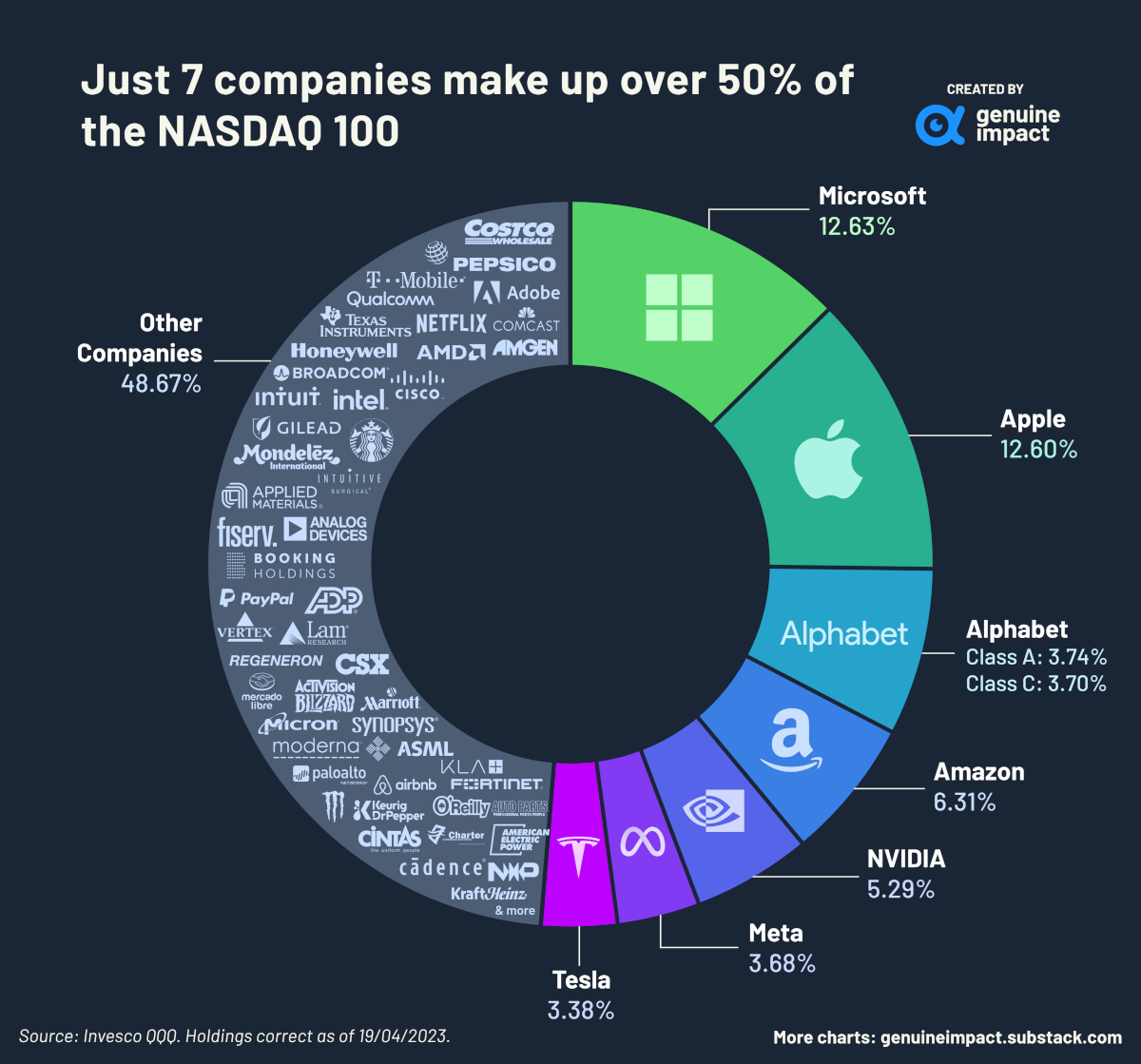
In recent years, the performance of the Nasdaq 100 has been heavily influenced by a group of companies known as the “Magnificent Seven”: Apple, Microsoft, Alphabet (Google), Amazon, Nvidia, Meta (Facebook), and Tesla. These companies are leaders in their respective fields—cloud computing, artificial intelligence, e-commerce, and digital advertising.
Because these firms have reached massive scales, their inclusion in the Nasdaq 100 provides a concentrated exposure to the themes of the digital age. When these companies report strong earnings, the entire index moves. While this concentration provides significant upside, it also requires investors to be aware of the “top-heavy” nature of the index, where the top ten holdings often account for more than 40% of the total index value.
Sector Composition Beyond Technology
While technology is the largest sector, accounting for roughly 50-60% of the index, the “Money” story of the Nasdaq 100 includes other powerful sectors. Consumer Services (including e-commerce and media) and Health Care are significant contributors. For example, retail powerhouses like Costco and biotech innovators like Amgen play a vital role in the index’s stability. This sectoral diversity provides a cushion; even if software stocks take a hit, the index may find support in the steady earnings of consumer staples or the breakthrough successes of healthcare providers.
Navigating the Risks: Volatility and Concentration
Investing in the Nasdaq 100 is not without its challenges. Higher potential returns almost always come with higher risk, and for the Nasdaq 100, that risk usually manifests as volatility.
Sensitivity to Interest Rates
Because the Nasdaq 100 is composed primarily of growth stocks, it is highly sensitive to changes in interest rates. Growth stocks are valued based on their future cash flows. When interest rates rise, the “discount rate” used by analysts to value those future cash flows also rises, making the stock less valuable in the present day.
Consequently, periods of aggressive Federal Reserve rate hikes often lead to significant sell-offs in the Nasdaq 100. Conversely, when rates are low or falling, these stocks tend to flourish. For an investor, managing a position in the Nasdaq 100 requires a keen eye on macroeconomic policy and inflation trends.
The Concentration Trap
As mentioned earlier, the Nasdaq 100 is top-heavy. This creates a “concentration risk.” If a regulatory change affects a specific sub-sector—such as antitrust laws targeting big tech—it can have a disproportionate impact on the entire index. Furthermore, the exclusion of financial stocks means the Nasdaq 100 lacks the “value” hedge that banks and insurance companies provide. During periods when the economy shifts toward cyclical or value stocks, the Nasdaq 100 can underperform significantly compared to more balanced indices like the S&P 500.
Maximum Drawdowns and Investor Psychology
Historically, the Nasdaq 100 has experienced “drawdowns” (peak-to-trough declines) that are more severe than the broader market. During the dot-com bubble of 2000-2002, the index lost more than 80% of its value. While the index is much more fundamentally sound today—with companies generating billions in actual profit rather than just “eyeballs”—the potential for 20-30% corrections remains high. Investing in this index requires a high risk tolerance and a long-term perspective to weather these inevitable storms.
Investment Vehicles: Practical Ways to Gain Exposure
For an individual interested in the Nasdaq 100, you cannot “buy” the index directly. Instead, you must use financial instruments designed to track its performance.
Exchange-Traded Funds (ETFs) and the QQQ
The most popular way to invest in the Nasdaq 100 is through an ETF. The Invesco QQQ Trust (ticker: QQQ) is one of the most traded and liquid ETFs in the world. It is designed to track the Nasdaq 100 closely, minus a small expense ratio (currently around 0.20%).
For those looking for a lower-cost option, the Invesco Nasdaq 100 ETF (ticker: QQQM) offers the same exposure with an even lower expense ratio, making it an excellent choice for long-term “buy and hold” investors. These ETFs allow you to own a piece of all 100 companies with a single transaction, providing instant diversification within the growth segment.
Mutual Funds and Index Funds
For those who prefer traditional brokerage accounts or 404(k) plans, many fund providers offer Nasdaq 100 index mutual funds. While these operate similarly to ETFs, they are priced once a day at the close of the market rather than being traded like stocks throughout the day. These are ideal for automated, recurring investments where the goal is dollar-cost averaging over several decades.
Derivatives: Options and Futures
For more advanced investors looking for leverage or hedging, the Nasdaq 100 offers a robust ecosystem of derivatives. The E-mini Nasdaq 100 futures and Micro E-mini futures allow traders to speculate on the index’s direction with significant leverage. Similarly, the options market for QQQ is incredibly liquid, allowing investors to buy “calls” to bet on an increase or “puts” to protect their portfolio against a market crash. However, these tools require a deep understanding of market mechanics and are not recommended for beginners.
Nasdaq 100 vs. S&P 500: Which Fits Your Portfolio?
Deciding whether to allocate capital to the Nasdaq 100 or the S&P 500 is a common dilemma in personal finance. The answer depends largely on your goals, age, and risk appetite.
Performance vs. Diversification
The S&P 500 offers broader diversification, covering roughly 80% of the total U.S. stock market capitalization and including 11 different sectors, including financials and utilities. It is generally less volatile than the Nasdaq 100. However, the Nasdaq 100 has historically offered higher “alpha”—the ability to beat the market—during periods of economic expansion and technological advancement.
Strategic Allocation
Many modern investors choose a “core-satellite” approach. They use a broad index fund (like an S&P 500 or Total Stock Market fund) as their “core” holding and then use a “satellite” holding in the Nasdaq 100 to increase their exposure to high-growth companies. This allows for a balance of stability and growth.
As you approach retirement, financial wisdom typically suggests reducing exposure to high-volatility indices like the Nasdaq 100 in favor of income-producing assets. However, for a young investor with a 30-year horizon, the growth potential of the Nasdaq 100 is a powerful tool for wealth accumulation.
Conclusion: The Nasdaq 100 as a Pillar of Modern Wealth
The Nasdaq 100 is more than just a ticker on a screen; it is the financial embodiment of the digital revolution. By focusing on the 100 largest non-financial companies, it captures the spirit of innovation and the power of scalable business models. While it comes with higher volatility and a heavy concentration in technology, its track record of outperforming the broader market makes it a compelling choice for growth-oriented investors.
Understanding its mechanics—from its modified market-cap weighting to its sensitivity to interest rates—empowers you to make informed decisions about your financial future. Whether you choose to invest via a simple ETF like the QQQ or use it as a benchmark to measure your own investment performance, the Nasdaq 100 remains an essential cornerstone of the global financial landscape. In the pursuit of long-term wealth, keeping a close eye on these 100 companies isn’t just a strategy—it’s a necessity.
aViewFromTheCave is a participant in the Amazon Services LLC Associates Program, an affiliate advertising program designed to provide a means for sites to earn advertising fees by advertising and linking to Amazon.com. Amazon, the Amazon logo, AmazonSupply, and the AmazonSupply logo are trademarks of Amazon.com, Inc. or its affiliates. As an Amazon Associate we earn affiliate commissions from qualifying purchases.