
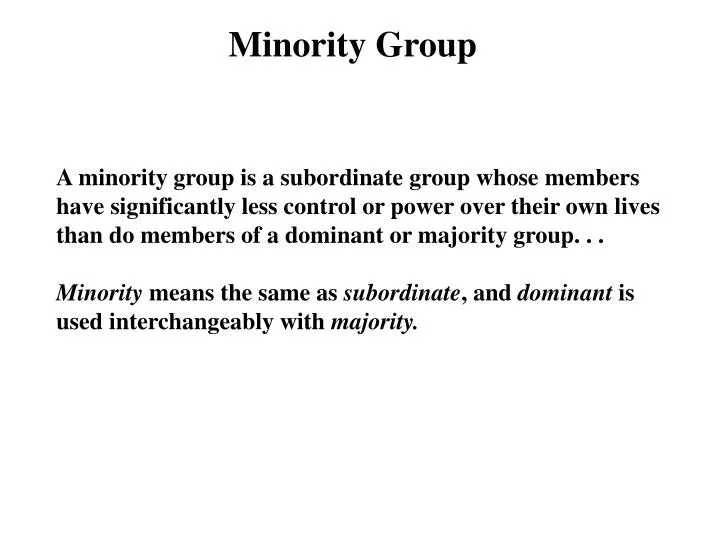
In the rapidly evolving landscape of the digital age, the term “minority group” has migrated from the realms of sociology and political science into the core of technological development. When we ask, “What is the minority group?” in a tech-centric context, we are not merely discussing demographic statistics. We are identifying the cohorts of users, data points, and communities that remain underrepresented, underserved, or overlooked by the algorithms, software, and hardware that shape our modern lives.
Understanding the minority group in technology is critical because the tools we build are only as inclusive as the data used to train them. From the code that powers artificial intelligence to the design principles of consumer gadgets, the exclusion of minority groups leads to “algorithmic bias”—a phenomenon where technology functions perfectly for the majority while failing, or even harming, those on the margins.

The Technical Definition: Minority Groups in Data and Algorithms
In the world of computer science and machine learning, a “minority group” is often defined by the volume of data it contributes to a system. If an artificial intelligence (AI) model is trained on a dataset where 90% of the entries reflect a specific demographic, the remaining 10% constitutes the minority group. This statistical imbalance creates a hierarchy of functionality within the software.
The Data Representation Gap
The “data representation gap” occurs when the information used to train systems—such as facial recognition, voice-to-text, or predictive analytics—does not accurately reflect the diversity of the global population. For example, if a developer builds a voice-activated assistant using only recordings of native English speakers from California, every other English speaker—those with accents from the Southern United States, India, or Nigeria—becomes part of a technical minority group. The software is not “broken” in a traditional sense, but it is fundamentally unoptimized for these users, leading to a degraded user experience.
Edge Cases vs. Essential Users
In traditional software engineering, developers often speak of “edge cases”—scenarios that fall outside the typical parameters of use. Too often, minority groups are relegated to these edge cases. When a developer views a minority group as an outlier, they may choose not to allocate resources to ensure the software works for them. However, in a globalized tech economy, these “outliers” often represent millions of potential users. Moving from a mindset of “edge case management” to “inclusive engineering” is the first step in addressing the technical debt incurred by ignoring minority groups.
The Impact of Exclusion in Artificial Intelligence
As AI becomes more integrated into high-stakes decision-making—such as hiring, healthcare, and law enforcement—the stakes of ignoring the minority group become significantly higher. Algorithmic bias isn’t just a technical glitch; it is a systemic failure that can reinforce existing social inequalities.
Facial Recognition and Demographic Accuracy
One of the most documented failures of tech regarding minority groups is in facial recognition technology. Numerous studies have shown that these systems are significantly less accurate when identifying individuals with darker skin tones or women. Because the training libraries (the “ground truth” data) were historically skewed toward Caucasian male subjects, the minority groups—in this case, people of color and women—experience higher rates of false positives and false negatives. This has real-world consequences, ranging from being unable to unlock a smartphone to being misidentified by surveillance systems in a criminal investigation.
Natural Language Processing and Linguistic Diversity
Natural Language Processing (NLP) is the backbone of search engines, translation tools, and chatbots. However, the “minority group” in the world of NLP includes anyone who speaks a “low-resource language.” While billions of dollars are spent optimizing AI for English, Mandarin, and Spanish, hundreds of other languages and dialects are left behind. This creates a digital divide where minority linguistic groups cannot access the same quality of information or digital services as those in the linguistic majority. Inclusive tech requires a pivot toward “polyglot AI,” which values the nuances of minority dialects and regional slang.
Building Inclusive Tech: From Design to Deployment
Fixing the “minority group problem” in technology requires more than just adding more data. It requires a fundamental shift in how products are designed, tested, and deployed. It involves a movement known as “Inclusive Design,” which posits that designing for the most marginalized users actually results in a better product for everyone.
Participatory Design Frameworks
To truly understand the needs of a minority group, tech companies must engage in participatory design. This means bringing members of underrepresented communities into the development process from day one. Instead of designing a product and then “checking for bias” at the end, companies should involve minority users in the brainstorming and prototyping phases. For instance, when designing health-tracking wearables, including users with various skin conditions or different physical abilities ensures that the sensors are calibrated for a wider range of biological realities.
Auditing Datasets for Ethical Integrity
A crucial part of modern software development is the “algorithmic audit.” Before a tool is released, it must be stress-tested against minority datasets to ensure parity in performance. If a credit-scoring algorithm is found to penalize users from certain zip codes or backgrounds, it must be recalibrated. Technical teams are increasingly employing “Red Teams”—groups of specialists who intentionally try to find ways the software might discriminate against or fail minority groups. This proactive approach treats the protection of minority data groups as a security requirement, similar to protecting against hackers.
The Economic and Social Necessity of Inclusive Software
Beyond the ethical arguments for inclusion, there is a powerful business case for focusing on the minority group. As the tech market reaches saturation in Western urban hubs, growth is increasingly found in the “next billion users”—many of whom belong to the very minority groups currently overlooked by mainstream tech.
Expanding Market Reach through Accessibility
Accessibility is often the bridge between a niche product and a global standard. Features originally designed for minority groups—such as closed captioning for the hearing impaired or voice commands for those with motor impairments—have become essential features for the general public (used by people in noisy environments or those who are driving). By prioritizing the needs of minority groups, tech companies often stumble upon innovations that improve the user interface (UI) and user experience (UX) for their entire customer base.
Mitigating Algorithmic Harm and Liability
As governments around the world, particularly in the EU with the AI Act, begin to regulate artificial intelligence, companies that ignore minority groups face significant legal and financial risks. “Algorithmic harm” is becoming a recognized legal concept. Tech firms that fail to ensure their products work equitably for minority groups may find themselves facing class-action lawsuits or heavy regulatory fines. In this sense, focusing on the minority group is not just “good PR”; it is a strategy for long-term corporate sustainability and risk management.
The Future of Representation: Decentralized Tech and AI Democratization
Looking forward, the solution to the minority group challenge may lie in the decentralization of technology itself. For decades, tech was a “top-down” industry where a few hubs (like Silicon Valley or Shenzhen) decided what the world needed. Today, the democratization of development tools is allowing minority groups to build their own solutions.
Open Source as a Catalyst for Inclusion
The open-source movement allows developers from minority communities to take existing code and “fork” it to meet their specific needs. Whether it is a localized version of an operating system or an AI model trained on indigenous languages, open source provides the infrastructure for minority groups to bypass the gatekeepers of Big Tech. This “bottom-up” innovation ensures that the minority group is no longer a passive consumer of technology, but an active architect of it.
The Role of Synthetic Data
To solve the problem of small sample sizes in minority groups, researchers are turning to “synthetic data.” By using AI to generate realistic, anonymized data points that represent minority demographics, developers can train more robust models without compromising individual privacy. This allows for the creation of “balanced” datasets even when real-world data is scarce, ensuring that the software performs with high accuracy across all demographic spectrums.
In conclusion, when we ask “What is the minority group?” in the tech industry, we are identifying the next frontier of innovation. The “minority group” represents the untapped potential of the digital world. By moving away from a “one-size-fits-all” approach and embracing the complexities of a diverse user base, the technology sector can move toward a future where “innovation” is synonymous with “inclusion.” The goal is a digital ecosystem where no user is an “edge case,” and where the power of software is accessible to everyone, regardless of the group they belong to.
aViewFromTheCave is a participant in the Amazon Services LLC Associates Program, an affiliate advertising program designed to provide a means for sites to earn advertising fees by advertising and linking to Amazon.com. Amazon, the Amazon logo, AmazonSupply, and the AmazonSupply logo are trademarks of Amazon.com, Inc. or its affiliates. As an Amazon Associate we earn affiliate commissions from qualifying purchases.