
Understanding the minimum wage landscape in the United States is more than just a matter of compliance for business owners; it is a fundamental component of personal finance, budgeting, and strategic career planning for employees. The U.S. labor market is unique in its dual-layered approach, where federal law provides a baseline, but individual states—and often cities—have the autonomy to set their own standards.
As we progress through the mid-2020s, the disparity between state rates has reached historic levels. While some states remain anchored to a rate that has not changed in over a decade, others have implemented aggressive escalators tied to inflation. This article provides an in-depth analysis of the minimum wage across the states, the economic drivers behind these figures, and what they mean for your financial health.

The Federal vs. State Minimum Wage Framework
To understand why a worker in Seattle earns significantly more than a worker in Mississippi for the same entry-level role, one must understand the interaction between the Fair Labor Standards Act (FLSA) and state sovereignty.
The Federal Floor: Understanding the Fair Labor Standards Act (FLSA)
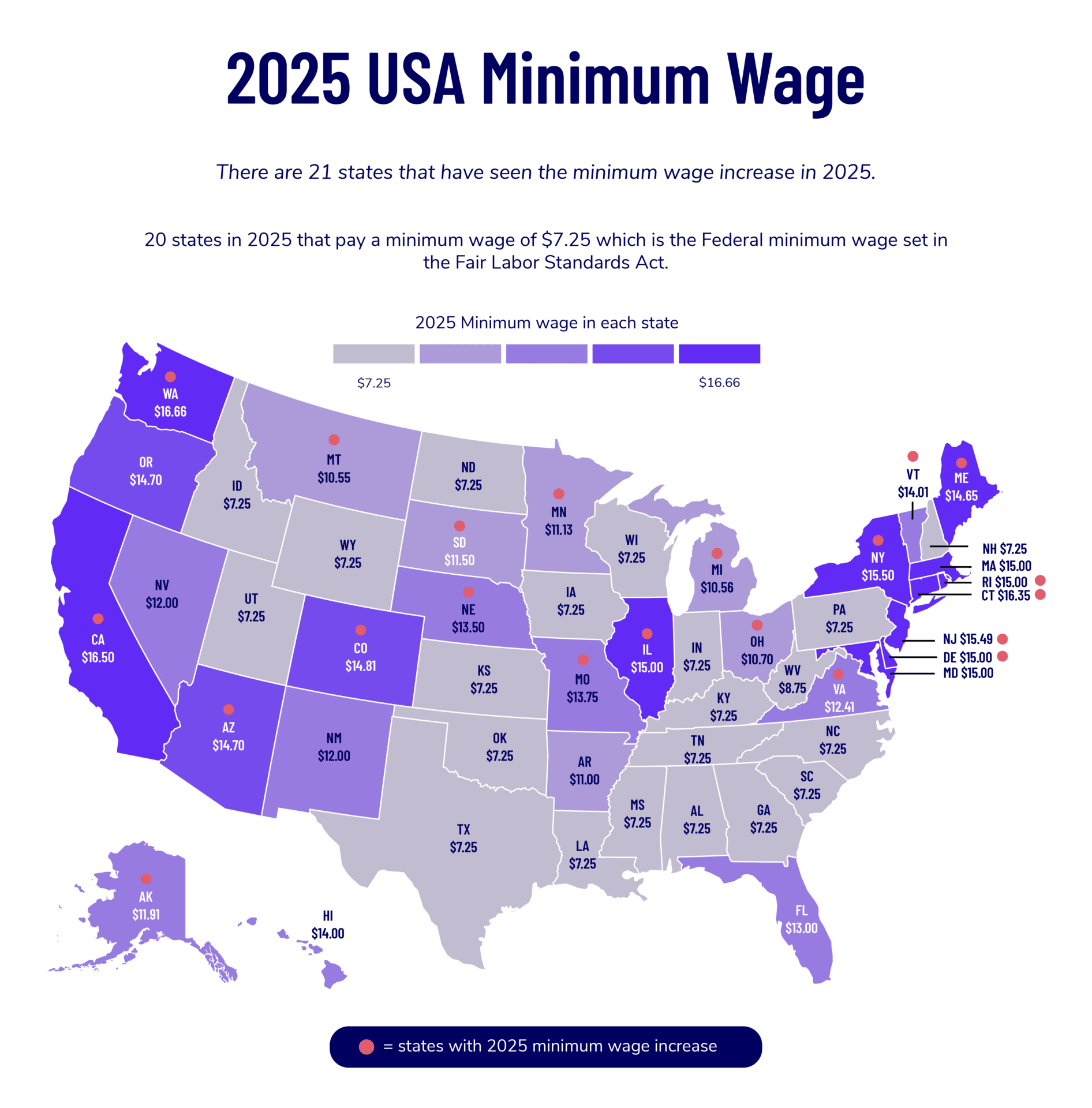
The federal minimum wage was first established in 1938 as part of the FLSA to ensure a “minimum standard of living necessary for health, efficiency, and general well-being.” Since July 2009, the federal minimum wage has been stagnant at $7.25 per hour. This rate serves as the legal floor; no state can legally permit an employer to pay less than this amount to covered, non-exempt employees. However, for many Americans, this federal floor has become increasingly disconnected from the actual cost of living.
Why State Laws Differ: The Push for Cost-of-Living Adjustments
Because the federal government has not raised the baseline in over 15 years, individual states have stepped in to fill the gap. Economic conditions vary wildly between the Silicon Valley tech hubs and the rural Midwest. States with high costs of housing, utilities, and transportation—such as Hawaii, California, and New York—have passed legislation to ensure that local wages reflect local expenses. This creates a patchwork of regulations that requires careful navigation by both job seekers looking to maximize their personal income and businesses looking to maintain healthy margins.
A Deep Dive into High-Wage States and Urban Centers
As of 2024, the map of the United States is divided into three distinct zones: states that match the federal $7.25, states that have mid-range wages between $10 and $13, and the “high-wage” leaders pushing toward or exceeding $16 per hour.
Leading the Pack: Washington, California, and New York
Washington state currently leads the nation among states with a minimum wage of $16.28 per hour. Following closely are California ($16.00) and Connecticut ($15.69). These states have adopted a progressive approach to labor economics, arguing that higher wages stimulate the economy by increasing consumer spending power. In New York, the wage is tiered; New York City, Long Island, and Westchester County have reached $16.00, while the remainder of the state sits at $15.00. This recognizes that even within a single state, the “Money” reality of an urban center is vastly different from a rural county.
The District of Columbia and Municipal Variations
It is important to note that the highest minimum wage in the country isn’t actually in a state, but in the District of Columbia, where the rate has climbed to $17.00 per hour. Furthermore, the concept of “home rule” allows cities like Seattle, San Francisco, and Denver to set rates even higher than their respective state levels. For someone managing their personal finances, these municipal rates are crucial. A worker might live in a suburb with a $14 wage but commute 15 minutes into a city with a $18 wage, drastically altering their monthly cash flow and savings potential.
The Economic Impact on Personal Finance and Business Finance

The “minimum wage” is not just a number on a paycheck; it is a pivot point for the entire economy. It influences everything from the price of a cup of coffee to the viability of a new startup.
Impact on the Individual: Managing Personal Cash Flow
From a personal finance perspective, a higher minimum wage is a double-edged sword. On one hand, it provides a more robust primary income stream, reducing the reliance on high-interest debt for basic necessities. It allows for the possibility of “Side Hustle” income to be used for investing and wealth building rather than just survival. However, in states where the wage is high, the cost of services often rises in tandem. Financial literacy in these regions requires a disciplined approach to budgeting, as the nominal increase in pay can often be neutralized by the rising cost of rent and groceries.
Business Finance Perspective: Balancing Labor Costs and Growth
For the entrepreneur or small business owner, state-mandated wage increases are a significant variable in business finance. Labor is often the largest line item on a Profit and Loss (P&L) statement. When a state raises its minimum wage, businesses must choose between three paths: absorbing the cost (reducing profit margins), increasing prices (potentially losing customers), or increasing efficiency through technology. Many businesses are now turning to AI tools and automation to handle tasks that were previously performed by entry-level staff, illustrating how wage policy directly drives technological adoption in the brand and retail sectors.
Emerging Trends: Inflation Indexing and Future Projections
The most significant trend in modern labor law is the shift away from “fixed” increases toward “indexed” increases. This change removes the political friction of raising the wage and makes it an automatic economic function.
Automatic Adjustments: States with Inflation-Linked Increases
Currently, about a dozen states, including Arizona, Colorado, Maine, and Ohio, have laws that automatically adjust the minimum wage based on the Consumer Price Index (CPI). This ensures that as inflation erodes the value of a dollar, the minimum wage rises to maintain purchasing power. For those focused on long-term financial planning, these states offer a level of predictability. Workers know their wages will not remain stagnant for a decade, and businesses can forecast their labor cost increases with greater accuracy.
The Fight for $15 (and Beyond): Future Legislative Outlook
While the “Fight for $15” was the rallying cry of the last decade, many advocates are now looking toward a $20 or $25 “living wage” in high-cost states. Several states have already scheduled incremental raises that will take them well past the $15 mark in the next two to three years. For investors and those looking at “Online Income” or “Side Hustles,” this upward pressure on wages is a signal. It suggests that the “floor” for human labor is rising, which may make certain business models less attractive while making others—particularly those that are highly automated—more valuable.
Strategic Planning for Workers and Employers
In a country where your zip code determines your base pay, strategic financial planning becomes essential. Whether you are an employee or an employer, you must look at the minimum wage as a dynamic variable.
Remote Work and Pay Equity across State Lines
The rise of remote work has introduced a complex layer to the minimum wage conversation. If a company is based in California (high wage) but employs a worker in Texas (low wage), which laws apply? Generally, the labor laws of the state where the work is physically performed take precedence. This has led to a “geographic arbitrage” where individuals move to lower-cost-of-living states while maintaining salaries that are competitive with higher-wage markets. Understanding these nuances is key to modern personal branding and career strategy.
Leveraging Side Hustles to Supplement State Minimums
In states where the minimum wage remains at the federal $7.25 level, the “Money” focus shifts heavily toward diversification. Reliance on a single, low-wage income stream is a high-risk financial strategy. In these regions, there is a burgeoning market for side hustles and online income. By leveraging digital platforms to sell skills or products globally, individuals can effectively “bypass” their local state’s minimum wage constraints, earning at a rate determined by the global market rather than local legislation.
In conclusion, the minimum wage per state is a vital metric that reflects the economic priorities and cost-of-living realities of different regions. By staying informed on these rates and the legislative trends behind them, you can make more informed decisions about where to live, where to work, and how to structure your financial future. Whether you are an entry-level worker or a seasoned business owner, the “Money” logic of the minimum wage is a cornerstone of American economic life.
aViewFromTheCave is a participant in the Amazon Services LLC Associates Program, an affiliate advertising program designed to provide a means for sites to earn advertising fees by advertising and linking to Amazon.com. Amazon, the Amazon logo, AmazonSupply, and the AmazonSupply logo are trademarks of Amazon.com, Inc. or its affiliates. As an Amazon Associate we earn affiliate commissions from qualifying purchases.