
Navigating the landscape of labor costs is a critical component of financial planning for both business owners and employees in the Old Line State. As of January 1, 2024, Maryland reached a significant milestone in its economic policy, implementing a uniform minimum wage that impacts hundreds of thousands of workers and tens of thousands of businesses. For entrepreneurs, this represents a shift in overhead management; for workers, it represents a change in baseline purchasing power. Understanding the nuances of these regulations is essential for maintaining fiscal health and ensuring legal compliance.
Understanding the 2024 Maryland Minimum Wage Laws
The most significant recent development in Maryland’s labor market is the acceleration of the “Fight for $15.” While previous legislation had set a gradual path toward a fifteen-dollar minimum wage, the Fair Wage Act of 2023, signed by Governor Wes Moore, moved the timeline forward. This legislative action was designed to help workers keep pace with the rising cost of living and high inflation rates seen throughout the early 2020s.
The Fair Wage Act of 2023
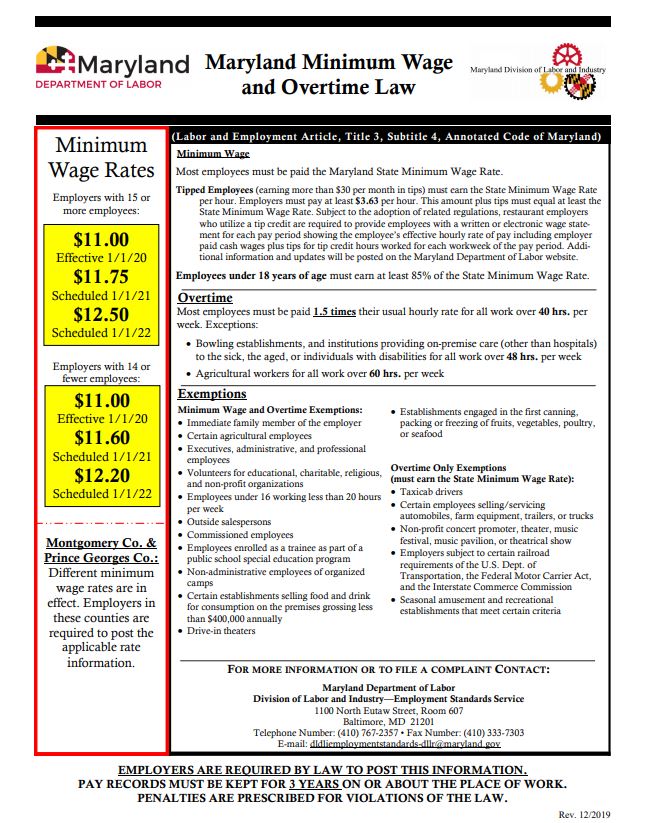
Before the Fair Wage Act took effect, Maryland utilized a tiered system that distinguished between “large” employers (those with 15 or more employees) and “small” employers (those with 14 or fewer). Under the old schedule, small employers were not required to reach the $15.00 mark until 2026. However, the 2023 Act eliminated this distinction. As of January 1, 2024, the state-mandated minimum wage for all employers, regardless of size, is $15.00 per hour. This move was intended to create a level playing field for workers across the state, ensuring that a person’s baseline income is not determined by the size of the company they work for.
Current Rates for Large and Small Employers
Because the distinction between employer sizes has been removed, the financial burden of the increase fell more heavily on small businesses that were previously planning for a slower transition. From a business finance perspective, this required a rapid adjustment of payroll budgets. Companies that were paying $13.25 or $12.80 per hour at the end of 2023 had to find the capital to support a significant percentage increase in labor costs almost overnight. For a business with ten employees working full-time, an increase of $2.20 per hour represents an additional $45,760 in annual payroll expenses, plus the associated increases in payroll taxes and workers’ compensation premiums.
Exceptions, Special Categories, and Local Variations
While the $15.00 rate is the general rule for the state, Maryland’s labor laws include several specific categories and geographical exceptions that financial planners and business owners must account for. Failing to understand these nuances can lead to either overpayment or, more dangerously, legal liabilities and back-pay penalties.
Tipped Workers and the Tip Credit
The hospitality and service industries operate under a different set of rules regarding “tipped employees.” In Maryland, a tipped employee is generally defined as someone who customarily and regularly receives more than $30 per month in tips. For these workers, the cash wage remains $3.63 per hour.
However, there is a financial “catch” known as the tip credit. Employers are permitted to use a tip credit of $11.37 per hour ($15.00 minus $3.63) to meet their minimum wage obligations. The crucial caveat is that if an employee’s cash wage plus their tips do not equal at least the $15.00 state minimum wage per hour, the employer is legally required to pay the difference. From a bookkeeping perspective, this requires rigorous tracking of tip reports to ensure that no pay period falls below the legal floor.
Youth and Training Wages
Maryland provides some financial relief for employers hiring younger workers. Employees under the age of 18 can be paid 85% of the state minimum wage. Based on the current $15.00 rate, the youth minimum wage is $12.75 per hour. This is an important consideration for seasonal businesses, such as summer camps, amusement parks, or retail outlets that rely on high-school-aged staff. By utilizing the youth rate, small businesses can manage their entry-level labor costs while providing valuable first-time employment opportunities.
Montgomery County’s Distinct Schedule
Perhaps the most complex aspect of Maryland’s wage landscape is the autonomy of Montgomery County. Due to its higher cost of living and proximity to Washington D.C., Montgomery County maintains its own minimum wage schedule that exceeds the state mandate. As of July 1, 2024, the rates are as follows:
- Large Employers (51+ employees): $17.15 per hour.
- Mid-sized Employers (11–50 employees): $15.50 per hour.
- Small Employers (10 or fewer employees): $15.00 per hour (matching the state rate).
For businesses operating in both Montgomery County and neighboring Prince George’s County or Howard County, payroll management becomes a logistical challenge, requiring location-based wage adjustments to ensure compliance with the specific local ordinances.
Economic Implications for Maryland Small Businesses
The transition to a $15.00 minimum wage carries significant weight in the realm of business finance. For many service-oriented businesses, labor represents the largest variable expense on the profit and loss (P&L) statement. When the floor for wages rises, the entire “wage ladder” often moves with it.
Managing Increased Payroll Costs
When the minimum wage increases, businesses often face “wage compression.” This occurs when the gap between entry-level workers and more experienced staff shrinks. To maintain morale and retain senior employees, businesses frequently feel pressured to raise wages for those already earning $16.00 or $17.00 per hour when the minimum moves to $15.00. This ripple effect can substantially inflate the total payroll budget beyond the direct impact of the legal minimum. Financial managers must perform a comprehensive audit of their pay structures to ensure that internal equity is maintained without jeopardizing the firm’s liquidity.
Impact on Pricing and Profit Margins
To offset higher labor costs, Maryland businesses often have to evaluate their pricing elasticity. Can the market support a 5% or 10% increase in prices? In industries like fast-casual dining or retail, where margins are razor-thin, the minimum wage increase often translates directly into higher prices for consumers. This is a delicate balancing act; if prices rise too sharply, customer volume may decrease, negating the revenue gains needed to cover the new payroll obligations. Strategic budgeting during this transition involves looking for operational efficiencies, such as better inventory management or reducing waste, to protect the bottom line.
Workforce Retention and Competitive Advantage
From a personal finance and human resources perspective, a higher minimum wage can be a tool for stability. While the “Money” aspect usually focuses on the cost to the employer, there is a financial benefit in reduced turnover. Recruiting and training a new employee can cost a business thousands of dollars in lost productivity and administrative expenses. By providing a more livable wage, businesses may see increased employee loyalty, better customer service, and lower turnover rates, which provides a long-term financial return on the initial investment in higher wages.
Navigating Compliance and Legal Requirements
In the world of business finance, the most expensive mistake is often a regulatory one. Maryland’s Department of Labor is rigorous about enforcement, and the penalties for non-compliance can far exceed the cost of simply paying the correct wage from the start.
Posting Requirements and Record Keeping
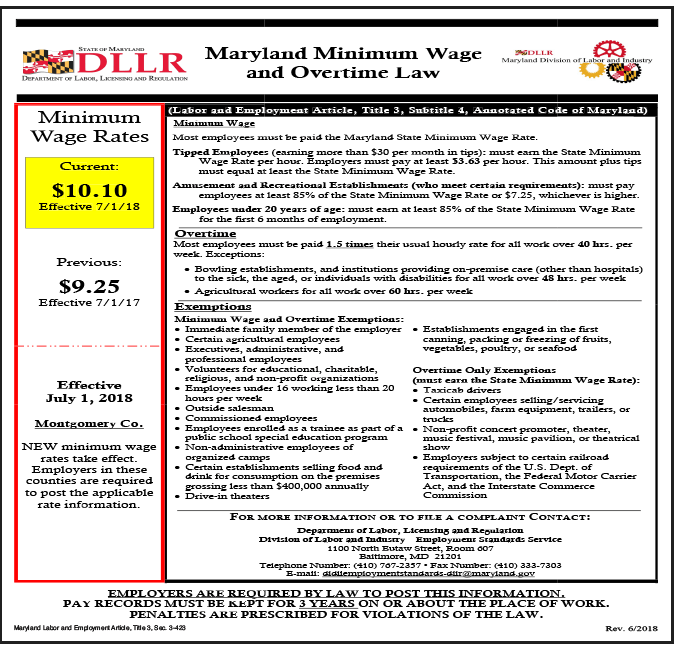
Transparency is a legal requirement. Every employer in Maryland is required to display the “Maryland Wage and Hour” poster in a conspicuous place where employees can easily read it. This poster outlines the current rates and the rights of the workers. Furthermore, businesses must keep meticulous records of hours worked and wages paid for at least three years. In the event of a Department of Labor audit, having a clean, digital trail of payroll records is the best defense against claims of wage theft or underpayment.
Penalties for Non-Compliance
If an employer is found to be in violation of the Maryland Wage and Hour Law, they may be liable for more than just the back pay. Courts can award “liquidated damages,” which are often up to three times the amount of unpaid wages, plus attorney’s fees and court costs. For a small business, a single lawsuit from an underpaid employee can lead to financial insolvency. Therefore, investing in robust payroll software or a professional PEO (Professional Employer Organization) is a wise financial move to automate compliance.
Overtime Rules and the Overlapping Regulatory Landscape
The minimum wage is only one part of the financial compliance equation. Maryland also follows strict overtime rules, generally requiring time-and-a-half pay for any hours worked over 40 in a single workweek. It is a common financial pitfall for businesses to assume that salaried employees are exempt from these rules. However, to be “exempt,” an employee must meet specific salary threshold requirements (set by federal law) and perform specific job duties. When the minimum wage rises, it often signals a future rise in the federal exempt salary thresholds, further complicating the long-term financial planning for Maryland firms.
Future Outlook and Long-Term Financial Planning
The achievement of a $15.00 minimum wage is likely not the end of the conversation regarding labor costs in Maryland. As the economic environment evolves, both businesses and individuals must look ahead to ensure continued financial resilience.
Potential Adjustments for Inflation
Unlike some states that have automatic yearly “COLA” (Cost of Living Adjustment) increases tied to the Consumer Price Index (CPI), Maryland’s current $15.00 rate is fixed until further legislative action is taken. However, given the political climate and the ongoing discussion regarding “living wages” versus “minimum wages,” it is highly probable that future sessions of the Maryland General Assembly will debate indexing the wage to inflation. Forward-thinking business owners should build “wage inflation” into their five-year financial models to avoid being caught off-guard by future legislative shifts.
Strategic Budgeting for Maryland Entrepreneurs
For the Maryland entrepreneur, the “Money” story of the minimum wage is one of optimization. Success in a high-wage environment requires a shift from labor-intensive models to value-intensive models. This might mean investing in employee training to increase revenue per labor hour or adopting new financial tools that provide real-time data on labor-to-revenue ratios.
Ultimately, the minimum wage in Maryland serves as a floor for the economy. For the worker, it is a foundation for budgeting and debt management. For the business owner, it is a key variable in the complex equation of profitability. By understanding the laws as they stand in 2024—including the $15.00 state rate and the higher local mandates in Montgomery County—stakeholders can make informed decisions that promote both personal and corporate financial growth.
aViewFromTheCave is a participant in the Amazon Services LLC Associates Program, an affiliate advertising program designed to provide a means for sites to earn advertising fees by advertising and linking to Amazon.com. Amazon, the Amazon logo, AmazonSupply, and the AmazonSupply logo are trademarks of Amazon.com, Inc. or its affiliates. As an Amazon Associate we earn affiliate commissions from qualifying purchases.