
In the world of cinematic finance, the horror genre occupies a unique and highly coveted position. While superhero epics and animated family features often dominate the raw “top ten” lists of all-time box office earners, horror remains the most consistently profitable sector of the film industry. To understand what the highest-grossing horror movie of all time is, one must look beyond mere ticket sales and delve into the financial mechanics of production budgets, return on investment (ROI), and global market distribution.

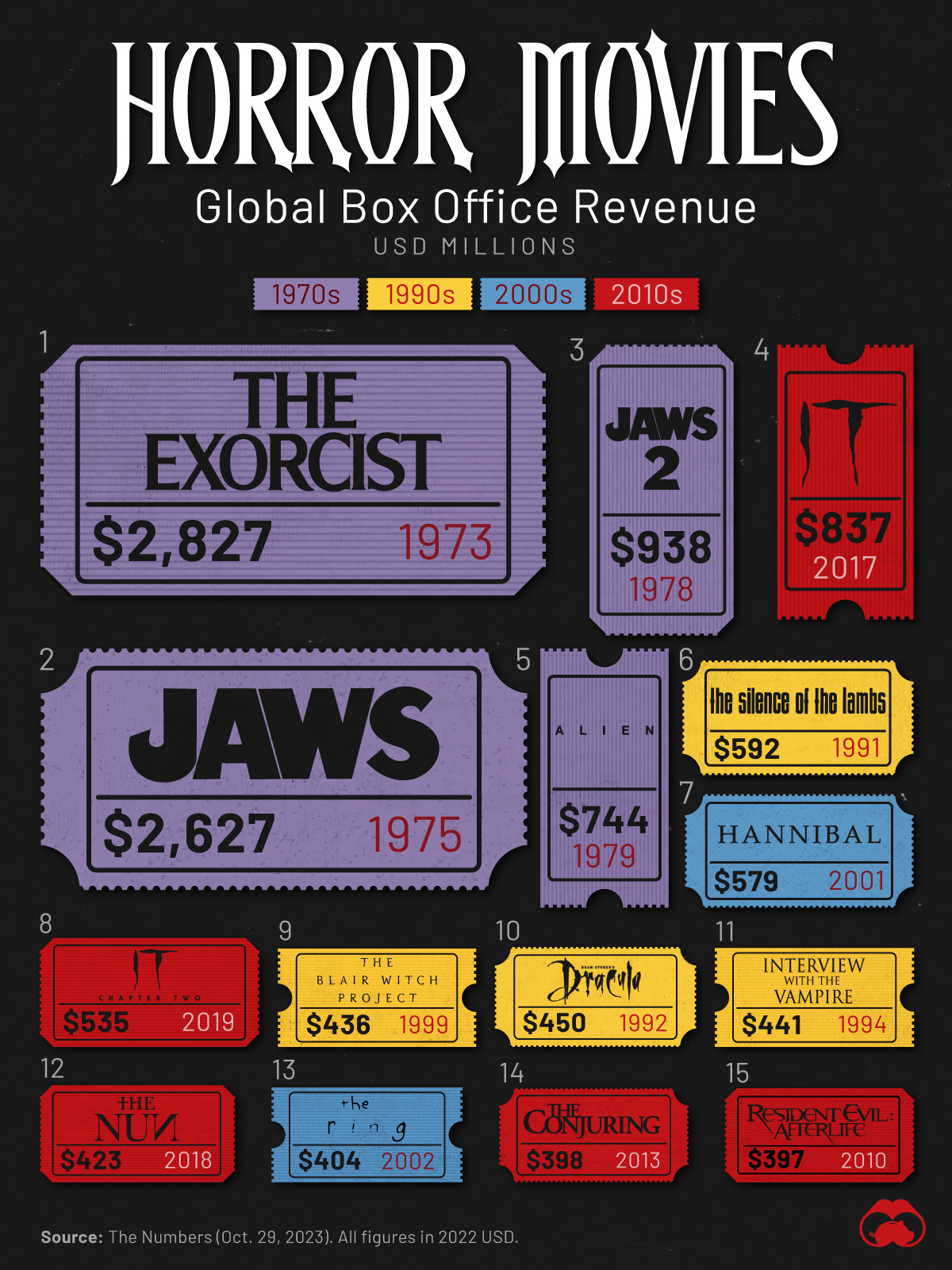
As of the current fiscal landscape, the 2017 adaptation of Stephen King’s “IT” holds the crown as the highest-grossing horror film in history, raking in over $701 million globally. However, for the astute investor or business analyst, the story isn’t just about that final number; it is about how a mid-budget production transformed into a blue-chip financial asset.
Decoding the Record-Breaker: IT (2017) and the $700 Million Milestone
When New Line Cinema and Warner Bros. released IT in September 2017, it didn’t just break records; it shattered the traditional ceiling for what a “niche” genre film could earn. To understand the magnitude of this financial success, we must examine the capital allocation and market timing that facilitated this windfall.
The Financial Anatomy of a Blockbuster
The production budget for IT was approximately $35 million. In the context of modern filmmaking, where “tentpole” movies often cost upwards of $200 million, this was a lean investment. When a film earns $701.8 million on a $35 million budget, the gross multiplier is staggering—roughly 20 times its production cost. This does not account for P&A (Prints and Advertising) costs, which were estimated at another $35–50 million, but even with those factored in, the net profit margin remains one of the healthiest in Hollywood history.
Comparative Analysis: Inflation vs. Raw Totals
From a purely monetary perspective, IT is the leader. However, a financial analysis would be incomplete without discussing inflation-adjusted earnings. If we adjust the 1973 classic The Exorcist for today’s dollar value, its original $441 million gross would equate to well over $1 billion. For contemporary business strategists, this highlights the difference between “raw gross” and “purchasing power.” While IT holds the nominal record, The Exorcist remains the benchmark for market penetration during a time when the global theatrical infrastructure was significantly smaller.
Why Horror is the Ultimate Investment Strategy for Studios
From a venture capital perspective, the horror genre functions similarly to a high-yield, low-risk startup. The “Business of Fear” is built on a model that prioritizes psychological impact over expensive visual effects or A-list talent salaries.
High ROI: The Blumhouse Model
The most significant shift in horror’s financial viability over the last decade can be attributed to the “Blumhouse Model.” Founded by Jason Blum, this strategy involves capping production budgets at extremely low levels (often under $5 million) and providing the director with creative freedom. If the film fails, the loss is negligible to a major studio. If it succeeds—as seen with Get Out or Paranormal Activity—the ROI can reach thousands of percentage points. This “Moneyball” approach to filmmaking has turned horror into a preferred asset class for studios looking to offset the losses of more expensive, failed blockbusters.
Low Production Costs, High Yield Margins
Unlike action films that require international stars with $20 million salaries, horror thrives on “the unknown.” In fact, recognizable stars can sometimes hinder the immersion of a horror film. By utilizing emerging talent and limited locations, producers can keep overhead low. Consequently, even a “moderately” successful horror film that grosses $50 million against a $5 million budget provides a better profit margin than a $200 million superhero movie that grosses $500 million.
Market Factors Influencing Global Box Office Revenue
The success of a film like IT is not accidental; it is the result of strategic market positioning. Revenue in the modern film industry is no longer dependent solely on North American audiences.
Domestic vs. International Market Saturation
Horror is a “universal language.” Fear is a primary human emotion that translates across cultural boundaries without the need for complex localization. While comedy often struggles in international markets due to linguistic nuances, a jump-scare works as well in Beijing as it does in New York. IT earned roughly 53% of its total revenue from international markets. For financial planners in the film industry, this global scalability is a key driver for greenlighting horror projects.
The Impact of Rating Classifications on Profitability
Historically, an “R” rating (Restricted) was seen as a financial handicap, as it barred the lucrative teenage demographic. However, the success of IT and The Conjuring franchise proved that an R-rating can actually enhance a brand’s “authenticity” and “prestige,” leading to higher per-screen averages. The “Forbidden Fruit” marketing strategy—positioning a movie as “too scary for some”—creates a viral urgency that drives ticket sales among adults, a demographic with higher disposable income.
The Financial Legacy of Horror Franchises
In business, “recurring revenue” is the holy grail. For movie studios, this manifests as a franchise or a “Cinematic Universe.” The horror genre is uniquely suited for brand extensions and long-tail revenue streams.
The Conjuring Universe: A Multi-Billion Dollar Asset
While IT is the highest-grossing standalone film, The Conjuring universe represents the pinnacle of horror as a corporate brand. Spanning several sequels and spin-offs like Annabelle and The Nun, this franchise has collectively grossed over $2 billion. By treating horror as an interconnected brand, Warner Bros. has created a reliable, diversified portfolio of assets. Each new release serves as a marketing vehicle for the back-catalog, driving digital sales and streaming residuals.
Merchandising and Ancillary Revenue Streams
The financial tail of a horror movie extends far beyond the theater. High-grossing horror films create “Iconic IP” (Intellectual Property). Pennywise the Clown, the antagonist of IT, became a merchandising powerhouse. From Halloween costumes and collectible figurines to licensed appearances in video games, the ancillary revenue generated by a successful horror brand provides a high-margin income stream that requires little to no additional production capital once the character is established in the public consciousness.

Conclusion: The Future of Horror as a Financial Powerhouse
The title of “highest grossing horror movie” is currently held by IT, but the significance of that record lies in what it signals to the financial world. It proved that horror is no longer a “fringe” or “B-movie” category; it is a Tier-1 financial performer capable of generating massive cash flows on relatively small capital outlays.
For investors, the horror genre offers a hedge against the volatility of high-budget filmmaking. As streaming services like Netflix, Max, and Shudder compete for subscriber retention, horror content remains a primary driver of engagement due to its high re-watchability and intense fan loyalty. Whether we are looking at the $701 million earned by a demonic clown or the $2 billion collective gross of a haunted house universe, the conclusion is clear: in the business of entertainment, fear is one of the most bankable commodities on the market.
As we look toward the future, the integration of new technologies—such as VR horror experiences and AI-driven personalized marketing—will likely push these gross figures even higher. The record set by IT is not just a milestone of cinematic history; it is a blueprint for the modern era of high-margin, low-risk entertainment investment. In the world of finance, the scariest thing about horror isn’t the monsters on the screen—it’s how much money would be left on the table by ignoring the genre.
aViewFromTheCave is a participant in the Amazon Services LLC Associates Program, an affiliate advertising program designed to provide a means for sites to earn advertising fees by advertising and linking to Amazon.com. Amazon, the Amazon logo, AmazonSupply, and the AmazonSupply logo are trademarks of Amazon.com, Inc. or its affiliates. As an Amazon Associate we earn affiliate commissions from qualifying purchases.