
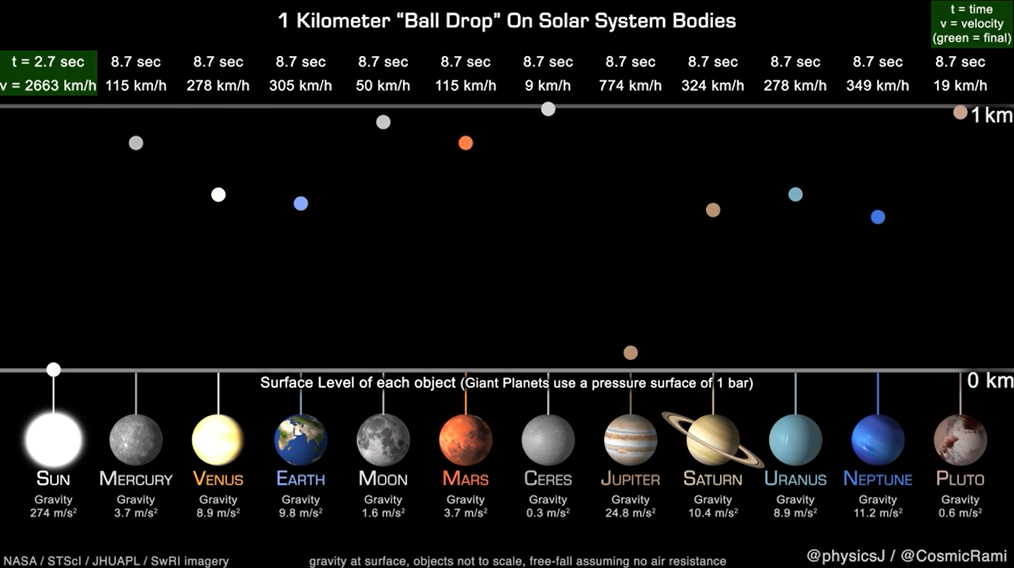
Determining the gravitational pull of a planet located approximately 886 million miles away from the Sun is not merely a feat of classical physics; it is a triumph of modern technology. Saturn, the ringed jewel of our solar system, possesses a surface gravity of approximately 10.44 m/s². While this number seems straightforward, the technological infrastructure required to calculate, verify, and utilize this data involves some of the most sophisticated hardware and software ever engineered by humanity. In the contemporary era, understanding Saturn’s gravity is less about dropping weights and more about leveraging AI-driven simulations, deep-space telemetry, and high-precision sensor arrays.

Engineering the Measurement: Sensor Technology and Gravimetry
The pursuit of measuring Saturn’s gravitational field—which is non-uniform due to the planet’s rapid rotation and gaseous composition—requires hardware that can operate in the most extreme environments. To understand the “pull” of Saturn, engineers rely on a combination of onboard spacecraft sensors and Earth-based monitoring systems.
High-Precision Accelerometers and IMUs
Modern space probes, such as the legacy Cassini-Huygens mission and proposed future orbiters, utilize Inertial Measurement Units (IMUs) and high-precision accelerometers. These are not the basic sensors found in a smartphone; they are ultra-sensitive instruments capable of detecting infinitesimal changes in velocity caused by the uneven distribution of mass within Saturn. As a spacecraft passes over different latitudes, these sensors record “gravity anomalies.” This data is then digitized and transmitted across the vacuum of space, requiring high-bandwidth transponders capable of maintaining signal integrity over billions of kilometers.
Deep Space Network (DSN) and Doppler Tracking
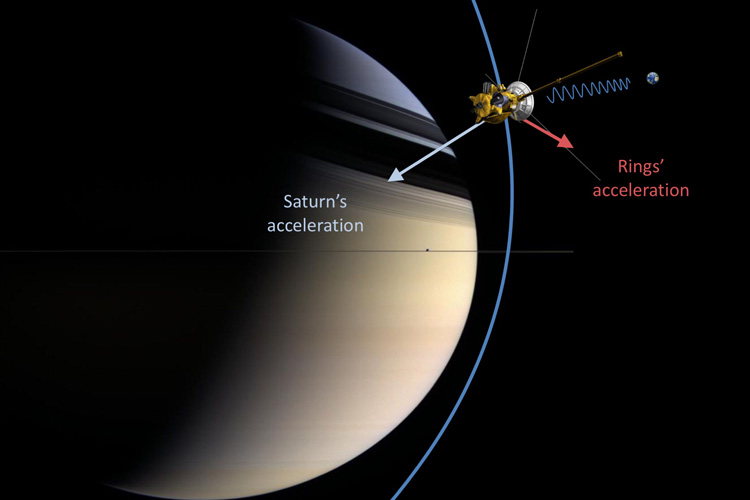
The primary “tech stack” for measuring planetary gravity is the Deep Space Network (DSN). By using massive radio antennas on Earth, scientists track the radio signals emitted by a spacecraft. As Saturn’s gravity pulls on the craft, it causes a slight shift in the frequency of the radio signal—a phenomenon known as the Doppler Effect. Digital signal processing (DSP) algorithms then analyze these frequency shifts to calculate the spacecraft’s precise acceleration. This technological synergy between a distant robot and terrestrial supercomputers allows us to map Saturn’s internal structure with surgical precision.
Software Simulations and AI in Planetary Physics
Once the raw data is captured by sensors and transmitted via the DSN, the focus shifts from hardware to software. The gravitational pull of Saturn is not a static value; it is influenced by its rings, its 146 moons, and its fluid dynamics. Decoding this complexity requires heavy-duty computational modeling.
Neural Networks for Orbital Mechanics
In recent years, Artificial Intelligence (AI) and Machine Learning (ML) have revolutionized how we interpret gravitational data. Traditional Newtonian models often struggle with the “n-body problem”—the challenge of predicting the individual motions of a group of celestial objects interacting with each other gravitationally. Modern software suites now employ neural networks trained on decades of telemetry data to predict orbital perturbations. These AI models can filter out “noise” from solar radiation pressure or gas leaks from a spacecraft’s thrusters, ensuring that the resulting gravity map of Saturn is as accurate as possible.
Simulating Atmospheric Drag and Ring Interaction
Saturn is a gas giant with no solid surface, meaning its “gravitational pull” is often measured at the one-bar pressure level (roughly equivalent to Earth’s sea level). Software developers have created complex Fluid Dynamics (CFD) simulations to understand how Saturn’s immense gravity interacts with its high-speed atmospheric winds. Furthermore, the rings of Saturn represent a massive technical challenge. Modeling the gravitational influence of trillions of ice particles requires massively parallel processing (MPP) environments, where thousands of CPU cores work in tandem to simulate the “pull” exerted by the ring system on passing probes.
The Role of Robotics in Gravitational Data Acquisition
The technology used to explore Saturn is increasingly autonomous. Because the one-way light time for a signal to reach Saturn is about 80 minutes, real-time control from Earth is impossible. Therefore, the robots we send to Saturn must be “smart” enough to manage gravitational transitions on their own.
Lessons from the Cassini-Huygens Mission
The Cassini spacecraft was a marvel of 1990s and 2000s technology, featuring a sophisticated Command and Data Subsystem (CDS). During its “Grand Finale,” Cassini dived between Saturn and its rings. This required the onboard software to make micro-adjustments to its trajectory based on real-time gravitational readings. The success of this mission proved that autonomous navigation software is critical for operating in high-gravity environments where the margin for error is measured in millimeters.
Future Tech: The Next Generation of Saturnian Probes
Looking forward, the technology for measuring Saturn’s gravity is pivoting toward “SmallSats” and swarm robotics. Instead of one massive, multi-billion-dollar probe, future missions may involve a fleet of smaller, interconnected robots. These swarms would use “Inter-satellite Link” (ISL) technology to communicate with one another, creating a local network that can measure gravitational gradients from multiple points simultaneously. This would provide a 4D map of Saturn’s gravity, showing how it changes over time as the planet’s internal fluids shift.
Cybersecurity and Data Integrity in Space Communications
As the technology used to study Saturn becomes more digital and interconnected, the importance of cybersecurity and data integrity cannot be overstated. The data representing Saturn’s gravitational pull is a vital scientific asset, and protecting the “pipeline” from the planet to the laboratory is a major technical undertaking.
Protecting Telemetry Data from Interference
Interplanetary data transmission is susceptible to both natural “noise” (from cosmic rays) and potential human-led interference. To counter this, engineers use sophisticated Error Correction Code (ECC) algorithms, such as Reed-Solomon or Turbo codes. These software-based solutions allow the receiving station to reconstruct missing bits of data, ensuring that the gravitational measurements remain precise despite the interference encountered during the long journey from Saturn to Earth.
Encryption Standards for Interplanetary Links
While the threat of “hacking” a Saturn probe seems like science fiction, the digital security of space assets is a growing field of research. Modern mission protocols are beginning to integrate advanced encryption standards (AES) into their telemetry streams. This ensures that the commands sent to a spacecraft—and the gravitational data sent back—cannot be spoofed or intercepted. As we move toward a more “congested” space environment with more nations and private companies launching missions, the software “handshake” between Earth and Saturn must be cryptographically secure to maintain the sanctity of scientific discovery.
The Future of Gravitational Computing
The question of “what is the gravitational pull on Saturn” has evolved from a theoretical physics problem into a multi-disciplinary technological challenge. Today, we answer this question through the lens of high-performance computing, autonomous robotics, and global communication networks.
As we refine our AI algorithms and deploy more sensitive sensors, our understanding of Saturn will continue to deepen. We are moving toward a future where “Digital Twins” of Saturn exist on Earth—virtual models so accurate that they can predict the gravitational effects of a passing comet or a shift in the planet’s core in real-time. Through the continued advancement of technology, the mysteries of Saturn’s gravity are being unraveled, one bit of data at a time, proving that the tools we build are just as significant as the planets we explore.
aViewFromTheCave is a participant in the Amazon Services LLC Associates Program, an affiliate advertising program designed to provide a means for sites to earn advertising fees by advertising and linking to Amazon.com. Amazon, the Amazon logo, AmazonSupply, and the AmazonSupply logo are trademarks of Amazon.com, Inc. or its affiliates. As an Amazon Associate we earn affiliate commissions from qualifying purchases.