
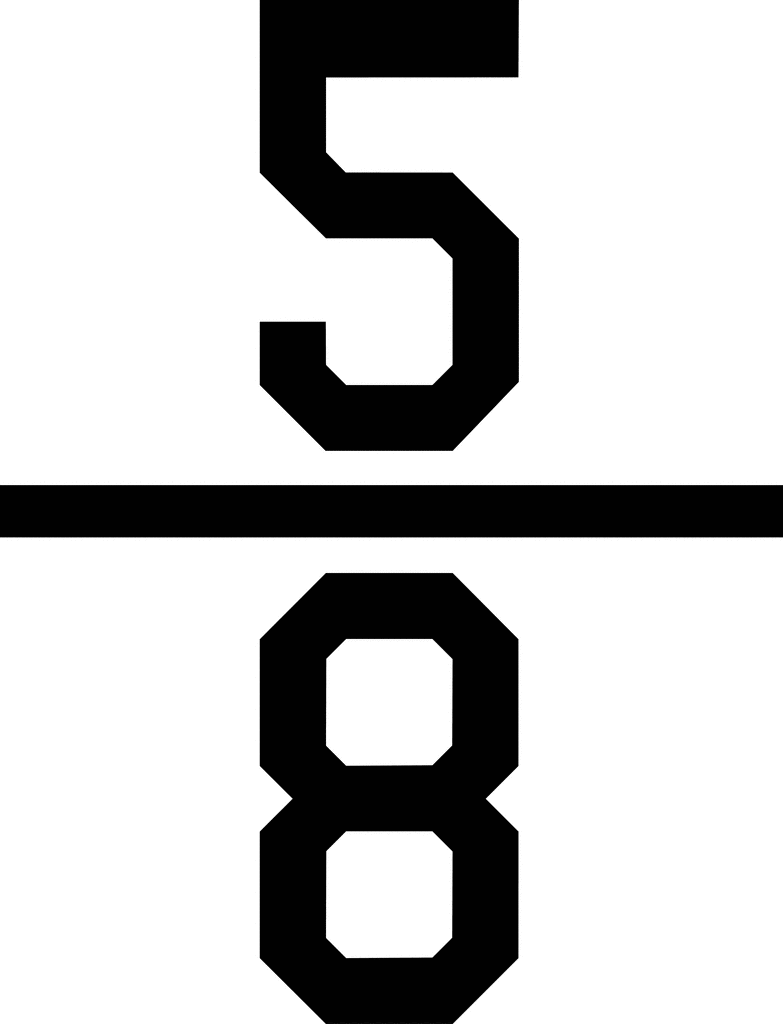
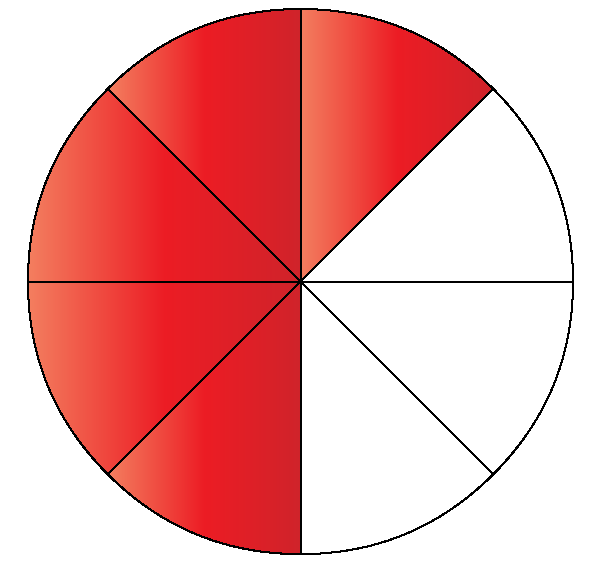
In the world of finance, precision is the difference between a calculated risk and a costly mistake. While many view the question “what is the fraction for 5/8?” as a simple mathematical inquiry, its application in the realms of personal finance, corporate equity, and market analysis is profound. At its core, 5/8 represents 62.5% of a whole. In financial terms, this ratio acts as a critical benchmark for everything from debt-to-income ratios to the historical pricing of stocks on major exchanges.
Understanding the fractional value of 5/8 is more than an exercise in arithmetic; it is an exploration of how we divide value, measure growth, and allocate resources. Whether you are a retail investor looking at dividend yields or a business owner evaluating a cap table, the 0.625 decimal equivalent of 5/8 serves as a pivot point for decision-making.

The Historical Significance of Eighths in the Financial Markets
To understand why 5/8 remains a relevant figure in financial literacy, one must look back at the history of the New York Stock Exchange (NYSE). For over two centuries, stock prices were not quoted in decimals but in fractions of a dollar, specifically in eighths. This system, rooted in the Spanish “pieces of eight” or “doubloons,” meant that the smallest price movement (or “tick”) was one-eighth of a dollar ($0.125).
The Era of Fractional Trading
During this era, if a stock was trading at five-eighths, it was priced at 62.5 cents above its base dollar value. Traders and brokers had to be fluent in these fractions to execute trades and manage spreads. This system persisted until the early 2000s, when “decimalization” was introduced to the markets to provide tighter spreads and more competitive pricing for investors.
The transition to decimals made the markets more accessible, but the legacy of the 5/8 fraction remains embedded in the psychology of market participants. Even today, technical analysts often look for specific percentage retracements that align closely with traditional fractional divisions.
Decimalization and Market Efficiency
When the markets moved from eighths to decimals, the minimum price variation dropped from $0.125 to $0.01. This change saved investors billions of dollars by reducing transaction costs. However, understanding the 5/8 fraction (0.625) still helps investors recognize patterns in older financial documents or legacy asset valuations where fractional ownership is still the standard.
5/8 in Modern Asset Allocation and Equity
In the contemporary financial landscape, the fraction 5/8 is a frequent visitor to corporate boardrooms and investment portfolios. When we talk about ownership stakes or the division of assets in a partnership, moving beyond the 50% mark—the simple majority—into the territory of 62.5% carries significant strategic weight.
Strategic Equity Stakes
In the context of corporate governance, owning 5/8 of a company represents a commanding majority. While 51% gives a shareholder the power to pass standard resolutions, a 62.5% stake often nears the “supermajority” threshold required for major corporate actions, such as mergers, acquisitions, or changes to the corporate bylaws.
For venture capitalists and angel investors, the 5/8 ratio is often used in “pre-money” and “post-money” valuation discussions. If an early-stage investor holds a significant portion of the remaining equity after a series of funding rounds, their influence over the company’s direction is solidified by the weight of their fractional ownership.
Portfolio Diversification and the 5/8 Rule
In personal finance, the “5/8 approach” can be applied to asset allocation. Some aggressive growth investors might allocate 5/8 (62.5%) of their portfolio to equities (stocks) while keeping the remainder in fixed income or alternative assets. This ratio balances high-growth potential with a significant enough buffer to withstand market volatility.
-
Growth Component: 62.5% in diversified index funds or individual stocks.
-
Stability Component: 37.5% in bonds, cash, or real estate.
This specific breakdown allows for more aggressive wealth accumulation than the traditional 50/50 split while remaining more conservative than a pure 80/20 growth model.
The Financial Power of 6.25%: Yields and Interest Rates
When we convert the fraction 5/8 into a percentage, we get 62.5%. However, when applied to interest rates and yields, the fraction often appears as 6.25% (or 5/8 of ten percent). In the current economic climate, understanding the value of a 6.25% return is vital for both savers and borrowers.
Dividend Yields and Passive Income
For income-focused investors, a dividend yield of 6.25% is often considered the “sweet spot.” It is significantly higher than the average yield of the S&P 500, yet usually low enough to suggest that the company’s payout is sustainable. A yield of 5/8 of ten percent often indicates a mature company with strong cash flows, making it an attractive target for those seeking to build a sustainable side hustle through passive income.
Interest Rates and Debt Management
From the perspective of a borrower, a 6.25% interest rate on a mortgage or a business loan is a critical benchmark. Historically, this rate sits near the long-term average for fixed-rate mortgages in the United States. When rates hover around this 5/8 decimal equivalent, it influences the “buy vs. rent” calculation for millions of households and determines the feasibility of expansion for small businesses.
Understanding how this fraction translates into real dollars is essential. On a $400,000 mortgage, the difference between a 5% rate and a 6.25% (5/8) rate can amount to hundreds of dollars in monthly payments and tens of thousands of dollars over the life of the loan.
Real Estate and Fractional Valuations
The real estate sector is perhaps the most frequent user of complex fractions. Land surveys, property deeds, and ownership transfers often rely on precise fractional measurements.
Partial Interest Ownership
In estate planning or commercial real estate syndication, it is common for multiple parties to own “undivided interests” in a property. If three siblings inherit a property and one decides to buy out a portion of the others, or if a partnership is dissolved, the 5/8 fraction may emerge as a settlement point.
Valuing 5/8 of a property requires more than just multiplying the total value by 0.625. Often, a “fractional interest discount” is applied. This is because owning 62.5% of a property does not give the owner total control over the asset in the same way 100% ownership would. Financial analysts must account for the lack of marketability and control inherent in fractional ownership, making the 5/8 calculation a cornerstone of professional appraisal.
REITs and the 5/8 Metric
Real Estate Investment Trusts (REITs) often use fractional metrics to report their Adjusted Funds From Operations (AFFO). When a REIT payouts 5/8 of its earnings as dividends, it is retaining enough capital for property maintenance and future acquisitions while providing a healthy return to shareholders. This balance is key to the long-term viability of the trust and the growth of the investor’s capital.
Conclusion: The Precision of Ratios in Wealth Building
The question “what is the fraction for 5/8?” may seem elementary, but as we have explored, its applications across the financial spectrum are vast. Whether it is used to define a majority stake in a growing business, determine the yield on a high-performing dividend stock, or navigate the historical complexities of market pricing, 5/8 is a number that commands respect.
In the pursuit of financial independence, precision is your greatest ally. Understanding that 5/8 is 0.625—and more importantly, understanding what that 0.625 represents in terms of equity, interest, and value—allows you to make more informed decisions. It allows you to look at a 6.25% interest rate and calculate its impact on your long-term wealth, or to look at a 62.5% ownership stake and understand the level of control it affords.
By mastering these ratios, you move beyond the basics of personal finance into a more sophisticated understanding of how money moves and grows. The fraction 5/8 is not just a math problem; it is a tool for measuring success and planning for a secure financial future. Regardless of whether you are analyzing a stock chart or a business contract, keep the power of 5/8 in mind as a benchmark for strategic growth and balanced allocation.
aViewFromTheCave is a participant in the Amazon Services LLC Associates Program, an affiliate advertising program designed to provide a means for sites to earn advertising fees by advertising and linking to Amazon.com. Amazon, the Amazon logo, AmazonSupply, and the AmazonSupply logo are trademarks of Amazon.com, Inc. or its affiliates. As an Amazon Associate we earn affiliate commissions from qualifying purchases.