
In the dynamic world of business, where attention spans are short and competition fierce, a well-crafted business plan serves as the compass guiding your venture. Yet, within this comprehensive document, one section stands out as arguably the most critical: the executive summary. Far from being a mere afterthought, the executive summary is the condensed essence of your entire business proposition, a powerful tool designed to captivate readers and unlock essential resources, particularly in the realm of business finance.
For entrepreneurs seeking investment, loans, or strategic partnerships, the executive summary is often the first, and sometimes only, impression they will make. It’s an elevator pitch meticulously detailed on paper, encapsulating the vision, strategy, and financial potential of a business in a concise, compelling format. Without a strong executive summary, even the most brilliant business idea with impeccable financial projections might never get a second look. This article will delve deep into what constitutes an effective executive summary, highlighting its paramount importance in navigating the financial landscape of business.
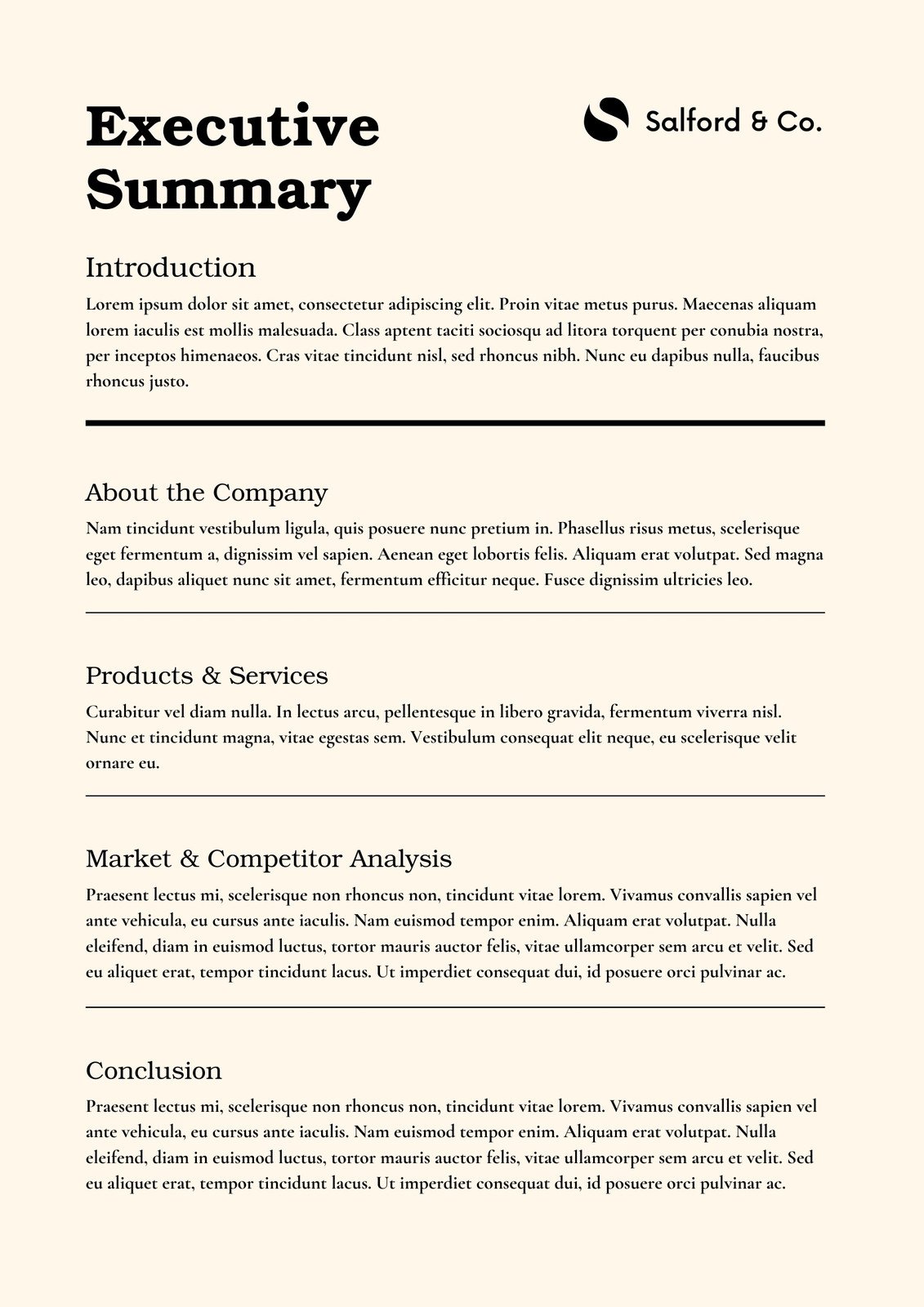
The Indispensable Role of the Executive Summary in Business Finance
The executive summary is not just an introduction; it’s a strategic financial instrument. Its primary function is to distill the complex financial narrative of your business plan into an easily digestible and persuasive overview, crucial for attracting and securing financial backing.
A Gateway to Funding and Investment
For businesses, access to capital is the lifeblood of growth and sustainability. Whether you’re approaching angel investors, venture capitalists, or traditional banks, their first point of contact with your business will almost always be the executive summary. These financial stakeholders are inundated with proposals, and they simply don’t have the time to wade through dozens of full business plans. The executive summary acts as a filter, allowing them to quickly assess the viability and attractiveness of your financial proposition.
A compelling executive summary must instantly convey your business’s potential for generating returns. It needs to highlight key financial asks, projected profitability, and the overall investment opportunity. It’s a testament to your ability to articulate financial potential, and its clarity can mean the difference between securing a follow-up meeting and having your proposal shelved indefinitely. For a bank, it quickly establishes creditworthiness and repayment potential; for an investor, it outlines the scalability and ROI.
Guiding Strategic Financial Decisions
Beyond external funding, a well-constructed executive summary serves as an internal anchor for financial decision-making. By forcing entrepreneurs to condense their entire financial strategy into a coherent narrative, it crystallizes the core financial objectives and the pathways to achieve them. This clarity helps internal stakeholders – from management to employees – understand the overarching financial goals, enabling more aligned and efficient resource allocation.
It becomes a living document, a quick reference point that reminds everyone of the agreed-upon financial vision, market positioning, and operational strategies that underpin financial success. When confronted with difficult choices regarding budgeting, expansion, or cost-cutting, returning to the core tenets outlined in the executive summary can provide invaluable guidance, ensuring decisions remain aligned with the business’s long-term financial health.
Demonstrating Financial Acumen
The executive summary is also an opportunity to showcase the entrepreneur’s financial literacy and business acumen. It reflects the founder’s ability to not only envision a product or service but also to construct a viable, profitable business model around it. When you present a summary that clearly outlines revenue streams, cost structures, funding needs, and projected financial performance, you demonstrate a deep understanding of the economic realities and financial levers of your business.
This financial sophistication instills confidence in potential investors and lenders. It signals that the business is led by individuals who understand the numbers, can manage finances effectively, and have a realistic grasp of the challenges and opportunities ahead. In the world of business finance, credibility is paramount, and a robust executive summary is a powerful instrument for establishing it.
Core Components of a Financially Compelling Executive Summary
To truly resonate with financial audiences, an executive summary must meticulously weave together various critical elements. Each component, though brief, must contribute to a cohesive narrative of financial promise and operational capability.
The Business Opportunity and Value Proposition
At its heart, any business must solve a problem or fulfill a need. The executive summary needs to articulate this core business opportunity with precision, followed by a clear statement of your unique value proposition. For financial stakeholders, this means translating the “what” and “why” into the “how it generates money.” How large is the market opportunity, and how will your solution capture a significant share of it? What is the pricing strategy, and how does it compare to competitors? A strong value proposition directly links to revenue generation and sustainable profitability.
Financial Highlights and Projections
This is arguably the most critical section for financial readers. Here, you must present a concise overview of your key financial metrics. This includes historical financial performance (if applicable), projected revenue, profit margins, cash flow, and crucial milestones like break-even points. It should clearly state the total funding required, how these funds will be utilized (e.g., for R&D, marketing, operations, working capital), and the projected return on investment (ROI) for investors or the repayment schedule for lenders. Use specific, credible numbers and mention underlying assumptions briefly. This section must be compelling, realistic, and supported by the detailed financial statements within the full business plan.
Management Team’s Financial Prowess
Investors invest in people as much as ideas. A brief but impactful introduction to your management team is essential, particularly highlighting their relevant financial, industry, and entrepreneurial experience. Showcase how their collective expertise—especially in areas like finance, operations, sales, and strategy—equips them to successfully execute the business plan and achieve the stated financial goals. Emphasize any past successes in launching ventures, securing funding, or managing significant financial responsibilities. This instills confidence in the team’s ability to navigate financial challenges and drive profitability.
Market Analysis and Competitive Advantage (Financial Lens)
A clear understanding of your target market and competitive landscape is vital for assessing financial viability. The executive summary should succinctly present key findings from your market analysis, focusing on market size, growth trends, and the specific segments you aim to capture. Crucially, it must explain your competitive advantage and how it translates into sustainable revenue streams and protected profit margins. Whether it’s through proprietary technology, a unique business model, superior customer service, or a cost leadership strategy, explain how this edge will allow your business to outperform rivals financially and secure a defensible market position.
Funding Request and Use of Funds
This section must be unambiguous. Clearly state the exact amount of capital you are seeking and provide a high-level breakdown of how every dollar will be spent. Transparency here is key. Investors and lenders want to understand precisely how their money will contribute to the business’s growth, achieve critical milestones, and ultimately generate returns. Vague statements about “operational expenses” won’t suffice. Instead, detail allocations for product development, marketing campaigns, hiring key personnel, capital expenditures, or working capital. This demonstrates financial foresight and a clear strategic plan for leveraging capital.

Crafting a Winning Executive Summary for Financial Success
While content is king, the way that content is presented in an executive summary can make all the difference, especially when aiming to impress financial decision-makers.
Conciseness and Clarity are King
The golden rule of an executive summary is brevity. Aim for one to two pages maximum. Financial professionals are time-starved; they need to grasp your core proposition quickly. Every sentence must be impactful and free of jargon or fluff. Use clear, direct language. The goal is to provide enough information to pique interest without overwhelming the reader, encouraging them to delve into the full business plan for deeper financial analysis.
Emphasize Key Financial Metrics
While the entire summary should hint at financial viability, dedicate specific, concise sentences to your most compelling financial figures. This includes projected revenues, profit margins, critical funding amounts, and potential ROI. These numbers, when presented clearly and credibly, act as powerful hooks for a financially-minded audience. Ensure these figures are consistent with the detailed financial projections in the main business plan.
Tailoring for the Audience
Not all financial audiences are the same. A bank loan officer will prioritize collateral, cash flow, and repayment capacity, while a venture capitalist will focus on scalability, market disruption, and exit strategies. Understand your target audience and subtly tailor the emphasis of your executive summary. While the core information remains consistent, the narrative slant and highlighted details can be adjusted to resonate most effectively with who you’re speaking to.
The Power of a Strong Hook
Begin your executive summary with a powerful opening statement that immediately grabs attention and highlights the core opportunity. This could be a compelling market statistic, a striking problem statement, or an audacious vision that clearly links to significant financial upside. The first few sentences are crucial for drawing the reader in and compelling them to continue reading, especially for busy investors sifting through numerous proposals.
Iteration and Refinement
The executive summary should typically be the last section you write, even though it appears first. This allows you to synthesize all the detailed research and financial projections from your full business plan. Once drafted, dedicate significant time to refining it. Get feedback from mentors, peers, or financial advisors. Ensure it flows logically, is grammatically perfect, and accurately reflects the financial and operational realities of your business. A polished summary reflects professionalism and attention to detail.
Common Pitfalls to Avoid in Your Executive Summary (Financial Perspective)
An otherwise strong business plan can be undermined by a poorly constructed executive summary. Avoiding common mistakes, especially from a financial standpoint, is crucial.
Over-reliance on Jargon without Explanation
While it’s important to demonstrate financial literacy, don’t assume your audience understands every specialized term or acronym. If you must use industry-specific financial jargon, provide brief, clear explanations. The goal is to inform and persuade, not to alienate or confuse. Clarity always trumps perceived sophistication.
Unrealistic Financial Projections
One of the quickest ways to lose credibility with financial stakeholders is to present overly optimistic or unsubstantiated financial forecasts. While ambition is good, projections must be grounded in realistic assumptions, thorough market research, and a clear understanding of your cost structure. Unrealistic numbers are a significant red flag and can lead to immediate rejection, indicating a lack of understanding or transparency.
Lack of a Clear Funding Ask and Use of Funds
Ambiguity regarding your capital requirements or how you intend to spend the funds is a critical error. Investors and lenders need precise figures and a clear breakdown. Vague statements like “we need money for growth” are insufficient. Be specific: “We are seeking $500,000 for a 15% equity stake, with funds allocated as follows: $200,000 for product development, $150,000 for marketing, and $150,000 for working capital.”
Focusing Too Much on Product/Service, Not Enough on Business Model/Financial Viability
While your product or service is the core offering, the executive summary, particularly for financial audiences, must prioritize how that offering translates into a viable and profitable business. Investors are interested in the financial engine, not just the beautiful car. Detail your revenue model, cost efficiencies, and scalability, demonstrating how your innovation will lead to financial returns, not just technological advancement.
Poorly Structured or Grammatically Incorrect Content
An executive summary that is poorly organized, riddled with typos, or grammatically incorrect reflects negatively on your professionalism and attention to detail. If you cannot present a concise, error-free summary, it suggests a lack of discipline that could extend to how you manage finances. Proofread meticulously, and consider professional editing to ensure the document is flawless.

Conclusion
The executive summary is more than just a brief introduction; it is the strategic cornerstone of your business plan, especially when it comes to business finance. It acts as the critical gatekeeper, determining whether your vision moves from concept to tangible financial opportunity. By distilling the essence of your business – its opportunity, financial projections, team strength, and competitive edge – into a concise, compelling narrative, you equip yourself with the most powerful tool to attract capital, forge partnerships, and guide internal financial decisions. Mastering the art of the executive summary is not just about summarizing; it’s about strategically showcasing your business’s financial potential, opening doors, and ultimately charting a course for long-term financial success.
aViewFromTheCave is a participant in the Amazon Services LLC Associates Program, an affiliate advertising program designed to provide a means for sites to earn advertising fees by advertising and linking to Amazon.com. Amazon, the Amazon logo, AmazonSupply, and the AmazonSupply logo are trademarks of Amazon.com, Inc. or its affiliates. As an Amazon Associate we earn affiliate commissions from qualifying purchases.