
In the realm of modern technology, we often focus on software architectures, neural networks, and user interfaces. However, the bedrock of every digital advancement—from the smartphone in your pocket to the massive servers powering global AI models—is rooted in the fundamental properties of matter. To understand the future of hardware, one must look at the atomic level. Specifically, the question “What is the electron configuration of iron?” is more than a chemistry homework assignment; it is a fundamental inquiry into the material science that enables magnetic storage, spintronics, and the next generation of high-performance computing.
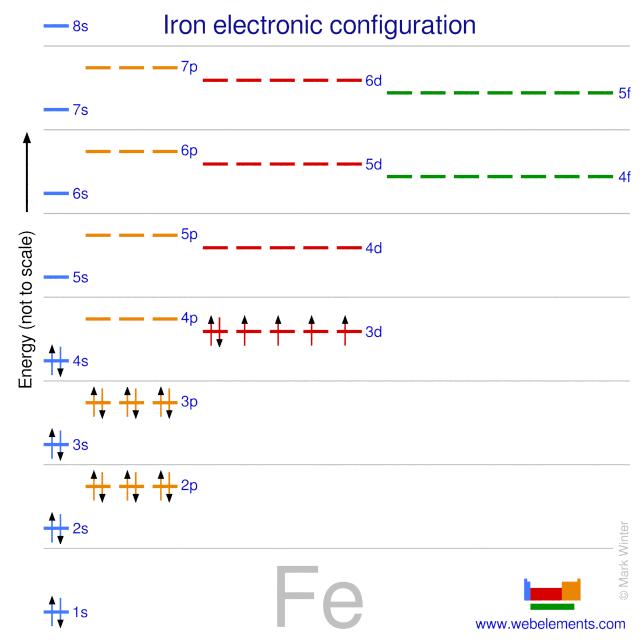
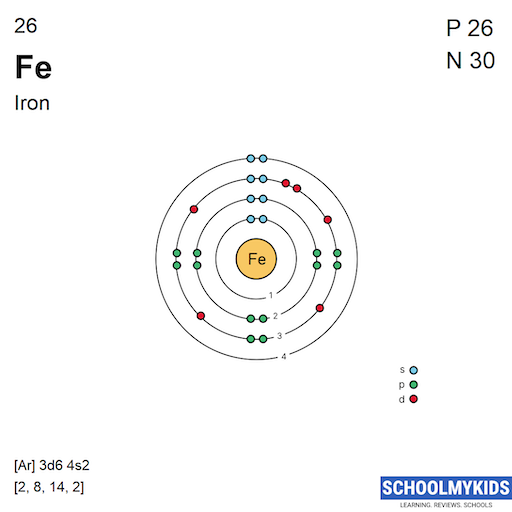
The electron configuration of iron (atomic number 26) is [Ar] 3d⁶ 4s². While this string of numbers and letters might seem abstract, it represents the specific arrangement of 26 electrons surrounding an iron nucleus. In the world of technology, this configuration is the “source code” for iron’s unique physical properties, particularly its ferromagnetism. Understanding how these electrons occupy their orbitals is essential for engineers and tech innovators who are currently pushing the boundaries of Moore’s Law.
Understanding the Atomic Architecture of Modern Hardware
At its core, technology is the manipulation of electrons. To manipulate them effectively, we must understand their distribution. Iron is a transition metal, located in the d-block of the periodic table. Its electron configuration is derived from the Aufbau principle, which dictates the order in which subshells are filled based on energy levels.
Defining the Electron Configuration: [Ar] 3d⁶ 4s²
The notation [Ar] 3d⁶ 4s² tells us that iron has the core electron structure of Argon (the preceding noble gas), with eight additional electrons in its outer shells. Specifically, there are two electrons in the 4s orbital and six electrons in the 3d orbital. In its neutral state, iron follows Hund’s Rule, which states that electrons will occupy empty orbitals in the same subshell before pairing up.
In the 3d subshell of iron, which has five orbitals, this results in four unpaired electrons. This lack of pairing is not a trivial detail; it is the primary reason iron is magnetic. In the tech industry, these unpaired electrons are the “bits” of the physical world, allowing us to store and retrieve data through magnetic alignment.
Why the D-Block Matters for Digital Logic
The transition metals, or d-block elements, are the workhorses of material technology. The 3d orbitals are closer to the nucleus than the 4s orbitals once they are filled, yet they are shielded less effectively. This creates a complex interplay of energy levels that allows iron to exist in multiple oxidation states (typically +2 and +3).
For hardware engineers, this versatility is crucial. It allows for the creation of various alloys and compounds used in electromagnetic shielding and inductor cores. Without the specific energy gaps provided by the 3d⁶ configuration, the efficiency of power conversion in our gadgets would plummet, leading to overheating and massive energy loss in data centers.
The Ferromagnetic Foundation of Data Centers
While the tech world is increasingly moving toward Solid State Drives (SSDs), the backbone of global data storage—particularly in cloud “cold storage”—still relies heavily on Hard Disk Drives (HDDs). The heart of an HDD is a platter coated with magnetic material, often involving iron-based alloys.
Spin States and Binary Logic
The four unpaired electrons in iron’s 3d orbital create a magnetic moment. In a tech context, these electrons act like tiny compass needles. By applying an external magnetic field, we can flip the direction of these “needles” to represent either a ‘0’ or a ‘1’.
The stability of these spin states is what allows a hard drive to retain information for decades without power. If iron had a different electron configuration—for instance, if all its electrons were paired—it would be diamagnetic, and the entire history of digital storage would have taken a completely different, and likely less efficient, path.
Optimizing Hard Drive Capacity via Molecular Engineering
As we strive for higher data density, tech companies are looking at “Heat-Assisted Magnetic Recording” (HAMR). This technology utilizes the electron configuration of transition metal alloys to shrink the size of a single bit. By understanding the 3d⁶ configuration, scientists can engineer iron-platinum (FePt) nanoparticles where the magnetic orientation is incredibly stable at room temperature but can be flipped when momentarily heated by a laser. This is a direct application of quantum chemistry to solve a “Big Data” infrastructure problem.

Spintronics: The Future of Computational Speed
Traditional electronics rely on the charge of the electron to process information. However, a burgeoning field in tech known as “Spintronics” (spin transport electronics) seeks to utilize the spin of the electron—a property directly dictated by its configuration in elements like iron.
Beyond Traditional Electrons: Harnessing the Spin
In a standard silicon chip, moving electrons generates heat due to electrical resistance. Spintronics aims to reduce this heat by using the electron’s spin state to carry information instead of its movement through a medium. Because iron has a high degree of spin polarization due to its 3d⁶ 4s² configuration, it is a primary candidate for “Spin-Transfer Torque” (STT) RAM.
STT-RAM is a type of non-volatile memory that combines the speed of SRAM with the non-volatility of Flash memory. By manipulating the spin of the unpaired electrons in iron-based layers, developers can create memory that is faster, uses less power, and never “forgets” when the device is turned off. This represents a massive shift in how we design mobile device architectures and AI edge-computing units.
Transition Metals in Next-Gen Processor Design
The integration of iron-based magnetic tunnels into semiconductor logic is one of the most exciting trends in deep tech. Researchers are experimenting with “Magnetic Logic Gates.” Unlike traditional transistors that require a constant flow of current to maintain a state, these iron-enhanced gates could potentially stay in their “on” or “off” state indefinitely without power, only requiring energy to switch. This would revolutionize the “Always-On” capabilities of IoT devices and wearable tech.
Material Science and the Software-Hardware Synergy
In the current tech landscape, the “siloed” approach to development is disappearing. Software developers are increasingly concerned with how their code interacts with the underlying material reality of the processor. This is especially true in AI, where the energy cost of a single “inference” (a decision made by an AI) is a major bottleneck.
Precision Alloying for High-Performance Computing (HPC)
To build more efficient AI accelerators, we need better magnetic materials for cooling and power delivery. The electron configuration of iron allows it to be alloyed with elements like silicon or nickel to create “soft” magnetic materials. These materials are used in the transformers and inductors that step down high-voltage power from the grid into the precise 1.2V required by a GPU.
The efficiency of this conversion is dictated by “hysteresis loss”—the energy lost as the magnetic field of the iron atoms flips back and forth. By fine-tuning the electron environment through precision alloying, tech manufacturers can create “low-loss” cores that allow AI data centers to run cooler and more sustainably.
Quantum Mechanics in Material Discovery Software
The search for the “next iron”—a material that might be even better for data storage or processing—is no longer done solely in a wet lab. It is done using AI-driven material discovery tools. These software platforms use Density Functional Theory (DFT) to simulate the electron configuration of thousands of theoretical alloys.
When an AI model searches for a new superconductor or a more efficient magnetic thin film, it is essentially solving the Schrödinger equation for the electron configurations of atoms. The 3d⁶ 4s² structure of iron serves as the baseline for these simulations. By understanding why iron behaves the way it does at a quantum level, developers can train AI models to predict the properties of entirely new synthetic materials that could replace silicon in the 2030s.
Conclusion: The Atomic Core of Digital Innovation
The question “What is the electron configuration of iron?” takes us on a journey from a simple chemistry definition—[Ar] 3d⁶ 4s²—to the cutting edge of global technology. Iron’s unique arrangement of electrons, particularly the four unpaired spins in its 3d orbitals, provides the magnetic and electronic properties necessary for the existence of the digital age.
As we look toward a future defined by quantum computing, spintronics, and sustainable AI, our reliance on the specific quantum states of transition metals will only grow. The tech industry is no longer just about writing better code; it is about mastering the atomic “hardware” provided by nature. By understanding and manipulating the electron configuration of iron, we continue to unlock new possibilities in how we store, process, and transmit the information that defines the modern world.
aViewFromTheCave is a participant in the Amazon Services LLC Associates Program, an affiliate advertising program designed to provide a means for sites to earn advertising fees by advertising and linking to Amazon.com. Amazon, the Amazon logo, AmazonSupply, and the AmazonSupply logo are trademarks of Amazon.com, Inc. or its affiliates. As an Amazon Associate we earn affiliate commissions from qualifying purchases.