
Navigating the landscape of college admissions requires meticulous planning, not least when it comes to standardized tests like the ACT and SAT. For students and families, these exams represent more than just academic hurdles; they are critical financial decisions that can unlock scholarships, determine access to specific institutions, and ultimately shape the return on investment (ROI) of a college education. This article delves into the fundamental differences between the ACT and the SAT, exclusively through a financial lens, guiding you to make the most economically sound choice for your future.
Understanding the Financial Implications of Standardized Testing
The journey to college is often characterized by significant financial outlays. Standardized tests, while seemingly a small component, carry both direct and indirect costs that can add up quickly. A strategic approach to these tests can mitigate expenses and maximize potential financial aid.
The Direct Costs: Registration Fees and Prep Materials
The most apparent financial burden associated with the ACT and SAT are the registration fees. These fees are subject to change and vary slightly between the two tests. While they might seem modest individually, consider the possibility of multiple sittings, which is a common strategy to achieve higher scores. Each retest incurs an additional fee, potentially doubling or tripling the initial cost.
Beyond the registration, a substantial market exists for test preparation materials and services. This includes official study guides, online courses, private tutoring, and group classes. These resources range widely in price, from free online practice tests to thousands of dollars for intensive private instruction. Families must carefully weigh the cost of these resources against their potential benefit—a higher score could unlock significant merit aid, making the upfront investment worthwhile. Conversely, investing in expensive prep that doesn’t yield a substantially improved score represents a sunk cost that detracts from other college savings.
Indirect Costs: Time Investment as a Resource
While not a direct monetary expense, the time invested in preparing for and taking the ACT or SAT is a valuable resource that carries an opportunity cost. Students dedicate countless hours to studying, attending prep sessions, and sitting for the exams. This time could otherwise be spent on part-time employment, extracurricular activities that build a strong college application profile, or academic pursuits that bolster GPA—all factors that also influence scholarship eligibility and college admissions. From a financial perspective, parents also invest their time in researching options, coordinating schedules, and often driving students to test centers. This opportunity cost should be factored into the overall financial decision-making process.
Fee Waivers and Financial Aid Opportunities
Both the ACT and SAT offer fee waivers for eligible low-income students. These waivers typically cover the registration fee for the test, and sometimes include additional benefits like free score reports to colleges and waived college application fees. Utilizing these waivers is a critical financial planning strategy for eligible students, as it can save hundreds of dollars that would otherwise be spent on testing and applications. Understanding the eligibility criteria and proactively applying for these waivers can significantly reduce the financial barrier to college access and help families reallocate funds to other essential educational expenses. It’s important to research what each waiver covers and how many waivers a student can receive, as this directly impacts the total testing budget.
Strategic Test Selection for Maximizing Scholarship Potential
Choosing between the ACT and SAT is not merely a preference; it’s a strategic decision that can directly impact a student’s ability to secure merit-based scholarships and access a wider range of financial aid opportunities. Different tests might better showcase a student’s strengths, leading to higher scores and, consequently, more scholarship money.
How Scores Influence Merit-Based Aid
Merit-based scholarships are often awarded based on a combination of factors, with standardized test scores playing a significant role. Many colleges use a tiered system where specific ACT/SAT score ranges correlate with various levels of scholarship funding. A student scoring in the 90th percentile, for example, might qualify for a full tuition scholarship, while a score in the 75th percentile might only yield a smaller award. Therefore, achieving the highest possible score on either test is a direct path to reducing the net cost of college. Researching the average scholarship amounts tied to specific score ranges at target universities is an essential step in this financial planning process. Understanding which test allows a student to perform their best is paramount.
Targeting Your Strengths to Achieve Higher Scores
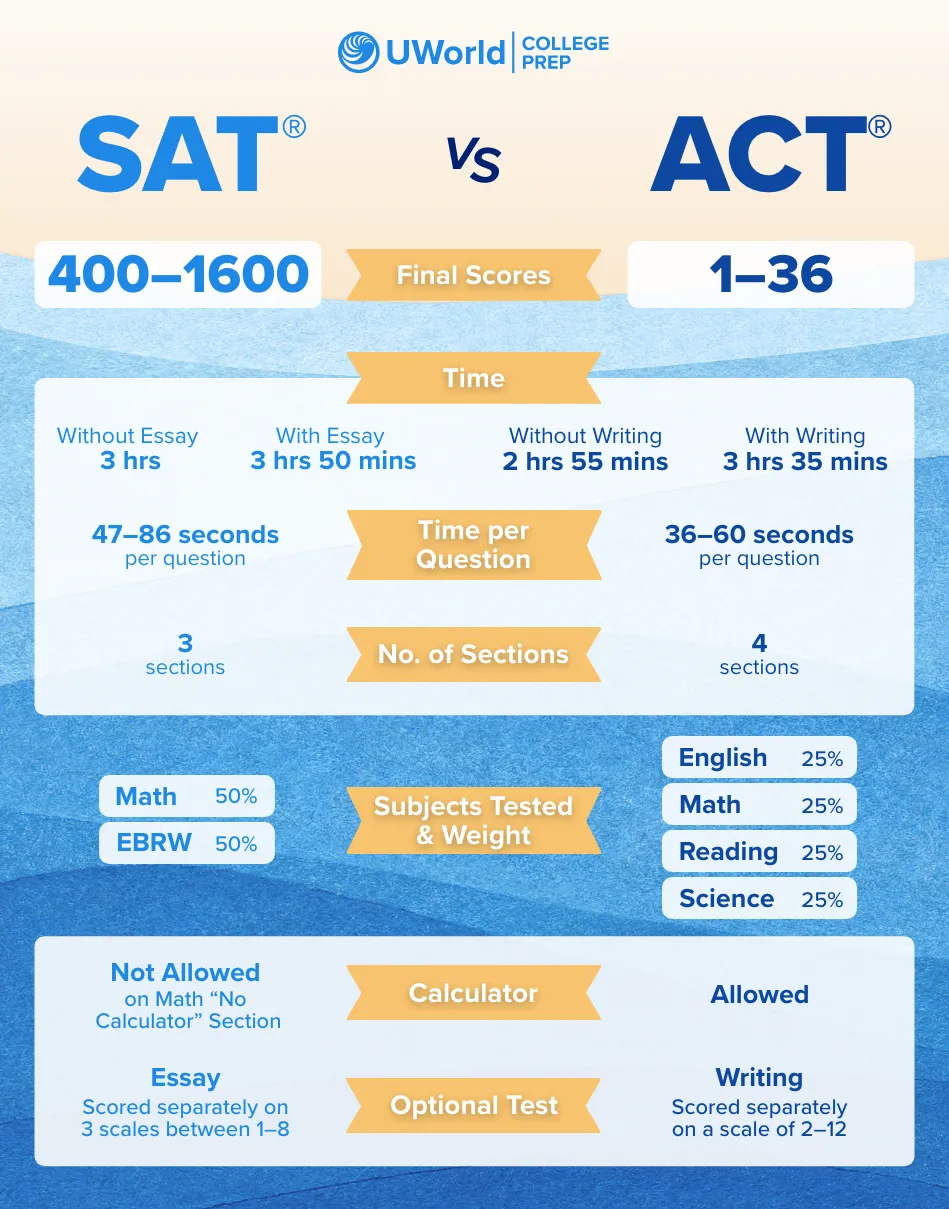
The ACT and SAT, while both measuring college readiness, differ in their structure, content emphasis, and time constraints. The ACT includes a science section and places more emphasis on geometry and trigonometry, while the SAT has a greater focus on algebra and data analysis, with a no-calculator math section. The ACT tends to be more straightforward but faster-paced, while the SAT often involves more complex reasoning skills.
A student’s inherent academic strengths might naturally align better with one test over the other. For instance, a student strong in natural sciences and quick problem-solving might excel on the ACT’s science section and rapid-fire questions, leading to a higher composite score. Conversely, a student adept at analytical reading and multi-step math problems without a calculator might thrive on the SAT. Investing time in taking full-length practice tests for both exams early on can reveal which test format better suits a student’s cognitive style. This initial “diagnostic” can be a cost-effective way to determine where to focus preparation efforts, preventing wasted time and money on the less suitable test.
Retesting Strategies and Cost-Benefit Analysis
Many students retest to improve their scores, as even a slight increase can significantly impact scholarship eligibility. However, retesting comes with additional registration fees and potentially more prep costs. A careful cost-benefit analysis is crucial. If a student’s score is already strong, the marginal benefit of a small increase might not outweigh the financial and time investment of retesting. Conversely, if an initial score is significantly below a target threshold for a desired scholarship, retesting with focused preparation could offer a substantial financial return. Families should consider factors like how close the student is to their target score, their capacity for further improvement, and the retest policies of their target schools (e.g., superscoring, which allows combining the best section scores from multiple attempts). Each retest should be viewed as a calculated financial decision, not just a routine step.
Long-Term ROI: How Test Scores Connect to Educational Investment
The financial impact of ACT/SAT scores extends far beyond immediate scholarship opportunities. These scores are an integral part of an applicant’s profile, influencing access to various institutions and, by extension, their long-term earning potential. Viewing test scores as an investment in future earnings provides a crucial perspective.
Access to Prestigious Institutions and Future Earnings
Top-tier universities often have higher average ACT/SAT scores for admitted students. Gaining admission to these institutions, which typically comes with strong alumni networks, robust career services, and highly regarded academic programs, can significantly enhance a graduate’s career prospects and lifetime earnings. While high test scores alone don’t guarantee admission, they are a powerful tool in opening doors to colleges that often yield a higher return on investment in terms of future salary and career growth. From a financial perspective, a small investment in test preparation that results in acceptance to a more selective college could translate into hundreds of thousands, if not millions, more in lifetime earnings. This long-term perspective underscores the importance of strategic test preparation.
The Role of Test-Optional Policies in Financial Decisions

An increasing number of colleges have adopted “test-optional” policies, meaning applicants are not required to submit ACT or SAT scores. While this might seem to simplify the application process and remove a financial burden, the financial implications are complex. For students with strong scores, submitting them can still be a significant advantage, particularly for merit-based scholarships. Many test-optional schools still use scores for scholarship consideration, even if not for admission.
For students with lower scores, test-optional policies can be financially beneficial by avoiding the costs of retesting and allowing them to focus on other application components. However, students applying to test-optional schools should carefully research the institution’s specific scholarship policies. Relying solely on a test-optional approach without strong alternative credentials (e.g., GPA, extracurriculars, essays) might reduce scholarship opportunities, potentially increasing the net cost of attendance. A savvy financial planner would advise students to assess if their scores are competitive enough to add value to their application and scholarship profile, even if not strictly required.
Balancing Test Prep Costs with Broader College Application Expenses
The costs associated with college applications extend beyond test fees and prep. There are application fees for each school, travel expenses for campus visits, and potentially portfolio submission fees or interview attire. Families need to view the ACT/SAT preparation and registration fees as part of a larger budget. Overspending on test prep might necessitate cutting back on other valuable application components, like visiting a crucial prospective college or applying to a safety school with a fee. Strategic budgeting involves allocating funds across all application-related expenses to maximize the chances of admission and financial aid without overextending resources in any single area.
Optimizing Your Investment: Preparation Strategies and Resource Allocation
Once the decision is made on which test to take, optimizing the investment in preparation becomes crucial. This means strategically choosing resources and developing an efficient study plan that maximizes score improvement while minimizing financial outlay.
Free vs. Paid Prep: Assessing Value and Effectiveness
A wealth of free ACT and SAT preparation resources exists, including official practice tests, Khan Academy (for SAT), public library resources, and educational websites. For many students, these free tools, coupled with self-discipline, can be highly effective. The financial benefit is clear: zero direct cost for potentially significant score improvement.
However, paid resources like private tutoring, commercial prep courses, or premium online platforms can offer personalized instruction, structured curricula, and diagnostic feedback that some students require. The decision to invest in paid prep should be based on a realistic assessment of the student’s learning style, initial scores, target scores, and available budget. A student struggling significantly in a particular section might find a targeted tutor to be a worthwhile investment if it leads to a scholarship. Conversely, a self-motivated student might gain minimal additional benefit from an expensive course. Assessing the incremental value of paid prep over free options is a key financial consideration.
Efficient Study Plans to Save Time and Money
An efficient study plan is a cornerstone of smart financial planning for test prep. A well-structured plan reduces the need for costly last-minute “cram” courses and minimizes the time investment. This involves:
-
Diagnostic Testing: Start with a full-length practice test for both ACT and SAT to identify strengths and weaknesses. This informs where to focus study efforts, ensuring resources aren’t wasted on already strong areas.
-
Targeted Practice: Concentrate practice on specific weak areas. For example, if algebraic concepts are challenging, focus on those specific math topics rather than reviewing all math concepts.
-
Realistic Schedule: Integrate study time into daily routines, avoiding burnout. Consistent, moderate effort is often more effective and less stressful than intense, sporadic bursts, which might lead to costly retesting.
-
Utilizing Official Resources: Prioritize official practice materials from the College Board and ACT, Inc., as these most accurately reflect the actual tests.
By studying smarter, not just harder, students can achieve desired scores with fewer retests and less reliance on expensive, intensive prep programs, thus saving money.
Maximizing Fee Waivers for Test and Application Costs
Revisiting fee waivers, their maximum utilization is a non-negotiable component of financial planning for college applications. Students eligible for fee waivers can often use them for more than just the test registration. They may also cover additional score reports (sending scores to more colleges without charge), and importantly, college application fees. Each application fee waiver can save $50-$100 per institution. For a student applying to 10-15 schools, this can translate into savings of hundreds or even over a thousand dollars, freeing up funds for tuition, books, or other essential college expenses. Families must ensure they understand the full scope of benefits provided by fee waivers and actively leverage them throughout the application cycle.
Making the Financially Savvy Choice: ACT vs. SAT Comparison
Ultimately, the choice between the ACT and SAT should be a financially informed one, made after considering how each test aligns with a student’s profile to maximize their chances for scholarships and cost savings.
Test Structure and Content: Where Your Strengths Translate to Score (and Scholarships)
| Feature | ACT (American College Testing) | SAT (Scholastic Assessment Test) | Financial Implication |
| :—————– | :——————————————————————————————————————————– | :——————————————————————————————————————————– | :————————————————————————————————————————- |
| Sections | English, Math, Reading, Science (optional Writing) | Reading, Writing & Language, Math (optional Essay) | Choosing the test where a student’s natural strengths shine can lead to a higher score, increasing scholarship potential. |
| Science Section| Unique to the ACT, tests interpretation, analysis, evaluation, reasoning, and problem-solving skills in science contexts. | No dedicated science section; science concepts are integrated into Reading and Writing & Language sections. | Strong science students might achieve a higher composite on the ACT, translating to more merit aid. |
| Math Content | Broad range including geometry and trigonometry; calculator allowed on all math questions. | Greater emphasis on algebra and data analysis; includes a no-calculator section. | A student’s math proficiency (e.g., strong in geometry vs. strong in algebra) dictates which test offers a higher score ROI. |
| Pacing | Generally faster-paced, more questions per minute. | Slightly more time per question, but often requires more in-depth critical reading and analytical reasoning. | Students who work quickly and efficiently may benefit from the ACT; those who prefer more time for deep thought, the SAT. |
| Scoring | Composite score 1-36; average of four section scores. | Total score 400-1600; sum of Evidence-Based Reading and Writing (EBRW) and Math scores. | Understanding conversion charts and target school averages can help identify which score looks “better” for scholarships. |
| Essay | Optional, scored separately. | Optional, scored separately. | The decision to take the essay section involves an additional fee for some administrations, impacting direct costs. |
The critical takeaway here is to select the test that best allows the student to perform at their peak. A higher score, regardless of which test it comes from, is the ultimate financial asset in the college application process, directly correlating with increased scholarship eligibility and reduced college costs.
Scoring and Super-Scoring Policies: Impact on Your Financial Profile
Both the ACT and SAT offer the ability to “super-score” in varying capacities, though policies differ by college. Super-scoring allows students to combine their best section scores from multiple test administrations to create a new, higher composite or total score. For instance, if a student scores higher in Math on one SAT attempt and higher in Reading/Writing on another, a super-scoring college will consider the best of each.
From a financial perspective, super-scoring is a game-changer. It means that retesting, while incurring additional fees, can be a highly efficient way to boost a composite score without needing to ace every section again. This policy encourages strategic retesting on specific sections, potentially reducing the overall number of full retests needed to achieve a target score, thereby saving money in the long run. Students should research the super-scoring policies of their target colleges carefully before committing to multiple retests.

Test Day Logistics and Reducing Travel/Hidden Costs
While seemingly minor, logistical factors surrounding test day can also have financial implications. Test centers are located globally, but access can vary. Choosing a test date and center that minimizes travel time, fuel costs, or potential overnight stays (for rural students) can contribute to overall savings. Additionally, students should ensure they have all necessary materials (approved calculator, valid ID, admission ticket) to avoid being turned away, which would result in a forfeited test fee. Preparing snacks and drinks from home, rather than purchasing them at higher prices near the test center, is another small but cumulative saving. These seemingly minor considerations can add up, and mindful planning contributes to overall financial prudence during the college application process.
In conclusion, the decision of whether to take the ACT or SAT, and how to prepare for them, is intrinsically tied to a family’s financial planning for college. By understanding the direct and indirect costs, strategically choosing the test that highlights a student’s strengths, leveraging fee waivers, and viewing test scores as an investment in future earnings, students can significantly reduce the net cost of higher education and optimize their financial trajectory.
aViewFromTheCave is a participant in the Amazon Services LLC Associates Program, an affiliate advertising program designed to provide a means for sites to earn advertising fees by advertising and linking to Amazon.com. Amazon, the Amazon logo, AmazonSupply, and the AmazonSupply logo are trademarks of Amazon.com, Inc. or its affiliates. As an Amazon Associate we earn affiliate commissions from qualifying purchases.