
Navigating the complexities of the modern equity market requires a deep understanding of market leaders, and perhaps no company exemplifies the intersection of growth and scale better than Amazon.com, Inc. (AMZN). For investors asking about the current stock price of Amazon, the answer is more than just a numerical value on a ticker; it is a reflection of global consumer health, the progression of cloud computing, and the efficiency of international logistics. To understand Amazon’s valuation, one must look past the daily fluctuations and examine the underlying financial engines that drive its market capitalization.

Understanding Amazon’s Market Position and Valuation Metrics
Amazon’s stock price is a primary barometer for the broader “Magnificent Seven” and the Nasdaq-100. Unlike traditional retail stocks, Amazon is valued as a high-growth technology hybrid. This unique positioning means that its stock price often trades at a premium compared to legacy retailers like Walmart or Target.
The Role of Earnings Per Share (EPS) and Price-to-Earnings (P/E)
When analyzing the current price of AMZN, institutional investors prioritize Earnings Per Share (EPS) and the Price-to-Earnings (P/E) ratio. Historically, Amazon has maintained a high P/E ratio, often interpreted by the market as a sign of future growth expectations. Because the company famously reinvests its profits back into infrastructure—specifically in its fulfillment network and data centers—the “bottom line” net income can sometimes appear lower than its massive revenue would suggest. However, as the company matures, its ability to generate consistent GAAP (Generally Accepted Accounting Principles) profit has become a more significant driver of its daily share price.
Free Cash Flow: The Metric That Truly Matters
For the sophisticated investor, the current stock price is best understood through the lens of Free Cash Flow (FCF). Amazon’s leadership has long prioritized FCF over short-term accounting profits. By examining the trailing twelve months (TTM) of free cash flow, investors can gauge how much liquidity the company has to settle debts, pay for acquisitions, or buy back shares. When FCF surges, the stock price typically follows, as it signals the company’s ability to self-fund its aggressive expansion without diluting shareholder value.
Factors Influencing Amazon’s Stock Price Fluctuations
The volatility seen in Amazon’s stock is rarely random. It is usually the result of specific macroeconomic shifts or internal operational updates. Understanding these factors allows an investor to determine if the current price represents a value opportunity or a moment of overextension.
AWS: The Profit Engine
While the e-commerce platform is the most visible part of the brand, Amazon Web Services (AWS) is the primary driver of the company’s operating income. The growth rate of AWS is perhaps the single most influential factor on the stock price. If AWS reports a deceleration in growth due to enterprise spending cuts, the stock price often reacts negatively, even if retail sales are strong. Conversely, breakthroughs in AI-driven cloud services can propel the stock to new heights, as AWS provides the high-margin revenue that supports the lower-margin retail business.
Advertising and Services Revenue
A newer but increasingly critical component of Amazon’s valuation is its advertising business. By leveraging its vast repository of consumer data, Amazon has become a titan in digital advertising. This segment carries significantly higher margins than physical product sales. As advertising revenue grows as a percentage of total revenue, the company’s overall margin profile improves, often leading to a re-rating of the stock price by Wall Street analysts.
Macroeconomic Pressures and Interest Rates
As a growth-oriented stock, Amazon is sensitive to interest rate environments. When the Federal Reserve raises rates, the “discount rate” applied to future cash flows increases, which can suppress the current valuation of growth stocks. Additionally, because Amazon relies on consumer discretionary spending, inflation and fuel costs impact the stock price. Higher shipping costs and lower consumer purchasing power can squeeze margins, leading to short-term price pullbacks.
Evaluating Amazon as a Long-term Investment
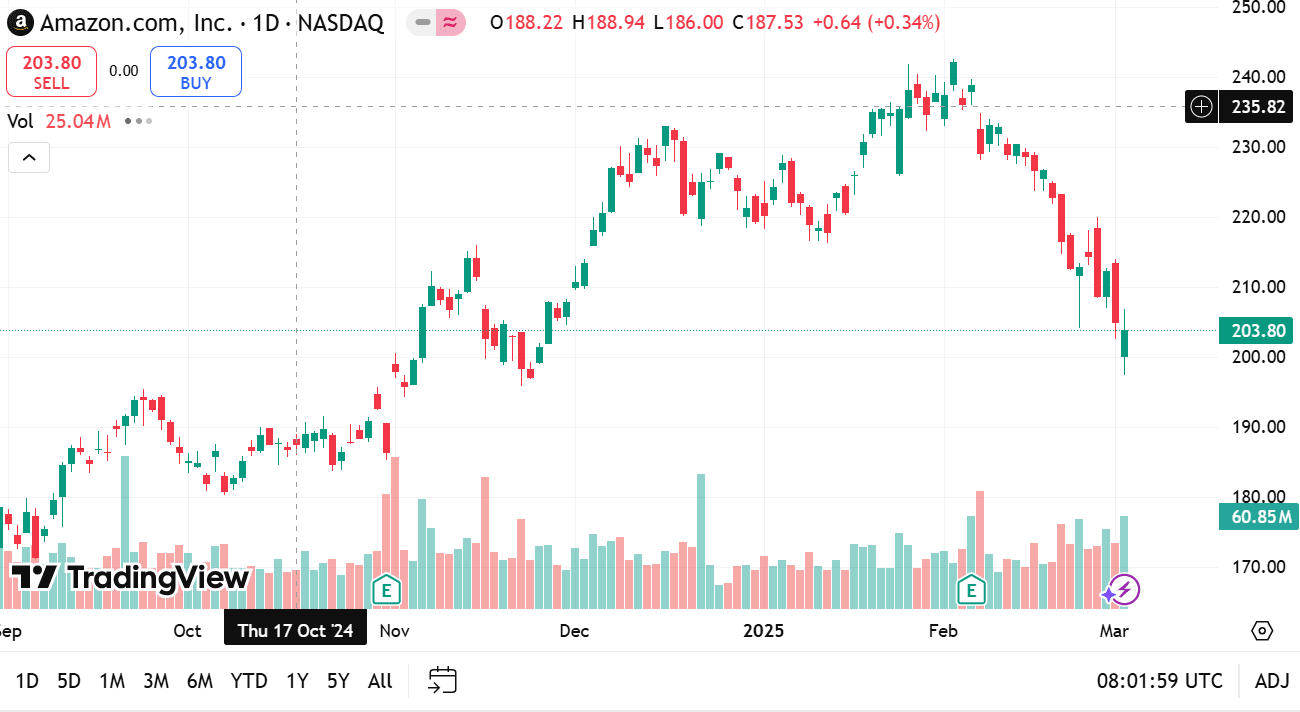
The current price of any stock must be viewed within its historical context. Amazon has undergone significant structural changes, including a 20-for-1 stock split in 2022, which made the shares more accessible to retail investors by lowering the price per individual share without changing the overall market capitalization.
Historical Performance and Stock Splits
Before the 2022 split, Amazon’s share price had climbed into the thousands of dollars, creating a barrier for small-scale investors. The split was a strategic move to increase liquidity and employee participation in stock-based compensation. When evaluating the current price, long-term investors should look at the “split-adjusted” historical highs and lows to understand the stock’s current trajectory relative to its 52-week range.
Risk Management and Volatility
Investing in Amazon is not without risk. Regulatory scrutiny regarding antitrust concerns in the US and Europe remains a persistent “headline risk” that can cause sudden price drops. Furthermore, the competitive landscape in cloud computing—primarily from Microsoft Azure and Google Cloud—requires Amazon to spend billions in capital expenditures (CapEx) to maintain its lead. Investors must weigh the current stock price against these ongoing capital requirements.
Tools for Monitoring Real-Time Financial Data
For those tracking the current stock price of Amazon for active trading or portfolio rebalancing, relying on high-quality financial tools is essential. The price of AMZN is updated every second during market hours (9:30 AM to 4:00 PM EST) and fluctuates during pre-market and after-hours sessions.
Utilizing Brokerage Platforms and News Aggregators
Modern brokerage platforms provide real-time Level 2 market data, showing the “bid” and “ask” prices. To get a holistic view of whether the current price is “fair,” investors use tools like Bloomberg Terminal, Reuters, or accessible web-based platforms like Yahoo Finance and CNBC. These tools provide not just the price, but the volume—the number of shares traded—which indicates the strength of a price movement.
Fundamental vs. Technical Analysis
-
Fundamental Analysis: This involves looking at the company’s “health” through its balance sheet, income statement, and quarterly earnings calls. If the current stock price is lower than the calculated “intrinsic value” based on projected earnings, a fundamental investor might see it as a “Buy.”
-
Technical Analysis: This focuses on price action and chart patterns. Traders might look at Moving Averages (such as the 50-day or 200-day) or the Relative Strength Index (RSI) to determine if the stock is currently “oversold” or “overbought.”
Future Outlook and Strategic Financial Forecasts
Looking ahead, the current stock price of Amazon will likely be dictated by its success in integrating Artificial Intelligence across its ecosystem. From AI-optimized logistics to generative AI tools within AWS, the company is positioning itself for a new era of efficiency.
Expansion into Healthcare and Satellite Internet
Amazon’s forays into healthcare (Amazon Clinic and One Medical) and its satellite internet initiative (Project Kuiper) represent massive “moonshot” bets. While these do not currently contribute significantly to the stock price, any sign of viability or market dominance in these sectors could lead to a massive valuation expansion. The current price reflects the market’s current confidence in these secondary ventures.

Dividend Policy and Share Buybacks
Unlike older tech giants like Apple or Microsoft, Amazon has traditionally not paid a dividend, preferring to reinvest every dollar into growth. However, as the company generates more excess cash, the market frequently speculates on the potential for a dividend or increased share buybacks. A formal announcement of a capital return program would likely have a major positive impact on the stock price, as it would attract a new class of “income” investors to the ticker.
In conclusion, the current stock price of Amazon is a multifaceted figure that encapsulates global trade, technological innovation, and investor sentiment. Whether you are a retail investor looking for a growth core for your portfolio or a business analyst studying market trends, understanding the mechanics behind AMZN’s valuation is vital. By focusing on AWS margins, free cash flow, and macroeconomic trends, one can gain a clearer perspective on whether the current market price aligns with the company’s long-term value proposition. While the number on the screen changes by the second, the underlying strength of the Amazon business model remains the primary anchor for its financial future.
aViewFromTheCave is a participant in the Amazon Services LLC Associates Program, an affiliate advertising program designed to provide a means for sites to earn advertising fees by advertising and linking to Amazon.com. Amazon, the Amazon logo, AmazonSupply, and the AmazonSupply logo are trademarks of Amazon.com, Inc. or its affiliates. As an Amazon Associate we earn affiliate commissions from qualifying purchases.