
The prime rate of interest stands as a cornerstone in the financial landscape, a critical benchmark that influences everything from the cost of consumer loans to the viability of business investments. For individuals and enterprises alike, understanding this fundamental interest rate is not merely an academic exercise; it is a practical necessity for informed financial decision-making. Far from being an obscure economic indicator, the prime rate directly impacts the monthly payments on a host of financial products, shaping borrowing costs and, by extension, the broader economic environment.
In essence, the prime rate is the interest rate that commercial banks charge their most creditworthy corporate customers on short-term loans. While this definition might suggest a narrow focus on corporate finance, its ripple effect extends profoundly into personal finance. It serves as a base rate for many variable-rate loans offered to consumers, including certain credit cards, home equity lines of credit (HELOCs), and small business loans. Therefore, keeping an eye on the prime rate offers a valuable barometer for anyone planning to borrow money or looking to understand the direction of interest rates in the economy. This article will demystify the prime rate, explain how it is determined, discuss its current status and historical context, and explore its significant impact on both personal and business finance, offering insights into how to navigate its fluctuations.
Unpacking the Prime Rate: A Core Financial Indicator
At its heart, the prime rate is a reflection of the overall cost of money within an economy. It’s a key metric that financial institutions use to price their lending products, making it a pivotal figure for anyone engaged in borrowing or assessing the economic climate.
Defining the Prime Rate and Its Significance
The prime rate is formally defined as the interest rate that banks charge their most creditworthy clients. These “prime” clients typically represent large corporations with impeccable credit histories, posing minimal risk to the lender. While it’s the lowest rate offered to corporate borrowers, it functions as a foundational index for a much wider array of financial products. Most variable-rate loans to consumers and smaller businesses are not directly priced at the prime rate but rather at a certain margin above it. For instance, a credit card might advertise an annual percentage rate (APR) of “prime plus 5%,” meaning its interest rate will move in tandem with the prime rate, always maintaining a 5% premium. This direct linkage makes the prime rate an indispensable reference point.
Its significance stems from its widespread application and its sensitivity to broader monetary policy. When the prime rate shifts, it signals a change in the cost of borrowing across the financial system. This impacts consumer purchasing power, business investment decisions, and overall economic growth. A higher prime rate generally means more expensive borrowing, potentially cooling down an overheated economy, while a lower prime rate aims to stimulate economic activity by making credit more affordable.
Who Uses the Prime Rate?
Virtually everyone in the financial ecosystem is, directly or indirectly, influenced by the prime rate:
- Commercial Banks: They use it as a reference point for setting interest rates on a wide range of loans, managing their profitability, and assessing risk.
- Consumers: Individuals with variable-rate credit cards, home equity lines of credit (HELOCs), personal loans, and certain adjustable-rate mortgages (ARMs) will see their interest payments adjust in response to changes in the prime rate. For those considering new variable-rate loans, the current prime rate dictates the starting cost of borrowing.
- Businesses (Small and Large): Small businesses often rely on lines of credit or term loans that are tied to the prime rate for operating capital, inventory purchases, or expansion. Larger corporations, even if they qualify for rates below prime, use it as a benchmark to assess their own borrowing costs against the market.
- Investors: While not directly using the prime rate for investment pricing, investors watch it closely as an indicator of monetary policy and economic health, which can influence bond yields, stock market performance, and currency values.
- Economists and Policymakers: They monitor the prime rate as a key indicator of credit conditions and the effectiveness of monetary policy actions.
The Federal Reserve’s Hand: How the Prime Rate is Determined
The prime rate is not set arbitrarily by individual banks. Instead, it is inextricably linked to the monetary policy decisions of the nation’s central bank, the Federal Reserve. Understanding this relationship is crucial for comprehending how the prime rate moves.
The Federal Funds Rate as the Foundation
The most significant factor influencing the prime rate is the federal funds rate. This is the target interest rate that the Federal Open Market Committee (FOMC), the monetary policy-making body of the Federal Reserve, sets for overnight borrowing between banks. Banks lend their excess reserves to other banks that need to meet reserve requirements. The federal funds rate is not a rate that consumers or businesses directly pay, but it is the rate that dictates the cost of money for banks themselves.
When the Federal Reserve raises the federal funds rate, it becomes more expensive for banks to borrow from each other, which in turn increases their overall cost of doing business. To maintain profitability, banks then pass these higher costs on to their customers by raising their own lending rates, including the prime rate. Conversely, when the Federal Reserve lowers the federal funds rate, it makes borrowing cheaper for banks, allowing them to reduce their prime rate and other lending rates. This mechanism ensures that changes in the Fed’s monetary policy swiftly propagate through the entire financial system.
The Role of Commercial Banks and the “Spread”
While the federal funds rate is the primary driver, commercial banks are the ones who set their individual prime rates. However, for consistency and market efficiency, the vast majority of U.S. commercial banks follow a common convention: they typically set their prime rate at approximately 300 basis points (or 3.00 percentage points) above the upper target of the federal funds rate.
This “spread” historically reflects the additional costs and risk associated with lending to customers beyond the interbank market. Although individual banks have the autonomy to set their rates, competitive pressures and the desire to remain aligned with market expectations usually result in a uniform prime rate across major financial institutions. This uniformity is why financial news outlets can generally report “the” prime rate, rather than a range of rates from different banks.
Official Sources for the Prime Rate
For the most widely recognized and accepted prime rate, the Wall Street Journal Prime Rate is the standard benchmark. The Wall Street Journal regularly surveys the 10 largest U.S. banks and publishes the most common rate quoted. This published rate is what financial institutions and consumers typically refer to when discussing “the” prime rate. Other reputable financial news sources and the Federal Reserve’s own publications also provide this information.
Tracking the Current Prime Rate: A Real-Time Snapshot
Knowing how the prime rate is determined is one thing; staying informed about its current level and recent trajectory is another. In today’s dynamic economic environment, the prime rate is subject to change, often reflecting shifts in inflation, economic growth, and the Federal Reserve’s response to these factors.
Current Landscape and Recent Trends
As an AI, I do not have real-time access to current, fluctuating market data beyond my last training update. Therefore, I cannot provide the exact prime rate at this very moment. However, I can explain how to find it and describe the typical context of its movement.
To find the current prime rate, you should:
- Check the Wall Street Journal: Their financial markets section routinely publishes the current prime rate.
- Consult the Federal Reserve’s Website: The Federal Reserve Board provides information on the federal funds rate target range, which directly implies the current prime rate (typically the upper bound of the federal funds rate target plus 3%).
- Review Major Bank Websites: Most large banks will prominently display their current prime lending rate.

Generally, the prime rate has seen periods of significant fluctuation throughout history. In recent years, central banks globally have navigated complex economic landscapes, from periods of ultra-low rates to stimulate growth following financial crises, to more aggressive rate hikes aimed at combating persistent inflation. The “current landscape” will depend on the most recent actions by the Federal Reserve. If the Fed has been raising rates, the prime rate will have followed suit, leading to higher borrowing costs. If the Fed has paused or cut rates, the prime rate would reflect that easing.
Historical Context of Prime Rate Movements
A look at history reveals the cyclical nature of the prime rate and its close ties to economic conditions:
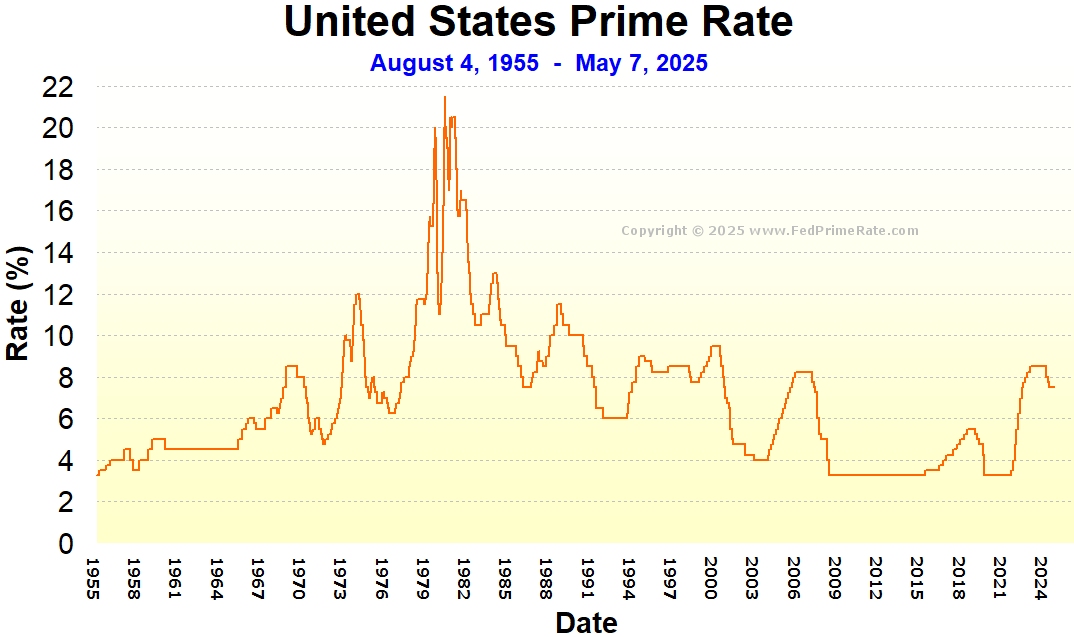
- Periods of High Inflation (e.g., 1970s-early 1980s): The prime rate soared to unprecedented levels, reaching as high as 20% in the early 1980s as the Fed aggressively fought inflation.
- Periods of Economic Stability and Growth (e.g., 1990s-early 2000s): The prime rate generally moved within a more moderate range, reflecting balanced economic expansion.
- Financial Crises (e.g., 2008 Global Financial Crisis): The Federal Reserve slashed the federal funds rate to near zero, causing the prime rate to drop significantly and remain historically low for an extended period, in an effort to stimulate a recovering economy.
- Post-Pandemic Inflationary Environment: Following the COVID-19 pandemic, a surge in inflation prompted the Federal Reserve to embark on a series of rapid interest rate hikes, causing the prime rate to rise considerably from its historic lows.
Understanding this historical context helps to put the current prime rate into perspective and provides insight into the potential future direction of interest rates.
The Far-Reaching Impact of Prime Rate Fluctuations
Changes in the prime rate, whether upward or downward, send ripples through virtually every corner of the economy. These fluctuations directly influence the cost of borrowing for individuals and businesses, affecting spending, investment, and ultimately, economic growth.
Impact on Consumer Lending: Credit Cards and HELOCs
For the average consumer, the most immediate and tangible impact of a changing prime rate is felt in variable-rate financial products:
- Credit Cards: The vast majority of credit cards have variable Annual Percentage Rates (APRs) that are tied to the prime rate. When the prime rate increases, the APR on outstanding credit card balances also rises, making monthly interest payments higher. Conversely, a decrease in the prime rate can lead to lower interest charges. This sensitivity makes managing credit card debt crucial, especially in a rising rate environment.
- Home Equity Lines of Credit (HELOCs): HELOCs are another common variable-rate loan product directly linked to the prime rate. Borrowers with HELOCs will see their minimum monthly payments change as the prime rate adjusts. A rising prime rate means higher interest costs on the drawn portion of the HELOC, potentially straining household budgets.
- Personal Loans: While some personal loans are fixed-rate, many others, particularly those from smaller lenders or with variable terms, may be tied to the prime rate or another index that moves in conjunction with it.
Business Borrowing and Economic Growth
Businesses, from small startups to multinational corporations, are significantly affected by prime rate changes, influencing their operational costs, investment decisions, and capacity for expansion:
- Small Business Loans: Many small business loans, including lines of credit for working capital, equipment financing, and expansion loans, are priced at prime plus a margin. A higher prime rate means increased borrowing costs for these businesses, which can cut into profits, limit investment in new projects, or make it harder to hire new employees.
- Corporate Borrowing: Larger corporations, while often able to secure more favorable rates, still use the prime rate as a benchmark. Changes in the prime rate affect the overall cost of capital, influencing decisions on issuing new debt, financing mergers and acquisitions, or investing in research and development.
- Economic Impact: When borrowing becomes more expensive due to a rising prime rate, businesses may reduce their spending and investment, leading to slower economic growth. Conversely, a lower prime rate can stimulate business activity, encouraging investment and job creation.
Mortgage Market Nuances: ARMs and Prime
While most conventional 30-year fixed-rate mortgages are not directly tied to the prime rate (they are typically linked to Treasury yields), certain mortgage products are indeed affected:
- Adjustable-Rate Mortgages (ARMs): Some ARMs, particularly those with shorter adjustment periods or hybrid structures, may use the prime rate as their index or an index that closely tracks it. When the prime rate adjusts, the interest rate on these ARMs can change at their next reset date, affecting monthly mortgage payments.
- Commercial Real Estate Loans: Loans for commercial properties are often variable-rate and tied to the prime rate, impacting developers and investors in the real estate sector.
- Construction Loans: Many construction loans, given their short-term and variable nature, are often indexed to the prime rate, making development projects more or less expensive depending on its movement.
Navigating a Changing Interest Rate Environment
Understanding the prime rate is the first step; strategically responding to its movements is the next. Both borrowers and savers can take proactive measures to mitigate risks and capitalize on opportunities presented by a fluctuating interest rate environment.
Strategies for Borrowers in a Changing Rate Climate
When the prime rate is on the rise, borrowers with variable-rate debt should consider several strategies:
- Refinance Variable-Rate Debt to Fixed-Rate: If you have a HELOC or other variable-rate loan, explore options to convert it into a fixed-rate loan or refinance it into a fixed-rate personal loan, locking in your payments before rates climb higher.
- Aggressively Pay Down High-Interest Debt: Prioritize paying down credit card balances and other variable-rate loans. Reducing the principal amount will lessen the impact of rising interest rates on your monthly payments.
- Consolidate Debt: Consider a debt consolidation loan at a fixed rate, especially if it offers a lower interest rate than your current variable-rate debts. This can simplify payments and provide predictability.
- Review Your Budget: Reassess your household or business budget to identify areas where you can cut expenses, freeing up more funds to service higher debt payments.
- Negotiate with Lenders: For business owners or individuals with significant borrowing, it might be worthwhile to open a dialogue with your bank to explore more favorable terms or discuss options that align with a rising rate environment.
Opportunities for Savers and Investors
While rising rates can be challenging for borrowers, they often present opportunities for savers and certain investors:
- Higher Yields on Savings Accounts and CDs: Banks typically respond to higher prime rates by offering better interest rates on savings accounts, money market accounts, and certificates of deposit (CDs). This is an excellent time for savers to maximize their returns on liquid cash.
- Attractive Bond Yields: Higher interest rates generally lead to higher yields on newly issued bonds, making them more appealing to income-focused investors. Short-term bonds are particularly sensitive to Fed rate hikes.
- Reassessing Investment Portfolios: Investors should review their portfolios to ensure they are well-positioned for the current interest rate environment. This might involve adjusting allocations between different asset classes.

The Value of Financial Planning
Regardless of the current prime rate or its direction, the cornerstone of sound financial management is proactive planning. Regularly reviewing your financial position, understanding your debt obligations, and aligning your strategies with economic realities are paramount.
Consulting with a qualified financial advisor can provide personalized guidance tailored to your specific circumstances and goals. An advisor can help you analyze your current debt profile, explore refinancing options, identify investment opportunities, and develop a robust financial plan that accounts for interest rate fluctuations. In an ever-evolving economic landscape, staying informed and prepared is the best defense against financial uncertainty and the surest path to achieving your financial objectives.
aViewFromTheCave is a participant in the Amazon Services LLC Associates Program, an affiliate advertising program designed to provide a means for sites to earn advertising fees by advertising and linking to Amazon.com. Amazon, the Amazon logo, AmazonSupply, and the AmazonSupply logo are trademarks of Amazon.com, Inc. or its affiliates. As an Amazon Associate we earn affiliate commissions from qualifying purchases.